


"Truck carrying movie poster, Omaha, Nebraska"
Ilargi: Sometime during the coming week we hope to make the interactive video presentation available of Stoneleigh's by now famous lecture "A Century of Challenges", which she has toured Europe and North America with over the past year (and counting). It won't be free, because we have to recuperate the costs for making it (it was produced by a professional media company), and we have to fund The Automatic Earth itself. Many of our plans run into financial roadblocks on a regular basis, and it's time to do something about that.
"A Century of Challenges" also won't at first be available on CD or DVD. We apologize to those for whom this is inconvenient, but, after much deliberation, we've decided that producing and sending a physical disk at this point in time would mean much more work and expenses for us, and therefore more costs for you, our audience.
For the majority among you, anno 2010, a streaming file will work just fine. It also has the added advantage that it can't be downloaded and copied. We plan to use the revenue generated this way for the production of a tangible disk. We're aiming for the Christmas season to have the disk ready to ship.
Which doesn't mean you have to wait: whoever's paid for the streaming file and later decides to order the CD/DVD will, if they request it, see their purchase price reflect that fact.
But that's for next week. Right now, Stoneleigh and her extended family and friends are minutes away from starting a gathering for the celebration of the life of her recently departed and so terribly missed little sister Gwen.
And, as meaningless as it seems at times, I have something to say as well:
"It ain't what you don't know that gets you into trouble.
It's what you know for sure that just ain't so."
Mark Twain
Ilargi: I used this Twain quote before, a long time ago, and I’m not a fan of repeating quotes, but sometimes they simply force themselves upon you. And I think a whole slew of politicians ad businessmen, used to anything from embellishing pictures to downright lying about them, should for their own sake by now be taking notice of how accurate this one is. Here's talking to you, kid.
The US Bureau of Labor Statistics, in the name of the government, may claim all it wants that unemployment is "only" at 9.6% right now, but if and when an increasing number of people realize this doesn't include the millions who have dropped out of the labor force, tons more who just haven't applied for a job for 4 weeks, or those who work 10 or 15 hours a week packing crates, and so on and so on, there comes a point where these stats simply lose their political use.
And then they turn against the ones who use them to paint rosy pictures with. Ironically, voters demand rosy pictures. They want to hear lies. But they don't want to "know for sure" they’re being lied to.
In today's economy, a politician can't win unless all his competitors lie as well. And that's how and why silly and simply wrong stats survive. The blame rests as much with voters as with politicians. If President Obama would suddenly shift towards the use of the 16,7% U6 unemployment number, and declare the US has been in recession for three years and counting with no end in sight, there's no way he would get re-elected.
Politicians bend the truth, and use "lies, damned lies and statistics", because voters demand that they do. Obama is not an exception, and neither is the US. People don’t want to know the truth, they want to feel good. Still, "knowing for sure" that they're being lied to can make them feel less good. It’s a thin line between love and hate.
Similarly, the National Bureau of Economic Research’s claim that the recession ended in June 2009 was received nationwide with wide-eyed wonder. What people need to understand is that the NBER’s methods in essence address only the financial system. And there is no recession there -for now-, because untold trillions of dollars have been pumped into it. The NBER is right from its own narrowly defined viewpoint; it simply is disconnected from real life.
Essentially, as long as a company's stock can rise simply as a result of scores of workers being laid off, the term "recession" loses all functional meaning as a description of the overall economy. After all, this means that an increased shift of wealth from the poorer to the richer segments of society can, all by itself, end a recession. Those who lose their jobs and homes can be filed under the label "increased efficiency", and then forgotten.
However, when, pointing to carefully selected stats such as these (there are many more), a president claims that his economic plans are on track, and the economy itself is on track, while all across a nation people experience something approaching a 180-degree difference from he claims is real, a widening chasm between a ruling political class and its voters will eventually develop.
If the statistics a government produces don't reflect a nation’s reality, you'd think that nation would demand different statistics. But in an admittedly kind of funny twist, the government insists the statistics are fine, and therefore there must be something wrong with reality. And voters don't want a gloomy reality either, so things stay as they are. Until they don't.
Still, one thing remains obvious: whether it’s unemployment numbers, or the NBER’s "recession over" claim, or a GDP boosted by people's misery, at some point it becomes very obvious that "it just ain't so". And that, as Mark Twain said, is what gets you into trouble.
And it's by no means limited to politics, of course. Kids say the darnedest things all over the place. Or at least, that's what I thought when I read a piece by a man named Jim Boswell at Business Insider. Now, I personally wouldn’t know Mr. Boswell from a hole in the ground, but since "Jim Boswell (MBA, MPA, BA) is the Executive Director and CEO of Quanta Analytics", you can bet someone takes him seriously.
Boswell has a few gems to offer:
If You Want To Reduce Unemployment, Then Rebuild This Real Estate GSE Nightmare[..] the best way to start taking action to stimulate our economy is through immediate legislation that abolishes Fannie Mae and Freddie Mac [..] There is no reason to wait any longer.
Ilargi: Hold on. Wouldn't that mean behemoth losses for either the banking system or the taxpayer? Or can you "abolish" Fannie and Freddie without establishing a fair valuation of their assets? If this were all that easy, why hasn't it been done yet?
Boswell' main gem, the Koh-i-Noor in his treasure chest, is this one:
[..] it is time to recognize that we have already paid most of the bill for our past mistakes. And now it is time to move on.
Ilargi: What? Excuse me? Did he actually say that?
Where do I begin? Who is "we"? Surely not the newly unemployed, nor those 5-10 million who no longer even count as such. Or the millions who will be foreclosed on. Unless perhaps losing your job and your home now means “paying the bill for your past mistakes". Then again, even then, it would have to mean that most lay-offs and foreclosures are behind us. No sign of it that I can see.
Does Mr. Boswell mean to say Fannie and Freddie? If they had "paid most of the bill for their past mistakes", they wouldn’t need to be abolished, would they? The banking system? Is he talking about the US government? Had a look at the latest deficit and debt numbers?
I’m sorry, I can only see this as a really weird thing to say, and with no underlying proof provided whatsoever. As far as I can see, nothing's been paid off, other than through virtual and potential future taxpayer commitments. The stock markets may have gone up, but take out funny and fuzzy accounting, and those same markets would closely resemble the killing fields.
More Boswell:
[..] Over the past three years [..] ninety percent of those who had mortgage debt continued to make their principal and interest payments.
Ilargi: Them numbers are hard to dig. Let's call in Michael David White:
Existing Home Sales Stuck Near Record Low and Inventory Stuck Near Record High[..] One in seven borrowers is delinquent. Nearly five percent are in foreclosure. The cure rate on delinquent mortgages is effectively zero once the loan goes to 60-days late. Approximately 13 million homeowners have no equity or negative equity. Almost five million homeowners have negative equity greater than 125% loan-to-value [..]
About 2.5 million homes have been lost to foreclosure since the recession started in December 2007 according to RealtyTrac. Another 3.3 million homes could be lost to foreclosure or distressed sales over the next four years according to Moody’s Analytics
Ilargi: So, Mr. White's kind of calling Mr. Boswell a liar. That is, either "One in seven borrowers is delinquent", or "ninety percent of those who had mortgage debt continued to make their principal and interest payments". Can't have both.
And besides, in a system that's as heavily leveraged as the one we're talking about here, replete with GSE's, MBS and other derivatives, a 10% default rate can easily bring down the entire shaky construction. The only thing that's preventing this to date is, again, funny and fuzzy accounting.
Oh, wait, there's more from Mr. Boswell:
Who are the investors that currently own the $10 Trillion of U.S. mortgage debt? A number of people own that debt, including the U.S. taxpayer, China, Japan, pension programs, banks, private individuals—the list goes on and on. And do you know what? Not a single one of those debt "investors" lost a single dime these past few years while collecting an annual average return of more than 5.0% on their mortgage security investments.
Ilargi: Even if it would be true that no-one lost a dime, which is highly doubtful if and when we consider the Case/Shiller estimate of close to 30% average losses in US home values thus far, there would still be one possible one reason only for it: the US taxpayer is forking over the 5% "annual returns".
How does that square with "we paid most of the bill for their past mistakes"? And how would China, Japan and US pension funds like to be told they will lose 27% (5% minus 1.5%) of their annual revenue on the loans?
Anyway, then, in short order, Jim Boswell seems to voluntarily relinquish any and all semblance of credibility:
For every one of those ninety to ninety-five percent of mortgagors that are current on their debt, who have a mortgage on their primary home under $500,000, the Government should immediately offer to refinance the "existing" loan amount on that primary home at 4.0% fixed rate (without allowing any cashouts). This guarantee should flow through the solid checks using a new underwriting system developed especially for the new Federal Mortgage Security Guaranty Corporation. Believe it or not, with technology, this could be done fairly quickly [..]
Ilargi: To get to the last point first, chalk me down for a "not". And now all of a sudden perhaps even as much as 95% of debtors are doing fine, where it was 90% a few minutes ago? I don’t want to spoil this for you, but Mr. White is right: 14% or more are currently in default. And even that is a minimum estimate: banks are known to hide large amounts of defaults on their books, and hold off on foreclosures, with admirable consistency. It’s that accounting thingy again: they can keep loans on their books at 100% as long as they don’t foreclose on them. The only reason to proceed with foreclosures regardless is that there's no revenue stream coming in. And that's a bit harder to hide on the books.
Then, Mr. Boswell suggests that all 95% of mortgages closed at 5.5% interest should now be refi’d at 4%. And claims this would build a great new system (consisting of tens of millions of mortgages), which can be "done fairly quickly". All at the expense of the taxpayer, mind you, but hey, look at the potential gains:
Refinancing $9.0 Trillion of mortgage debt down to 4.0% from what is now on average 5.5% will reduce American mortgagor annual housing payments by $100 billion. And this $100 billion will provide an immediate and ongoing stimulus to our economy.
$100 billion? What kind of stimulus is that for a $14 trillion economy, that has just swallowed whole a $787 billion stimulus, an $800 billion TARP, God only knows how much more, and is still left with a gaping hungry hole in its intestines? Refinancing payments for $9.0 trillion in mortgage debt by 27% will reduce that debt by a mere 1.11% annually? Maybe this would be of help in a parallel universe, but surely not in this one.
For a fair balance, let's turn to Chris Whalen:
Double dip or global deflation?[..] some of the leading experts in the housing sector believe that the U.S. is less than 25% through the restructuring of defaulted loans on commercial and residential real estate, and that the backlog is growing. [..] Laurie Goodman from Amherst Securities predicted that one in five U.S. households remains at risk of foreclosure. If this prediction turns out to be correct, the optimistic view of the U.S. economy and banking sector must be radically revised — and soon.
Ilargi: Even if the interest rate on 90% of $9 trillion in mortgage debt is refi’d down by 1.5% a year, payments only come down by $120 billion, actually a bit more than Mr. Boswell’s number, The question, though, is not the hypothetical amount. The question is what happens to all these mortgages if and when home prices keep falling.
Refinancing existing loans will not fix the problem; interest rates for new mortgages are already at 4%, and sales are at historic lows in spite of that.
In other words, 14% of mortgages are presently in default, far more are already underwater, inventories are through the celing, and there are no buyers.
There are no options left to redo Fannie and Freddie in such a way that US home prices will NOT come crashing down like boulders in an avalanche. US housing politics are nothing but yet another attempt at denying gravity. And outside perhaps of quantum mechanics, gravity always wins. As Whalen puts it:
Just as the housing sector and the related debt was the driver of the U.S. economy over the past several decades, I believe that the deflation of the housing market could spell an equally drastic period of shrinkage in economic activity in the U.S. and around the world. In order to meet this challenge, both the political and economic communities need to put aside preconceived notions of how the economy should look and begin to develop new language to describe what is really happening to consumers and businesses. Only then can we truly begin the process of working through what is the most serious economic contraction in the U.S. since WWI.
Ilargi: Well, good luck on that last one, Chris. Once the political and economic communities "put aside preconceived notions of how the economy should look", they would have to admit to the losses and damage they've been hiding from the public all along. In other words, they'd have to come out and say:
"We lied all along, we had no idea what we were doing, and by the way, we wasted just about all of your money in the process. Therefore, we will be the first president, the first administration, and the first House, to preside over the bankruptcy of not just the nation itself, but indeed its entire economic system."
It’s not going to happen on a voluntary basis. Of course they "know for sure what just ain't so". But that only means they know they have nothing left to lose. It’s either the lies or the pitchforks for them. What would you choose?
$10 Oil? Mike Maloney Schools Bankers on Deflation, Gold and Silver
Double dip or global deflation?
by Christopher Whalen - Reuters
The page proofs of my upcoming book, "Inflated: How Money and Debt Built the American Dream," just went back to the editors. One of the benefits of writing a book about U.S. financial history is that it forces you to take a long view of both economics and the political narrative used to describe it. It is the issue of language and labels, in my view, that is making it so difficult for Americans to understand the current state of the economy.
The National Bureau of Economic Research just declared that the "recession" that began in 2007 ended in the middle of 2009, making it the longest downturn since WWII. The only problem is that none of the people who work at NBER today, which is one of my favorite research organizations, are old enough to remember what the U.S. economy was like before WWII; before the age of Keynesian socialism and the use of debt to stimulate growth and employment became standard policy in Washington.
Let’s start with the term "recession," which itself reflects the assumption that economic growth is always positive and the trend line is always upward sloping. While many economists in the U.S. remain convinced that this is an accurate descriptor, what Americans and many other people of the world need to consider is whether the assumption that the economy will grow endlessly is reasonable.
In the period following the Crisis of 1907 and before the start of WWI, Americans faced a grim economic outlook. Jobs were scarce, product and commodity prices were flat, and the value of farm products and land had been falling for years. The American economy was entirely dependent upon Europe for financing and to buy U.S. products, mostly agricultural and other commodities. The dismal economic scene fed the rise of the Progressive movement in U.S. politics.
WWI provided a sharp relief from this picture of economic stagnation. Employment rebounded, American agricultural prices soared and the value of real estate around the U.S. also rose sharply. With renewed growth came inflation, however, so that by the time that WWI ended, prices for many consumer staples had doubled, but wages did not keep pace. Economic activity gradually slowed as the U.S. made its way through the Roaring Twenties, but many Americans never saw any benefit from this period of speculation and financial excess.
Following the Crash of 1929, the pretense observed by both political parties that all was well in the U.S. economy evaporated into almost twenty years of economic stagnation. While the massive mobilization for WWII provided the appearance of a recovery, and the period of the Cold War extended this mirage on a sea of public debt and paper dollars, the basic issue of overcapacity remained.
From the 1970s, when the U.S. shifted from defense to housing as the chief driver of American economic growth, the illusion became ever more attractive and, seemingly at least, permanent. But the sad fact is that much of what Americans think was real growth supported by real income and real work was, in fact, the result of deficit spending and reckless monetary expansion by the Fed, first under Alan Greenspan and now Ben Bernanke.
In an interview for my book former Fed Chairman Paul Volcker noted:We live in an amazing world. Everybody has big budget deficits and big easy money, but somehow the world as a whole cannot fully employ itself. It is a serious question. We are no longer just talking about a single country having a big depression but the entire world. If the world as a whole cannot employ everyone who is ready and able to work, it raises some big questions.
Earlier this week in a research note for the IRA Advisory Service, we reported that some of the leading experts in the housing sector believe that the U.S. is less than 25% through the restructuring of defaulted loans on commercial and residential real estate, and that the backlog is growing. Last week at the AmeriCatalyst conference held in Austin, TX, Laurie Goodman from Amherst Securities predicted that one in five U.S. households remains at risk of foreclosure. If this prediction turns out to be correct, the optimistic view of the U.S. economy and banking sector must be radically revised — and soon.
Just as the housing sector and the related debt was the driver of the U.S. economy over the past several decades, I believe that the deflation of the housing market could spell an equally drastic period of shrinkage in economic activity in the U.S. and around the world. In order to meet this challenge, both the political and economic communities need to put aside preconceived notions of how the economy should look and begin to develop new language to describe what is really happening to consumers and businesses. Only then can we truly begin the process of working through what is the most serious economic contraction in the U.S. since WWI.
Existing Home Sales Stuck Near Record Low and Inventory Stuck Near Record High
by Michael David White - Housingstory.net
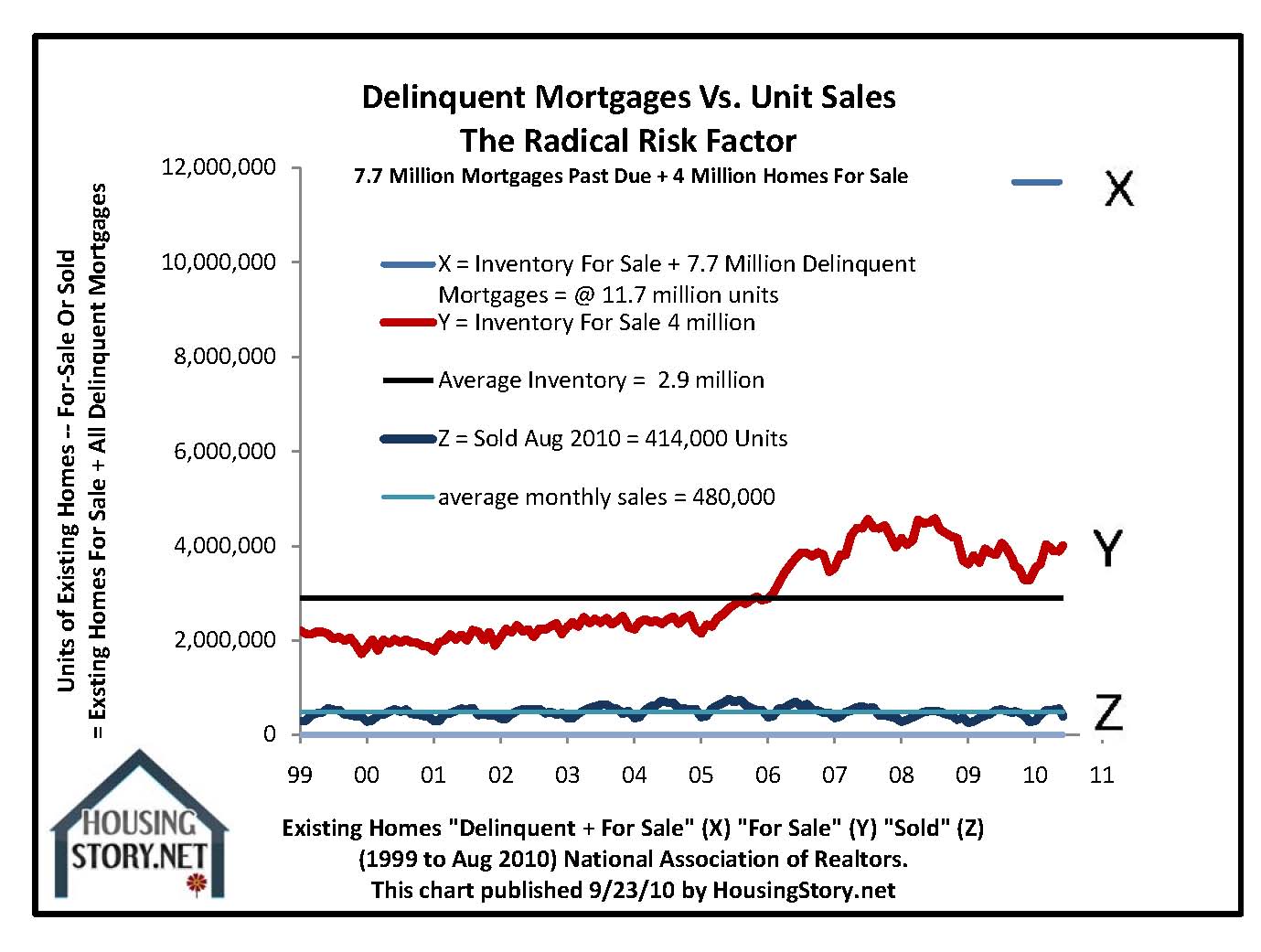
Sales remain deeply depressed with 11.6 months of inventory available for purchase and an estimated 1.1 million excess units actively in the market after an uptick in August sales of 7.6 percent.The median price fell 1.9% in August and units of inventory fell slightly to 3.98 million. The NAR reported 414,000 sales closed, but 28% of those sales were all cash closings. That’s three times the norm, and an obvious sign of distress. One of three sales are officially “distressed” sales. Foreclosures, the highest stress transactions, sell for a discount of approximately 25%.
The rate of sales is the second worst on record according to Bloomberg and Marketwatch (but only going back to 1996 according to BNP Paribas). Months-of-supply is also the second worst on records going back to at least 1999 and probably as far back as 1983 (Please see the chart above of months of inventory). Last month’s readings registered extreme lows for both months-of-inventory and the sales rate.
"Double digit supply and the low sales rate are the key stories," said Bill McBride, editor of Calculated Risk, who described 11.6 months of supply as far above normal. "Sales were very weak in August … and will continue to be weak for some time."
Today’s stats are the second release of existing-home-sales data that gives us a view of buyer demand with much less of the free-down-payment prop. Please note that inventory in units fell 25,000 (Please see inventory of units for sale above.), but we estimate the excess of units on the market as 1.1 million of the 4 million for sale. The crash high inventory was 4.5 million in July 2007.
Buyers of residential real estate act inside of the context of a deluge of negative risk factors. One in seven borrowers is delinquent. Nearly five percent are in foreclosure. The cure rate on delinquent mortgages is effectively zero once the loan goes to 60-days late. Approximately 13 million homeowners have no equity or negative equity. Almost five million homeowners have negative equity greater than 125% loan-to-value (Please see the chart above comparing monthly unit sales, total inventory, and the number of delinquent mortgages.). Strategic default is a viable option in the mix coming out of the worst recession since the Great Depression.
About 2.5 million homes have been lost to foreclosure since the recession started in December 2007 according to RealtyTrac. Another 3.3 million homes could be lost to foreclosure or distressed sales over the next four years according to Moody’s Analytics (in a report from MSN.com).
Current real estate bulls point to values which have fallen 29% from their peak, interest rates which are at record lows, and a federal government which has devoted all weapons large and small to support prices including unlimited capital for government mortgage lenders.
Yet unit sales remain generally weak in the last four years when compared to bubble sales (Please check the historical chart of unit sales immediately above.) and we are just a hop skip and a jump away from starting a new crash if it hasn’t already begun.
***
"August Home Sales Were Actually Terrible" Sy Harding, Great Speculations
"We got run over by a beer delivery truck." Dirk van Dijk, Zacks.com
"The hurdle was just so low that you almost had to beat it (last month’s reading)." Mark Tepper, Strategic Wealth Partners



If You Want To Reduce Unemployment, Then Rebuild This Real Estate GSE Nightmare
by Jim Boswell - Business Insider
If you want to reduce unemployment in the United States then action, not double-talk, is needed in Washington. And the best way to start taking action to stimulate our economy is through immediate legislation that abolishes Fannie Mae and Freddie Mac and replaces the GSEs with a new entity called the Federal Mortgage Security Guaranty Corporation. And this means that Congress, the Treasury, and the Fed need to get their acts in order now. There is no reason to wait any longer.
Mortgage debt in the United States is $10 Trillion of which about half is currently being managed by the Government (through the GSEs, FHA, VA, Ginnie Mae) and half by private sector banks. Despite the horrific manner in which mortgage debt has been handled in the past, it is time to recognize that we have already paid most of the bill for our past mistakes. And now it is time to move on.
Mortgage debt does not have to be bad debt. In fact, most of the mortgage debt in the United States is good debt. Over the past three years , including the period encompassing the entire period of the Greatest Recession Since the Great Depression, ninety percent of those who had mortgage debt continued to make their principal and interest payments month after month, keeping their loans current. In other words, more than ninety percent of Americans continued to honor their debt obligations throughout our Great Recession. Currently, after removing a lot of the bad debt, that percentage has increased to represent nearly ninety-five percent of our remaining mortgage debt obligations.
Like mortgage debt, a U.S. guaranteed mortgage-backed security also does not have to be a bad security. I know because a good portion of my professional career in finance dealt with mortgage-backed securities. For a twelve-year period (1988-2000), including the period covering the S&L crisis, I lead the PricewaterhoueCoopers’ team that was responsible for monitoring the risk of $600 billion of mortgage-backed securities at Ginnie Mae.
How does a mortgage-backed security work? Here is a two sentence primer that fundamentally explains it all. When a mortgagor originally gets, for example, a 5.5% mortgage, it is quickly packaged and bundled with other 5.5% mortgages and put into a security that is then sold to an investor who will collect interest on that security at a 5.0% rate. The remaining 0.5% that the mortgagor pays is used to cover the costs of servicing the loan, foreclosures, and to make a reasonable profit for the entity that issues the security.
A U.S. guaranteed mortgage-backed security means that an investor is assured to receive proper principal and interest payments as the loan is paid down. If the loan defaults or is put into foreclosure, the investor is still guaranteed to recover the remaining principal associated with that loan.
The Great Recession did not come about because we "eased credit in terms of rates" like many economists like to claim, but because we "eased credit to people that did not deserve credit." And there is a big, big difference between those two different ways of easing.
Every risk manager of mortgage debt worth a grain of salt knows that certain fundamental financial principals should be followed before issuing mortgage credit. A couple of the more standard principals are: (1) the ratio of annual mortgage principal and interest payments should not exceed 31% of a mortgagor’s income; and (2) the ratio of total overall annual debt payments, including that of mortgage debt, should not exceed 38% of a mortgagor’s income. A large part of what happened in the 2000s is that both the GSEs and the banks ignored these principals, and believe it or not, mortgage debt was issued without asking what kind of income the borrower was making.
Every risk manager of mortgage debt worth a grain of salt also knows that ARM loans and other such type of "funny" loans, used to qualify borrowers that could not get the same loan under a fixed rate, are also high risk loans. In fact, history has shown that ARM loans prove to be more risky than fixed rate loans even before ARM loans even get readjusted after their low-rate grace period. Unlike the GSEs and the private banks, the FHA and the VA learned of ARM loan risk a long time ago and essentially shutdown their ARM programs long before the Great Recession.
Who are the investors that currently own the $10 Trillion of U.S. mortgage debt? A number of people own that debt, including the U.S. taxpayer, China, Japan, pension programs, banks, private individuals—the list goes on and on. And do you know what? Not a single one of those debt "investors" lost a single dime these past few years while collecting an annual average return of more than 5.0% on their mortgage security investments. That is a 5.0% return on a guaranteed risk-free investment when inflation has been less than 2.0% if not nil.
Now here is what needs to be done to stimulate the economy and reduce unemployment. For every one of those ninety to ninety-five percent of mortgagors that are current on their debt, who have a mortgage on their primary home under $500,000, the Government should immediately offer to refinance the "existing" loan amount on that primary home at 4.0% fixed rate (without allowing any cashouts). This guarantee should flow through the solid checks using a new underwriting system developed especially for the new Federal Mortgage Security Guaranty Corporation. Believe it or not, with technology, this could be done fairly quickly , and we have already waited longer than we should have to put this action in motion.
As part of this refinancing effort, pay off the investors who own the securities associated with the current mortgage and issue new securities at 3.5%. This is a common refinancing practice that has been going on for more than twenty years and investors are fully aware of the practice.
Now if China, Japan, the individual investor does not want to renew their debt investments by buying these new U.S. guaranteed securities, which most of them will, then okay, let the U.S. Government purchase them. Remember, this is risk free debt backed with substantiation (i.e., debt to individuals that have already proven that they pay their debts throughout a very serious recession). Long term inflation in the U.S. for a number of various reasons is very likely to remain low and a 3.5% risk free interest rate on a U.S. guaranteed security is more than justified and still represents a credit-worthy hedge against inflation.
Refinancing $9.0 Trillion of mortgage debt down to 4.0% from what is now on average 5.5% will reduce American mortgagor annual housing payments by $100 billion . And this $100 billion will provide an immediate and ongoing stimulus to our economy , and unlike Government spending or tax reductions, it will not adversely affect the Federal Budget.
Some of my critics say, mortgage rates are already being offered at 4.0%, so what is so new about what you are professing? My response is this: (1) no cash outs; (2) "every primary" home with a mortgage under $500,000 that has a proven track record of current payments "without questioning currently assessed values"; (3) continued Government guarantees for those loans; and (4) offer only fixed rate refinancing.
Now Washington, if you want to find consensus for my approach, don’t bother talking to three different economists (you’ll get four different responses). And that has been half of your problem. Instead start listening to those ninety-five percent of homeowners out there with a mortgage that still want to believe in their country and who have proven so by honoring their debt responsibilities. As I have said many times before, those are the people that are the true heroes of our recovery, and it is long past time that we reward them.
So my question for you, Washington, is this: How much longer is going to take for you to get your act in order?
Jim Boswell (MBA, MPA, BA) is the Executive Director and CEO of Quanta Analytics.
A Recovery That Looks Like Recession
by Comstock Partners
For some strange reason a number of economists and strategists seen on TV and quoted in the press maintain that the exceedingly weak recovery we are now undergoing is really a "normal" or "average" recovery. Nothing could be further from the truth. This is not our opinion, but is based on fact.
We have taken eight major economic indicators and compared them to where we are now as compared to the economic peak 33 months ago. We did the same for the equivalent time periods for the prior two business cycles, using dates designated by the National Bureau of Economic Research. We did not use surveys, opinions or diffusion indexes, but relied on basic economic indicators related to employment, income, consumption, production, housing and capital expenditures.
The results are very clear that the current recovery is far weaker than the prior two expansionary periods, which themselves were below the average for post-war recoveries. The results are outlined as follows. Remember, for each indicator we are showing the change over 31-to-33 months after the cyclical peak for the economy.
- GDP was up 5.3% and 5.7% at this point in the last two cycles, and is now down 1.3%
- New home sales were down 8% and up 31%; now down 42%.
- Industrial production was up 3% and 1%; now down 7%.
- Retail sales were up 9% and 12%; now down 4%.
- Payroll employment was flat and down 2%; now down 5%.
- Personal income was up 11% and 7%; now up 2%.
- New orders for durable goods were up 5% and 6%; now down 22%.
- Initial weekly unemployment claims were down 5% and 9%; now up 34%.
The facts speak for themselves. The current recovery is far weaker than the prior two, which themselves were weaker than the average for post-war expansions. Moreover, as we discussed in previous comments, even this sub-par recovery has been losing steam in recent months. That is why six months ago the discussion centered on when and how the economic stimulus would be removed, whereas now all of the talk is about another round of quantitative easing (QE2).
Does anyone really think that the probability of QE2 a full 33 months after the economy peaked and 15 months after it bottomed is really saying anything positive for the economy or the stock market? The current market seems based on the same delusionary views that prevailed at the tops of early 2000 and late 2007. In our view the economy will continue to disappoint for some time to come. That is not being discounted at current market levels.
Deflation or Inflation: Will Helicopter Bernanke Come Flying to the Rescue?
by Editorial Staff- Elliott Wave International
The deflationary pressures that Robert Prechter first forecast back in 2002 in his best-seller Conquer the Crash are becoming more and more pronounced.
A Sept. 21 piece on MarketWatch reports, "The Federal Reserve on Tuesday warned it was concerned about the potential outbreak of deflation, laying the groundwork for buying government bonds at future meetings."
Of course, in trademark form, the Federal Reserve's comments about deflation were less specific:Measures of underlying inflation are currently at levels somewhat below those the Committee judges most consistent, over the longer run, with its mandate to promote maximum employment and price stability,” the statement said.
While skillfully avoiding the use of the term, the Fed was sending an unmistakable message that it's gearing up to fight the deflation threat. Translation: Watch out, below! Here comes more quantitative easing, which means the Fed will create more money on its books and start buying up banks' bad loans in exchange for more money to lend.But the Fed can only go so far with this policy, as Robert Prechter explains in chapter 13 of his 2002 New York Times best-seller, Conquer the Crash.
The Fed’s Final Card
The Fed used to have two sources of power to expand the total amount of bank credit: It could lower reserve requirements or lower the discount rate, the rate at which it lends money to banks. In shepherding reserve requirements down to zero, it has expended all the power of the first source. In 2001, the Fed lowered its discount rate from 6 percent to 1.25 percent, an unprecedented amount in such a short time. By doing so, it has expended much of the power residing in the second source. What will it do if the economy resumes its contraction, lower interest rates to zero? Then what?
Why the Fed Cannot Stop Deflation
Countless people say that deflation is impossible because the Federal Reserve Bank can just print money to stave off deflation. If the Fed’s main jobs were simply establishing new checking accounts and grinding out banknotes, that’s what it might do. But in terms of volume, that has not been the Fed’s primary function, which for 89 years has been in fact to foster the expansion of credit. Printed fiat currency depends almost entirely upon the whims of the issuer, but credit is another matter entirely.
What the Fed does is to set or influence certain very short-term interbank loan rates. It sets the discount rate, which is the Fed’s nominal near-term lending rate to banks. This action is primarily a “signal” of the Fed’s posture because banks almost never borrow from the Fed, as doing so implies desperation. (Whether they will do so more in coming years under duress is another question.) More actively, the Fed buys and sells overnight “repurchase agreements,” which are collateralized loans among banks and dealers, to defend its chosen rate, called the “federal funds” rate.
In stable times, the lower the rate at which banks can borrow short-term funds, the lower the rate at which they can offer long-term loans to the public. Thus, though the Fed undertakes its operations to influence bank borrowing, its ultimate goal is to influence public borrowing from banks. Observe that the Fed makes bank credit more available or less available to two sets of willing borrowers.
During social-mood uptrends, this strategy appears to work, because the borrowers — i.e., banks and their customers — are confident, eager participants in the process. During monetary crises, the Fed’s attempts to target interest rates don’t appear to work because in such environments, the demands of creditors overwhelm the Fed’s desires. In the inflationary 1970s to early 1980s, rates of interest soared to 16 percent, and the Fed was forced to follow, not because it wanted that interest rate but because debt investors demanded it.
Regardless of the federal funds rate, banks set their own lending rates to customers. During economic contractions, banks can become fearful to make long-term loans even with cheap short-term money. In that case, they raise their loan rates to make up for the perceived risk of loss. In particularly scary times, banks have been known virtually to cease new commercial and consumer lending altogether. Thus, the ultimate success of the Fed’s attempts to influence the total amount of credit outstanding depends not only upon willing borrowers but also upon the banks as willing creditors.
Economists hint at the Fed’s occasional impotence in fostering credit expansion when they describe an ineffective monetary strategy, i.e., a drop in the Fed’s target rates that does not stimulate borrowing, as “pushing on a string.” At such times, low Fed-influenced rates cannot overcome creditors’ disinclination to lend and/or customers’ unwillingness or inability to borrow. That’s what has been happening in Japan for over a decade, where rates have fallen effectively to zero but the volume of credit is still contracting. Unfortunately for would-be credit manipulators, the leeway in interest-rate manipulation stops at zero percent.
When prices for goods fall rapidly during deflation, the value of money rises, so even a zero interest rate imposes a heavy real cost on borrowers, who are obligated to return more valuable dollars at a later date. No one with money wants to pay someone else to borrow it, so interest rates cannot go negative. (Some people have proposed various pay-to-borrow schemes for central banks to employ in combating deflation, but it is doubtful that the real world would accommodate any of them.)
When banks and investors are reluctant to lend, then only higher interest rates can induce them to do so. In deflationary times, the market accommodates this pressure with falling bond prices and higher lending rates for all but the most pristine debtors. But wait; it’s not that simple, because higher interest rates do not serve only to attract capital; they can also make it flee. Once again, the determinant of the difference is market psychology: Creditors in a defensive frame of mind can perceive a borrower’s willingness to pay high rates as desperation, in which case, the higher the offer, the more repelled is the creditor. In a deflationary crash, rising interest rates on bonds mean that creditors fear default.
A defensive credit market can scuttle the Fed’s efforts to get lenders and borrowers to agree to transact at all, much less at some desired target rate. If people and corporations are unwilling to borrow or unable to finance debt, and if banks and investors are disinclined to lend, central banks cannot force them to do so. During deflation, they cannot even induce them to do so with a zero interest rate.
Thus, regardless of assertions to the contrary, the Fed’s purported “control” of borrowing, lending and interest rates ultimately depends upon an accommodating market psychology and cannot be set by decree. So ultimately, the Fed does not control either interest rates or the total supply of credit; the market does.
Darkness On The Edge Of Town
by Kirk Barrell- Random Roving
This coming November, Bruce Springsteen will release "The Promise: Darkness On The Edge Of Town". It's six hours of film and more than two hours of audio across 3 CDs and 3 DVDs including a documentary on the making of the album "Darkness On The Edge Of Town". As a 30 year Springsteen fan, I anxiously await its release.
Over the years, Robert Prechter of Elliott Wave International has made some great comparisons between mass social mood, financial markets, and the mood of music and movies. He's presented exhaustive analysis on how music and movie themes align with the mass social mood of the people. As I was reading articles about Springsteen's upcoming re-release of "The Darkness" record, I started to wonder how the timing of both releases would present itself in relation to the financial markets."Darkness was an angry record. I took the 10 toughest songs I had.I didn't want something with a broader, more compassionate overview. That didn't feel right to me."
Bruce Springsteen (Interview with Edward Norton at the Toronto International Film Festival, Sept. 2010)
The chart below presents the Dow Jones Industrial Average Gold Ratio with the two dates for the release of "Darkness On The Edge Of Town". My hypothesis proves to be true. Both releases align with a downward trending cycle.
Dow Jones Industrial Average Gold RatioDARKNESS ON THE EDGE OF TOWNThey're still racing out at the Trestles,But that blood it never burned in her veins,
Now I hear she's got a house up in Fairview,
And a style she's trying to maintain.
Well, if she wants to see me,
You can tell her that I'm easily found,
Tell her there's a spot out 'neath Abram's Bridge,
And tell her, there's a darkness on the edge of town.
Everybody's got a secret, Sonny,
Something that they just can't face,
Some folks spend their whole lives trying to keep it,
They carry it with them every step that they take.
Till some day they just cut it loose
Cut it loose or let it drag 'em down,
Where no one asks any questions,
or looks too long in your face,
In the darkness on the edge of town.
Some folks are born into a good life,
Other folks get it anyway, anyhow,
I lost my money and I lost my wife,
Them things don't seem to matter much to me now.
Tonight I'll be on that hill 'cause I can't stop,
I'll be on that hill with everything I got,
Lives on the line where dreams are found and lost,
I'll be there on time and I'll pay the cost,
For wanting things that can only be found
In the darkness on the edge of town.

Should Government Tax Debt?
by Mark Whitehouse - Wall Street Journal
Certain economists, most notably Harvard professor Gregory Mankiw, have long advocated so-called Pigovian taxes aimed at discouraging pollution and other socially costly activities. Now two academics are suggesting such a tax might be applied to a dangerous behavior that has become popular in the U.S.: Taking on too much debt.
In a new paper, Olivier Jeanne of Johns Hopkins University and Anton Korinek of the University of Maryland build a model designed to determine what kind of tax would best smooth out the credit booms and busts that can cause so much economic damage. The result: We could all be better off if, during booms, the government placed a tax of 0.56% on the borrowings of small and medium-sized businesses, and 0.48% on the borrowings of U.S. households. The tax would fall to zero in busts.
To be sure, such a tax would be politically tough to implement in a system that has long encouraged the opposite behavior. Homeowners enjoy an income-tax deduction on mortgage interest, and companies don’t owe taxes on the interest they pay on their debt. That gives them an incentive to take on as much debt as they can handle, and a vested interest in the status quo.
That said, a Pigovian tax on debt wouldn’t be unprecedented. Chile, for example, has long levied a tax on short-term foreign loans as part of a broader effort to limit speculative capital flows. The jury is still out, but some economists believe the measures have helped protect Chile from the kind of foreign-investor panics that tend to hit emerging economies.
White House: Recovery to take years
by Kurt Brouwer - Market Watch
White House Press Secretary Robert Gibbs made a rather startling statement in a press briefing on September 21st. He acknowledged that the economy is bad and he further stated under questioning that the recovery would take several years.I wonder why this did not get reported far and wide? The only report I’ve seen on this came from the conservative news source, CNS News [emphasis added]?
White House Press Secretary Robert Gibbs said at Tuesday’s White House press briefing that the economic recovery "is going to take an enormous amount of time," and when asked to clarify what that meant, he said, "it’s going to take several years."…At Tuesday’s briefing New York Times reporter Sheryl Gay Stolberg asked Gibbs whether the president thinks "people are simply frustrated at the state of the economy, or does he think that they are frustrated with him personally and his handling of it?"
"I don’t doubt that people are frustrated that the pace of our economic recovery has not been faster under the president’s watch," said Gibbs. "But what is undeniable and that you heard the president reiterate yesterday is if you look at where we were and look at how far we’ve come, we’ve not come as far as the president would like–not by a long shot–but we’re adding jobs: eight months of private sector hiring, positive economic growth.
Again, all of which is going to take–this is going to take an enormous amount of time. No one in this administration ever said that this was going to be easy or that it wouldn’t take some time."Later in the briefing, Steven Thomma of McClatchy news asked Gibbs to specify what he meant by an "enormous mount of time."
"On the economy," said Thomma, "you said earlier this is going to take an ‘enormous amount of time.’ How long?"
"Well," said Gibbs, "I think it’s going to take several years from–I think getting through a recession as deep as the one that we were faced with, the sheer amount of job loss, the shock to the system, shock to our financial system, the change in our housing market. We’re dealing with, in many ways, if you look at what happened and what cascaded downward all at a certain period of time, you’re dealing with sort of the perfect storm."
Neither The New York Times nor McClatchy reported on Gibbs comments regarding the pace of the economic recovery…
I went to the White House web site and found the press briefing for September 21 and it includes these passages. The link to the briefing is here. The question from the New York Times reporter is about 60% of the way through the briefing and the McClatchy reporter’s question is about 90% of the way through.
One would think this news — coming at the tail end of the so-called ‘Recovery Summer’ would be newsworthy.
Volcker Spares No One in Broad Critique
by Damian Paletta - Wall Street Journal
Former Federal Reserve Chairman Paul Volcker scrapped a prepared speech he had planned to deliver at the Federal Reserve Bank of Chicago on Thursday, and instead delivered a blistering, off-the-cuff critique leveled at nearly every corner of the financial system.
Standing at a lectern with his hands in his pockets, Volcker moved unsparingly from banks to regulators to business schools to the Fed to money-market funds during his luncheon speech.He praised the new financial overhaul law, but said the system remained at risk because it is subject to future "judgments" of individual regulators, who he said would be relentlessly lobbied by banks and politicians to soften the rules.
"This is a plea for structural changes in markets and market regulation," he said at one point.
Here are his views on a variety of topics.
1) Macroprudential regulation — "somehow those words grate on my ears."
2) Banking — Investment banks became "trading machines instead of investment banks [leading to] encroachment on the territory of commercial banks, and commercial banks encroached on the territory of others in a way that couldn’t easily be managed by the old supervisory system."
3) Financial system — "The financial system is broken. We can use that term in late 2008, and I think it’s fair to still use the term unfortunately. We know that parts of it are absolutely broken, like the mortgage market which only happens to be the most important part of our capital markets [and has] become a subsidiary of the U.S. government."
4) Business schools — "We had all our best business schools in the United States pouring out financial engineers, every smart young mathematician and physicist said ‘I don’t want to be a civil engineer, a mechanical engineer. I’m a smart guy, I want to go to Wall Street.’ And then you know all the risks were going to be sliced and diced and [people thought] the market would be resilient and not face any crises. We took care of all that stuff, and I think that was the general philosophy that markets are efficient and self correcting and we don’t have to worry about them too much.
5) Central banks and the Fed — "Central banks became…maybe a little too infatuated with their own skills and authority because they found secrets to price stability…I think its fair to say there was a certain neglect of supervisory responsibilities, certainly not confined to the Federal Reserve, but including the Federal Reserve, I only say that because the Federal Reserve is the most important in my view."
6) The recession — "It’s so difficult to get out of this recession because of the basic disequilibrium in the real economy."
7) Council of regulators — "Potentially cumbersome."
8) On judgment — "Let me suggest to you that relying on judgment all the time makes for a very heavy burden whether you are regulating an individual institution or whether you are regulating the whole market or whether you are deciding what might be disturbing or what might not be disturbing. It’s pretty tough and it’s subject to all kinds of political and institutional blockages as well."
9) On procyclicality — "It’s the hardest thing as a regulator in my opinion…when things are really going well, the economy is going well, the market is not disturbed, but you see developments in an institution or in markets that is potentially destabilizing, doing something about it is extremely difficult. Because the answer of the people in the markets is, ‘what are you talking about? Things are going really well. We know more about banking and finance than you do, get out of my hair, if you don’t get out of my hair I’m going to write my congressman.’"
10) Risk management — "Markets that are prone to excesses in one direction or another are not simply managed under the assumption that we can assume that everybody follows a normal distribution curve. Normal distribution curves — if I would submit to you — do not exist in financial markets. Its not that they are fat tails, they don’t exist. I keep hearing about fat tails, and Jesus, it’s only supposed to occur every 100 years, and it appears every 10 years."
11) Derivatives — "I’ve heard so many stories about how important" derivatives are but "there doesn’t seem to be much doubt that the creation of derivatives has far exceeded any pressing need for hedging."
12) Money market funds — "Money market funds have encroached so much on the banking market. They are nothing, in my view, but a regulatory arbitrage. The purpose that they serve in handling payments and short term paper is a commercial banking function" but they don’t hold the capital or face the regulation of banks.
13) The Fed and Dodd-Frank — Volcker said it was a "miracle" that despite all the criticism aimed at the Fed the central bank "came out with enhanced regulatory authorities rather than reduced regulatory authorities."
California demands halt to foreclosures by mortgage giant
by Dale Kasler - Sacramento Bee
California officials today demanded that Ally Financial Inc. stop foreclosing on homes in the state, citing reports indicating the big mortgage lender is violating the law. The cease-and-desist letter, issued by Attorney General Jerry Brown, came as officials in several other states began investigating Ally's operations.
The controversy stems from a Florida court case in which an Ally official reportedly testified that he signed thousands of documents in foreclosure cases without even reviewing the homeowners' loan documents.
According to Brown, California law forbids a lender from issuing a notice of default - the first step toward foreclosure - unless it can show it has tried to contact the borrower. The law covers mortgages originated between 2003 and 2007. Attorneys general in Texas, Iowa, Illinois and Florida are also investigating.
How Canada is among most indebted nations in the world
by Michael Babad - Globe and Mail
Canada has been winning praise throughout the industrialized world for Ottawa's fiscal position, a relatively low level of government debt-to-GDP when compared to its peers. But, Scotia Capital notes today, add in private debt and it doesn't look so good.
"Just as the federal government vacated the debt markets from the mid-1990s onward, Canadian households, businesses and some provinces all too eagerly stepped up to the plate to fill the space," said economists Derek Holt and Grocia Djeric. "Canada's combined household debt and business debt readings relative to GDP give us among the most indebted private sectors anywhere using this World Economic Forum measure of private debt extended by lenders to households and businesses."
As their chart above illustrates, Canada is "pushing toward the outer limit," in company with the likes of the United States, Britain and Spain when you look at both public and private gross debt.
"Connect the dots between the U.S., U.K., Canada, France, Italy and Japan on the chart, and being near the resulting ring isn't terribly appealing to us," the Scotia economists said in a research note. "Canada has a lot of company in this zone, but the view that the country is vastly superior on debt exposures that itself stems from focusing just on the federal government or just net debt of all governments combined is incorrect."

Ireland faces double dip, mulls restructuring of junior bank debt
by Ambrose Evans-Pritchard - Telegraph
Irish borrowing costs have surged to a post-EMU record after Ireland's recovery buckled over the summer and Dublin said creditors of Anglo Irish Bank may be asked to "share" losses, a warning to bondholders that the dam may at last be breaking on debt restructuring in the eurozone. The Irish economy contracted at a 1.2pc rate in the second quarter, making Ireland the first country since the Great Recession to face a double-dip downturn. The setback is a blow for hopes that Ireland can slowly grow its way out of debt, and may renew concerns that fiscal austerity without other forms of relief risks tipping the economy into a self-reinforcing spiral.
Ireland has been praised for grasping the nettle early in its debt crisis with public sector wage cuts of 13pc, leading the way for other eurozone debtors in trouble. But the reward for good behaviour has yet to come. Otmar Issing, a founder of the European Central Bank, told a Berlin forum that the risk of a populist backlash against austerity is growing. "I think it's a big challenge for responsible parties in the middle of the spectrum to explain to people why these hardships are necessary," he said. Dr Issing said it would be "suicide" for any country to leave the euro, but it could happen anyway if a state finds itself "in such a disastrous situation that extreme parties get a majority".
A recent poll by the German Marshall Fund found that 55pc of EU citizens now think the euro is a "bad thing". The Irish upset came as the PMI purchasing managers index for eurozone fell sharply in August. Manufacturing orders fell to the lowest in 14 months. German PMI fell to an eight-month low of 54.8, a sign that Germany's mini-boom is losing steam. "This data has marked slowdown written all over it," said Martin van Vliet from ING.
Spreads on Ireland's 10-year bonds have risen to 405 basis points. Gavan Nolan from Markit said credit default swaps measuring bond risks on Irish banks are nearing the levels of Icelandic banks shortly before they defaulted two years ago, reaching 955 for Anglo Irish (senior debt), 615 for Allied Irish and 530 for Bank of Ireland. Brian Lenihan, the finance minister, sent shivers through debt markets by refusing to rule out a haircut for holders of Anglo's €2.4bn subordinated debt during a hearing of the Dail's finance committee.
An Irish official told The Daily Telegraph that Dublin will "explore the appropriate burden-sharing arrangements" over coming weeks as it fleshes out its plan to break up the nationalised bank. Anglo Irish may ultimately cost Irish taxpayers as much as €25bn. "This is not just an Irish concern," said Gary Jenkins from Evolution Securities. "Politicians across Europe want to share some of the pain of the financial crisis with bondholders, and that will force creditors to crystalise losses. The markets are waking up to the restructuring risk."
"Investors took extra risk to gain extra yield from subordinated debt, so this fair enough. However, we still have a bank sector on life support, and if they push this too far it will drive up borrowing costs for banks," he said. Ireland is extending its bank guarantee scheme for another three months, but "sub-debt" will not be covered. Dublin said this was done to bring the country in line with EU guidelines. Bank of Ireland has €5.29bn of such debt, and AIB has €4.4bn.
Ireland has reached a delicate juncture in its recovery strategy. Economic contraction has eaten into tax revenues, causing the budget deficit to remain stubbornly high at 12pc of GDP this year – or about 20pc if the bank bail-out is included. House prices have fallen 35pc. The more they drop, the more they damage banks. Mr Lenihan is mulling further spending cuts beyond the extra €3bn already in the pipeline. He has vowed to meet a deficit target of 3pc by 2014. Slackening would "denude this country of any credibility in world markets", he said.
Julian Callow from Barclays Capital said Ireland needs negative interest rates of –9pc under the 'Taylor Rule' on output gaps, while Austria needs +2pc and Germany +1.3pc – a divergence that exposes the headache facing the ECB as it runs a one-size fits-all policy for states with disparate labour laws and housing markets. He said the gap between EMU states had grown wider over the past two years. The self-correcting mechanism is not functioning.
Mr Callow said Ireland's nominal GDP has contracted by 18pc since the peak. This partly due to deflation, which has helped the country claw back competitiveness lost in the bubble. But deflation is double-edged. Debt contracts are fixed in nominal euros, so the country risks a classic debt-deflation trap as the real burden of interest payments keeps rising. Mr Callow said Ireland has a "get out of jail free card" in the form of dynamic exports – pharma, IT and services – but needs a "much weaker euro" to play that card. The euro surge against the dollar and sterling could hardly have come at a worse time.
Irish GDP Drops Unexpectedly
by Neil Shah and Quentin Fottrell - Wall Street Journal
Ireland's economy contracted in the second quarter, startling investors worried about the country's banks and fueling fears that Prime Minister Brian Cowen's government may need even tougher austerity measures to tackle a massive budget deficit. On Thursday, Ireland's Central Statistics Office said gross domestic product, a broad measure of the value of goods and services produced by the economy, dropped 1.2% from the first three months of the year. Economists had forecast a 0.5% growth rate, which would have extended a brief expansion of the Irish economy that began in the first quarter.
Financial markets responded poorly to Thursday's much weaker-than-expected report, though pressure on Ireland has been building for days. The euro drifted lower, falling 0.3% to $1.3350 against the dollar, while prices of Irish government bonds plummeted. To borrow from the capital markets, Ireland now pays an interest rate that is 4.25 percentage points higher than Germany, the euro-zone's benchmark—the highest so-called risk premium since the introduction of the euro in 1999.
In recent weeks, some investors have begun to fear a Greece-style bailout for Ireland, though most observers say it is unlikely for now, in large part because Ireland has financed its budget until the middle of next year. Ireland's small, export-fueled economy is notoriously volatile, economists said. Before surging 2.2% in the first quarter, the country's output contracted 2.5% in the fourth quarter of last year.
Ireland's deepening troubles raise doubts about the wisdom of the stringent fiscal austerity measures that the former Celtic Tiger and other European countries have put in place, which effectively hamper consumers and take cash out of the economy. "There's a gap between political imperatives and economic reality, and economic reality is going to rear up and bite the politicians," says Stuart Thomson, portfolio manager at Ignis Asset Management in Glasgow, Scotland, who says he believes Ireland's austerity measures will hurt its economy.
At the same time, Ireland's gloomy prospects mean the government may have to make even deeper cuts this winter to reduce its budget deficit, which is expected to surpass 25% of GDP this year, the biggest in the 16-nation euro area by that measure. The possible doubling in the deficit—now about 12% of GDP—is due largely to the cost of bailing out its most troubled bank, Anglo Irish Bank Corp.
Ireland's disappointing economic performance also highlights a major problem in the euro zone: The widening gulf between strong economies such as Germany and weaker links such as Ireland and Greece. Ireland's performance, which lags behind the euro zone's 1% second-quarter growth, will make it harder for the European Central bank to set monetary policy for the bloc as a whole.
Ireland's "economy is going to stagnate over the next couple of years," said Ben May, European economist at Capital Economics in London. "That is going to make it more difficult for the government to reduce its deficit in line with its current goals without implementing significant austerity measures."
A surge in imports into Ireland likely hammered its economy in the second quarter, skewing its performance. With Irish imports surpassing its sales of goods abroad, Ireland's trade subtracted roughly 1.8% from its GDP, after pumping in 3.5% in the first quarter, according to Capital Economics. Irish consumers also remain reluctant to spend given the country's weak labor market and expectations of further austerity measures. But rising imports suggest healthier levels of domestic demand, and there were improvements in the country's construction and agriculture sectors.
Ireland is struggling to recover from one of Europe's messiest real-estate busts, which has left its banks awash in souring loans to property developers that likely won't be paid. The International Monetary Fund expects Ireland's economy to contract by 0.5% this year, before growing 2.3% next year. Further headwinds could be in the cards. Exports fuel about 50% of Ireland's economy, but signs of slowing recoveries have grown in the U.S. and Britain, two of Ireland's biggest trading partners. The euro's appreciation in recent months also could hurt Irish trade.
The danger is that Ireland's economic woes will amplify its fiscal and banking problems. A weaker economy means less tax revenues, making it harder for the government to meet its goal of cutting the deficit to Europe's limit of 3% by 2014. As the economy weakens, Irish borrowers will also find it harder to repay their loans, saddling Ireland's banks with more bad loans. That, in turn, could force the Irish government to provide more financial assistance, eroding its own creditworthiness.
Even before Thursday's figures, the cost to insure Ireland's sovereign bonds against default jumped to a record as investors fretted over the government's plans for winding down Anglo Irish. It now costs roughly $475,000 a year to insure $10 million of Irish bonds for five years, according to data provider Markit. Earlier Thursday, Ireland's credit-insurance costs hit $500,000 for the first time. Before October, Ireland's central bank is expected to provide more details on plans to split Anglo Irish into a deposit-holding bank and an "asset recovery" bank that would be wound down over time.
Of particular concern to investors is the fate of roughly €2.4 billion ($3.2 billion) of riskier bonds issued by Anglo Irish. Of that, €1.7 billion will no longer be protected by the government once a key guarantee expires at the end of the month.
On Thursday, Irish Finance Minister Brian Lenihan said Ireland's poor second quarter was partly due to a "surge in imports" and that the country's exports continued to perform well. Mr. Lenihan has already signaled that Ireland may push for more than the €3 billion of additional cuts expected when he unveils the 2011 budget on Dec. 7. But economists are worried about the impact of more austerity measures. "One thing these figures should do is provide a clear signal that raising taxes further on hard-pressed workers would only be counter-productive at this juncture," said Alan McQuaid, an economist at Dublin-based stockbroker Bloxham, in a report.
It wasn't all bad news. Gross national product—a measure that some economists consider more accurate for Ireland because it excludes multinational companies—performed slightly better. GNP fell 0.3%, the lowest rate of decline since the start of the downturn in 2008, after falling 1.2% in the first quarter. Also, Ireland's debt managers were able to pull off a successful sale of Treasury bills before the data were released on Thursday, despite the market's troubles.
European Economic Gains Fizzle
by Brian Blackstone and Neil Shah - Wall Street Journal
A double dose of bad economic news Thursday—a contraction in Ireland and a seven-month low in business activity in the euro zone—caught investors by surprise and reinforced the notion that Europe is stagnating. The purchasing-managers index for the euro zone slid in September, suggesting the 16-nation currency bloc is following the U.S. into a period of tepid growth too weak to dent unemployment.
Separately, Ireland said that its economy shrank by nearly 5% on an annualized basis in the second quarter. The contraction, following a brief expansion in the first quarter, startled investors already worried about the country's banks. Irish government bonds plunged Thursday, pushing the yield on 10-year bonds to 6.5%, a 0.20 percentage-point increase on the day and a record 4.2 percentage points above German yields.
In the euro zone, the manufacturing purchasing-managers index fell 1.5 points to 53.6 in September. Services, which make up the bulk of employment and output in the bloc, slid even further, to 53.6 from 55.9 a month ago. Index readings above 50 indicate an increase in business activity. The European business-activity figures, along with recent data, are consistent with an annualized growth rate of around 1% to 1.5% in the euro zone this quarter, economists say. That is below the roughly 2% rate needed on a sustained basis to bring down unemployment, now at 10% in the euro zone.
The euro-zone's gross domestic product grew at an annualized pace of 3.9% in the second quarter, a four-year high and more than double the U.S.'s pace. "Growth could peter out quite sharply by the end of the year," says Ben May, economist at the consultancy Capital Economics. The euro zone's slowing recovery likely reflects the effect of both a deceleration in global trade, due to a weakening expansion in the U.S. and Asia, as well as reluctance by European consumers to spend in the face of government-imposed austerity.
China, in particular, has served as an important source of demand in recent months for European exports but efforts by Beijing to temper lending in the country could be cooling trade with the euro zone. Only a few weeks ago it appeared that Germany, buoyed by strong demand from China, Brazil and elsewhere, could withstand slower growth in key trading partners including the U.S. and Japan, and propel the euro-zone economy as a whole.
German GDP grew at a 9% annualized rate in the second quarter thanks to rising exports. The services component of Germany's September PMI survey, which economists say is a good proxy for consumer demand, declined but continued to show expanding activity. The German GDP rise "was so welcome, people said now we will have rocket-boosting figures" for the rest of the year, says Stefan Kirschsieper, chief executive of tool maker Walter Kottmann GmbH, a family-owned business in Wuppertal, Germany, that makes chisels for electric hammers used primarily in the building industry.
The reality, he says, is "we cannot yet see that this will be a real stable situation." Business in Germany is stable, Mr. Kirschsieper says, but in countries such as Spain, where sales depend heavily on the construction sector, "there is nothing." The hopes of Germany and Europe being able to go it alone—which economists call decoupling—have been dimmed by a series of sober economic reports. In addition to the PMI slide, industrial orders throughout the euro zone sank 2.4% in July from June, suggesting a weak start to the third quarter.
Germany's economy, accounting for about one-third of the euro zone, is still expanding, but a nearly four-point drop in the country's September PMI to 54.8 suggests that slower growth in global trade is already having an impact. A softening in German production wouldn't have been as much of a concern several years ago, when many of the euro-zone's smaller nations were notching rapid growth. However, as Europe tries to advance its recovery, Berlin is being counted on to offset continuing sluggishness among smaller members of the euro zone.
That dependency was highlighted Thursday by Ireland's dismal economic report. Though Ireland represents only 1.8% of the euro-zone economy, its problems are shared by other highly indebted countries along the zone's periphery, including Greece and Spain. Ireland is struggling to recover from one of Europe's messiest real-estate busts, which has left its banks awash in souring loans to property developers that likely won't be paid.
Ireland's contraction signaled that the government may need to undertake even tougher austerity measures to reduce its massive budget deficit, the euro-zone's biggest as a percentage of GDP. The deficit, which is now around 12% of GDP, is expected to soar due to the cost of bailing out troubled banks. One big worry is that Ireland's economic woes will amplify its fiscal and banking problems.
A weaker economy means less tax revenue, making it harder for the government to meet its goal of cutting the deficit to Europe's limit of 3% by 2014. As the economy weakens, Irish borrowers will find it harder to repay their loans, saddling the country's banks with more bad loans. That, in turn, could force the Irish government to provide more financial assistance, eroding its own creditworthiness.
In recent weeks, some investors have begun to fear a Greece-style bailout for Ireland, though many observers say it is unlikely for now, in large part because Ireland has financed its budget until the middle of next year. The velocity of Ireland's contraction will likely rekindle a debate over whether Europe's pursuit of austerity in the face of a fading recovery is doing more harm than good. Just months ago, Ireland was winning widespread praise for the quick and decisive steps it has taken to cut its deficit.
Despite the bleak outlook in Ireland and Greece, many economists say a double-dip recession is unlikely in the euro zone as a whole. The euro fell only slightly on Thursday's economic news, easing about 0.3% to $1.3348 Thursday n New York. European Central Bank President Jean-Claude Trichet has dismissed any risks arising from Europe's differing economic fortunes, likening the situation to the normal divergence between faster and weaker-growing states in the U.S. But some economists say the ECB is underestimating the threat posed by the periphery, whose banks remain heavily reliant on the ECB for funding and whose government bonds are held by commercial banks throughout Europe.
Continuing downturns in Ireland and Greece could prompt the ECB to further delay the unwinding of the emergency lending programs that have been in place since the height of the financial crisis in 2008, economists say, especially if the region as a whole weakens later this year. Mr. Trichet said earlier this month that the ECB will make some of its unlimited cheap loans available "as long as necessary" and at least until January 2011.
Eurozone crackdown on public finances
by Peter Spiegel and Joshua Chaffin - Financial Times
Members of the eurozone would be forced to pay punitive fines if they did not keep their public finances under control, according to proposals amounting to the most sweeping changes in the European Union’s economic governance since the introduction of the single currency.
The proposed legislation, to be presented on Wednesday by Olli Rehn, the European commissioner for economic and monetary affairs, would levy fines equivalent to 0.2 per cent of the gross domestic product of eurozone members who consistently fail to bring down their public debt levels. Other penalties could also be imposed on member states that fail to control their annual spending or fail to reform their economies to improve their competitiveness, according to people briefed on the proposals and documents seen by the Financial Times.
The proposals, backed by José Manuel Barroso, European Commission president, are the EU’s most ambitious attempt to reorder its economic governance since this spring’s debt crisis that nearly destroyed the single currency. The hurdles facing their implementation, however, remain high as some member states are fiercely opposed to financial sanctions.
Herman Van Rompuy, president of the European Council, the powerful body comprising the heads of all member governments, is heading his own task force examining economic governance. He is set to present his own proposals to national finance ministers on Monday.
In spite of the institutional rivalry, Mr Rehn’s proposals appear to reflect a growing consensus between the two bodies, particularly over the need to identify countries slipping into economic crisis earlier. The most controversial proposal is likely to be stringent new measures to control national debt. Under current treaties, all EU members must keep their debt below 60 per cent of GDP – a requirement that is widely flouted and that the EU now has little means of enforcing. Under Mr Rehn’s proposal, the EU would establish benchmarks under which indebted countries must show they are moving towards the 60 per cent threshold by reducing the gap by one-twentieth every year over a three-year period.
In order to give the fines some teeth, they could only be stopped if the European Council voted to veto them by qualified majority within 10 days. Significantly, the proposals also include measures to improve the competitiveness of Europe’s underperforming economies. In order to track competitiveness, the plans would establish a "scoreboard" of productivity data. Eventually, countries that ignore recommendations could be subject to a fine of 0.1 per cent of GDP.
Global food risk from China-Russia pincer
by Ambrose Evans-Pritchard - Telegraph
World food supplies are caught in a pincer as China becomes a net importer of corn for the first time in modern history and Russia's drought inflicts even more damage than expected, raising the risk of a global grain shock in 2011. The Moscow bank Uralsib said half of Russia's potato crop has been lost and the country's wheat crisis will drag on for a second year, forcing the Kremlin to draw on world stocks.
Wheat prices have risen 70pc since June to $7.30 a bushel as the worst heatwave for half a century ravages crops across the Black Sea region, an area that supplies a quarter of global wheat exports. This has caused knock-on effects through the whole nexus of grains and other foods. "We had hoped things would calm down by September, but they haven't: more commodities are joining in," said Abdolreza Abbassanian, grain chief at the UN's Food and Agriculture Organisation.
The UN fears a repeat of the price spike in 2008 that set off global food riots. Wheat prices are still far below the $13 peak they reached then, and the global stocks to use ratio is still "safe" at 22pc. However, the outlook is darkening. "It is not yet a crisis but things are precarious. If there is another bad year in Russia and Ukraine, this will leave us prone to shocks. All it takes then is one piece of bad news," he said.
Chris Weafer, Uralsib's chief economist, said Russia's wheat harvest will be near 60m tonnes this year, far short of the 75m consumed locally. The country has intervention stocks of 9.5m. "We think Russia faces shortfall of 17m tonnes and will have to import next year," he said. Moscow has already disrupted grain supplies by imposing an export ban until late 2011, but markets have not discounted the risk of Russia becoming a substantial importer.
Luke Chandler at Rabobank said the drought has gone on long enough to hit winter wheat planting and damage yields for next year's spring wheat. "At this stage there is no substantial recovery in subsoil moisture levels in Russia," he said. Ominously, a corn crunch is also creeping up on the world. Global stocks are at their lowest level for 37 years, at a stock to use ratio of 13pc. "This is getting extremely tight," said Mr Chandler, questioning whether the US should divert 36pc of its corn crop into ethanol for fuel.
Corn prices have jumped 40pc since June, reaching $5 a bushel. This was first blamed on lower US crop yields due to bad weather, but China has since revealed that it imported a record 432,000 tonnes in August. Sudakshina Unnikrishnan from Barclays Capital said China may soon become a "structural" corn importer. While it imported corn in 1994, that was due to bad harvests. This time the cause is a permanent shift towards meat-based diets. This has led to a steady rise in the use of corn for animal feed. More than 70pc of China's corn is now used in feed. It takes about seven kilos of grain to produce one kilo of beef.
There is a widely-held view that roaring "agflation" and record gold prices signal inflation, evidence that ultra-loose monetary policy in the US and Europe is leaking excess liquidity into the world. Japan is the latest country to boost liquidity, launching "unsterilised" yen sales. However, this year's spike is narrower. Crude oil is at $75 a barrel, half the 2008 peak. The CRB commodity index is back to 2004 levels. Natural gas prices have fallen this year. Copper has surged, but other base metals have lagged. While gold is in vogue, this is partly due to diversification out of euros and dollars by Asian governments, and loss of faith in Western leadership.
Central banks must make a tricky judgement call, deciding whether food shortages are inflationary or deflationary. They can be either. Policy makers in the US and Europe misread the commodity spike of 2008 as the start of a 1970s inflation spiral, when in reality it sapped broader demand. Central banks tightened policy, just as their economies were buckling. The financial system crashed two months later. Inflation collapsed in short order. The US Federal Reserve does not want to repeat that mistake. Its minutes this week warned of "downside risks" to inflation. The message is clear: the Fed plans to steel its nerves this time and "look through" any spike in resource costs.
Groundwater Depletion Rate Accelerating Worldwide
by ScienceDaily
In recent decades, the rate at which humans worldwide are pumping dry the vast underground stores of water that billions depend on has more than doubled, say scientists who have conducted an unusual, global assessment of groundwater use. These fast-shrinking subterranean reservoirs are essential to daily life and agriculture in many regions, while also sustaining streams, wetlands, and ecosystems and resisting land subsidence and salt water intrusion into fresh water supplies. Today, people are drawing so much water from below that they are adding enough of it to the oceans (mainly by evaporation, then precipitation) to account for about 25 percent of the annual sea level rise across the planet, the researchers find.
Soaring global groundwater depletion bodes a potential disaster for an increasingly globalized agricultural system, says Marc Bierkens of Utrecht University in Utrecht, the Netherlands, and leader of the new study. "If you let the population grow by extending the irrigated areas using groundwater that is not being recharged, then you will run into a wall at a certain point in time, and you will have hunger and social unrest to go with it," Bierkens warns. "That is something that you can see coming for miles." He and his colleagues will publish their new findings in an upcoming issue of Geophysical Research Letters, a journal of the American Geophysical Union.
In the new study, which compares estimates of groundwater added by rain and other sources to the amounts being removed for agriculture and other uses, the team taps a database of global groundwater information including maps of groundwater regions and water demand. The researchers also use models to estimate the rates at which groundwater is both added to aquifers and withdrawn. For instance, to determine groundwater recharging rates, they simulate a groundwater layer beneath two soil layers, exposed at the top to rainfall, evaporation, and other effects, and use 44 years worth of precipitation, temperature, and evaporation data (1958-2001) to drive the model.
Applying these techniques worldwide to regions ranging from arid areas to those with the wetness of grasslands, the team finds that the rate at which global groundwater stocks are shrinking has more than doubled between 1960 and 2000, increasing the amount lost from 126 to 283 cubic kilometers (30 to 68 cubic miles) of water per year. Because the total amount of groundwater in the world is unknown, it's hard to say how fast the global supply would vanish at this rate. But, if water was siphoned as rapidly from the Great Lakes, they would go bone-dry in around 80 years.
Groundwater represents about 30 percent of the available fresh water on the planet, with surface water accounting for only one percent. The rest of the potable, agriculture friendly supply is locked up in glaciers or the polar ice caps. This means that any reduction in the availability of groundwater supplies could have profound effects for a growing human population. The new assessment shows the highest rates of depletion in some of the world's major agricultural centers, including northwest India, northeastern China, northeast Pakistan, California's central valley, and the midwestern United States.
"The rate of depletion increased almost linearly from the 1960s to the early 1990s," says Bierkens. "But then you see a sharp increase which is related to the increase of upcoming economies and population numbers; mainly in India and China." As groundwater is increasingly withdrawn, the remaining water "will eventually be at a level so low that a regular farmer with his technology cannot reach it anymore," says Bierkens. He adds that some nations will be able to use expensive technologies to get fresh water for food production through alternative means like desalinization plants or artificial groundwater recharge, but many won't.
Most water extracted from underground stocks ends up in the ocean, the researchers note. The team estimates the contribution of groundwater depletion to sea level rise to be 0.8 millimeters per year, which is about a quarter of the current total rate of sea level rise of 3.1 millimeters per year. That's about as much sea-level rise as caused by the melting of glaciers and icecaps outside of Greenland and Antarctica, and it exceeds or falls into the high end of previous estimates of groundwater depletion's contribution to sea level rise, the researchers add.


