


"U.S.S. Vixen, Maxim machine gun and gunner Smith, who fired 400 consecutive shots at Battle of Santiago de Cuba, July 3, 1898"
Ilargi:
There can of course only be one topic du jour today, certainly stateside. Is it Obama 1 - Osama 0? Or even Obama 1 - all potential Republican presidential candidates 0? Whichever option we may pick, once the burial at sea of Osama bin Laden has been digested, we will need to return to the seas off Fukushima, and the radioactive contamination that keeps on flowing into them, if only because it may very well kill a lot more people that bin Laden ever has. Therefore, here, once again, is TAE's nuclear safety expert Stoneleigh's interpretation of the latest events:
Stoneleigh:
It will be a long time before we have a complete picture of the unfolding nuclear catastrophe at Fukushima, and much longer before the scale of the impacts can truly be understood. Misinformation and disinformation abound in an emotive and exceptionally polarized debate over the nuclear power industry. Teasing apart fact from fiction will be a major task. First we need to look at the latest information on the state of affairs at Fukushima, and then turn to the debate over the health impacts of radiation and comparisons with Chernobyl.
The best interpretation of data and events at Fukushima is being provided by Arnie Gundersen at Fairewind Associates, a nuclear engineer of long experience. His most recent contribution puts the events of the last six seeks in stark perspective. He compares the explosive events at units 1 and 3, providing a very convincing case for the unit 3 detonation having resulted from a prompt criticality in the spent fuel pool. Pieces of fuel rods have been discovered as much as two miles away, plutonium dust has been detected on site and uranium and americium powder has been detected as far away as the US, indicating the volatilization of nuclear fuel.
Much of the building is missing, enough for it to be impossible for the spent fuel pool to have survived. TEPCO data appears to suggest the reactor itself is intact, but the scale of the destruction must lead to some considerable doubt.

Stoneleigh: The spent fuel at the plant is a major concern, with at least two spent fuel pool (at units 3 and 4) either damaged or destroyed. The pool at unit 3 contained almost an entire reactor core of spent fuel, and at unit 4 the total was even much higher - between two and three reactor cores.

Stoneleigh: In addition to the individual spent fuel pools, there is a common pool, which has also had cooling difficulties.
In addition to these individual pools, there is a larger common spent fuel pool that is used to store spent fuel from all 6 reactors once it has been out of the reactor for 19 months and has cooled down. It has a volume of 3,828 cubic meters (29m x 12m x11m deep) and currently has 6,375 spent fuel assemblies in it. It is located 50 meters west of Unit 4. Reports also say that this pool continues to have water supplies but its cooling system is not functional.
Stoneleigh: The quantity of radioactive material at the site is simply staggering, and its condition precarious. We could yet see more uncontrolled releases of contamination from this material, in addition to the on-going releases due to containment breaches, radioactive steam emissions and water flooding:
April 27th: Radiation Readings in Fukushima Reactor Rise to Highest Since Crisis BeganRadiation readings at Japan’s Fukushima Dai-Ichi station rose to the highest since an earthquake and tsunami knocked out cooling systems, impeding efforts to contain the worst nuclear crisis since Chernobyl.
Two robots sent into the reactor No. 1 building at the plant yesterday took readings as high as 1,120 millisierverts of radiation per hour, Junichi Matsumoto, a general manager at Tokyo Electric Power Co., said today. That’s more than four times the annual dose permitted to nuclear workers at the stricken plant.
April 27th: Reactor Flooding Effort Proceeds at Japan ReactorTurbine areas at reactors No. 1, No. 2 and No. 3 contain nearly 70,000 metric tons of significantly contaminated water, the International Atomic Energy Agency said. Transfers of fresh water continued into reactors No. 1, No. 2 and No. 3, and a vehicle over the weekend fired 305 metric tons of fresh water on the No. 4 reactor's spent fuel cooling pond. The liquid is intended to prevent additional releases of radiation from the cooling ponds.
April 28th: TEPCO Data Shows Ongoing Criticalities Inside Leaking Fukushima Daiichi Unit 2Data released on April 28, 2011 by TEPCO is now unequivocal in showing ongoing criticalities at Unit 2, with a peak on April 13. TEPCO graphs of radioactivity-versus-time in water under each of the six reactors show an ongoing nuclear chain reaction creating high levels of "fresh" I-131 in Unit 2, the same reactor pressure vessel (RPV) with a leak path to reactor floor, aux building, and outdoor trenches, that is uncontrollably leaking high levels of I-131, Cs-134, Cs-137 into the Pacific Ocean.
Because I-131 has no long-lived "parent" to "feed it" by parent decay, the levels of I-131 in scrammed reactors with intact geometry will decrease exponentially with an 8-day halflife, meaning that after 5 halflives (40 days) the I-131 levels are only 3% of what they were at scram. But instead of seeing that expected decrease in I-131 levels relative to Cs-134 and Cs-137 in the regular TEPCO press releases, I-131 was seen to be increasing, instead of decreasing as the physics said it should.
"Outlier" Unit 2 has I-131 levels roughly 20 times its levels of Cs-134/137. The only possible source of I-131 would be "pockets" of molten core in the Unit 2 RPV settled in such a way that the boron in the injected water is insufficient to stop the localized criticalities.
Stoneleigh: The scope of the accident and its likely impact on the surrounding heavily populated area continues to be considerably underestimated, and evacuation efforts remain grossly inadequate.
IAEA Confirms Very High Levels of Contamination Far From ReactorsToday the IAEA has finally confirmed what some analysts have suspected for days: that the concentration per area of long-lived cesium-137 (Cs-137) is extremely high as far as tens of kilometers from the release site at Fukushima Dai-Ichi, and in fact would trigger compulsory evacuation under IAEA guidelines.
The IAEA is reporting that measured soil concentrations of Cs-137 as far away as Iitate Village, 40 kilometers northwest of Fukushima-Dai-Ichi, correspond to deposition levels of up to 3.7 megabecquerels per square meter (MBq/sq.m). This is far higher than previous IAEA reports of values of Cs-137 deposition, and comparable to the total beta-gamma measurements reported previously by IAEA.
This should be compared with the deposition level that triggered compulsory relocation in the aftermath of the Chernobyl accident: the level set in 1990 by the Soviet Union was 1.48 MBq/sq.m. Thus, it is now abundantly clear that Japanese authorities were negligent in restricting the emergency evacuation zone to only 20 kilometers from the release site.
Stoneleigh: Arnie Gundersen calls the exposure limits being applied for children in the area of the stricken plant "a gross miscarriage of radiation science". Children are particularly vulnerable to radiation, as their cells are dividing very rapidly. The impact of a given dose is therefore 10-100 times greater, yet the dose limit for children in the area of Fukushima is set at a level most countries would use for adults working at a nuclear plant.
Stoneleigh: Toshio Kosako, a government advisor on radiation safety, recently resigned in protest over the handling of the accident by the Japanese government.
In one of his most damaging charges, the adviser, Toshiso Kosako, drew attention to a recent government decision to allow children living near the crippled Fukushima Daiichi nuclear plant to receive doses of radiation equal to the international standard for nuclear power plant workers. That level is far higher than international standards set for the public. "I cannot allow this as a scholar," said Mr. Kosako, an expert on radiation safety at the University of Tokyo.
He also blasted the government for what he said was a lack of transparency in releasing radiation levels around the Fukushima Daiichi plant, and for setting an overly high limit on radiation exposure for workers who have spent weeks struggling to keep the plant under control.
Government advisory positions are considered prestigious, and it is highly unusual for an academic to quit one in protest.
Stoneleigh: Another senior advisor, Michio Ishikawa, the former head of the Japan Nuclear Technology Institute and an ardent supporter of the nuclear industry, also made dramatic claims contradicting the official version of the extent of the damage at Fukushima.
I believe the fuel rods are completely melted. They may already have escaped the pressure vessel. Yes, they say 55% or 30%, but I believe they are all melted down. When the fuel rods melt, they melt from the middle part on down.
I think the temperature inside the melted core is 2000 degrees to 2000 and several hundred degrees Celsius. A crust has formed on the surface where the water hits. Decay heat is 2000 to 3000 kilowatts, and through the cracks on the crust the radioactive materials (mostly noble gas and iodine) are escaping into the air.
Volatile gas has almost all escaped from the reactor by now. The water [inside the pressure vessel] is highly contaminated with uranium, plutonium, cesium, cobalt, in the concentration we've never seen before.
My old colleague contacted me and shared his calculation with me. At the decay heat of 2000 kilowatt... There's a substance called cobalt 60. Highly radioactive, needs 1 to 1.5 meter thick shields. It kills people at 1000 curies. He calculated that there are 10 million curies of cobalt-60 in the reactor core. If 10% of cobalt-60 in the core dissolve into water, it's 1 million curies.
They (TEPCO) want to circulate this highly contaminated water to cool the reactor core. Even if they are able to set up the circulation system, it will be a very difficult task to shield the radiation. It will be a very difficult work to build the system, but it has to be done.
It is imperative to know the current condition of the reactor cores. It is my assumption [that the cores have melted], but wait one day, and we have water more contaminated with radioactive materials. This is a war, and we need to build a "bridgehead" at the reactor itself instead of fooling around with the turbine buildings or transporting contaminated water.
Stoneleigh: While acknowledging high radiation levels, he nevertheless declared those levels to be safe and said that people in the evacuation zone should be allowed to return to their homes.
The Fukushima disaster inevitably leads to comparisons with Chernobyl, particularly with regard to the expected health impacts. Twenty-five years after Chernobyl, estimates of morbidity and mortality are almost inconceivably variable. The official story is that fewer than 50 people died as a direct result of the accident, and that the only other identifiable impact has been a few thousand cases of thyroid cancer in children exposed to radioactive iodine in milk.
This impact is said to have been preventable with appropriate restrictions on consumption of contaminated food, and its seriousness is minimized in the official discourse as thyroid cancer is described as readily curable. This official position incenses those who lived through the Chernobyl catastrophe and have been involved in dealing with its aftermath.
The debate hinges on the nature of the data and evidence, with huge disagreement as to what should be taken into consideration. The outcome is far from purely academic, as it will determine the future of the nuclear power industry.
Most recently the two sides have been personified by George Monbiot, an environmental journalist and recent convert to nuclear power, and Helen Caldicott, a doctor and long term opponent of the nuclear industry. Monbiot began the exchange immediately following the events at Fukushima:
Why Fukushima made me stop worrying and love nuclear powerYou will not be surprised to hear that the events in Japan have changed my view of nuclear power. You will be surprised to hear how they have changed it. As a result of the disaster at Fukushima, I am no longer nuclear-neutral. I now support the technology.
A crappy old plant with inadequate safety features was hit by a monster earthquake and a vast tsunami. The electricity supply failed, knocking out the cooling system. The reactors began to explode and melt down. The disaster exposed a familiar legacy of poor design and corner-cutting. Yet, as far as we know, no one has yet received a lethal dose of radiation. [..]
Yes, I still loathe the liars who run the nuclear industry. Yes, I would prefer to see the entire sector shut down, if there were harmless alternatives. But there are no ideal solutions. Every energy technology carries a cost; so does the absence of energy technologies. Atomic energy has just been subjected to one of the harshest of possible tests, and the impact on people and the planet has been small.
Stoneleigh: Monbiot accepts the official position on the impact of Chernobyl, on the grounds that it represents the scientific consensus, and has become increasingly vociferous in his condemnation of the evidence for greater health consequences:
Evidence MeltdownOver the past fortnight I’ve made a deeply troubling discovery. The anti-nuclear movement to which I once belonged has misled the world about the impacts of radiation on human health. The claims we have made are ungrounded in science, unsupportable when challenged and wildly wrong. We have done other people, and ourselves, a terrible disservice. [..]
For the past 25 years, anti-nuclear campaigners have been racking up the figures for deaths and diseases caused by the Chernobyl disaster, and parading deformed babies like a mediaevel circus. They now claim that 985,000 people have been killed by Chernobyl, and that it will continue to slaughter people for generations to come. These claims are false [..]
Professor Gerry Thomas, who worked on the health effects of Chernobyl for Unscear (UN Scientific Committee on the Effects of Atomic Radiation), tells me that there is "absolutely no evidence" for an increase in birth defects.
The double standards of green anti-nuclear opponentsIn the normal course of operations, at least six people are killed in Chinese coal mines every day. Even if you accept the official figure, Chinese coal mining alone kills as many people every week as the worst nuclear power accident in history – the Chernobyl explosion – has done in 25 years.
Stoneleigh: Monbiot accuses those who oppose nuclear power on health grounds of "failing to provide sources, refuting data with anecdote, cherry-picking studies, scorning the scientific consensus, invoking a cover-up to explain it".
The double standards of green anti-nuclear opponentsWe emphasise, when debating climate change, the importance of the scientific consensus, and reliance on solid, peer-reviewed studies. But as soon as we start discussing the dangers of low-level radiation, we abandon that and endorse the pseudo-scientific gibberish of a motley collection of cranks and quacks, who appear to have begun with the assumption that it must be killing thousands of people every year, and retrofitted the evidence to match it.
Stoneleigh: Monbiot places a great deal of faith in scientific consensus, but this presents considerable pitfalls in its own right. Truth and consensus are not necessarily identical, nor even comparable. There are many academic fields, including economics and finance which we focus on here at The Automatic Earth, where an established consensus acts as a substantial impediment to discovering the truth about events and to making sense of them.
It can be virtually impossible to fund or publish studies conflicting with received wisdom which has hardened into dogma. Since only data from peer reviewed publications is considered evidence, it is possible to ignore huge amounts of relevant information and reinforce the fallacious consensus even further. All conflicting information is then dismissed as anecdotal. This is exactly what appears to have occurred in relation to Chernobyl.
In a review of the book Chernobyl: Consequences of the Catastrophe for People and the Environment, which Monbiot has read and dismissed as unscientific, Dr. Rosalie Bertell writes:
Until now we have read about the published reports of limited spotty investigations by western scientists who undertook projects in the affected territories. Even the prestigious IAEA, WHO and UNSCEAR reports have been based on about 300 such western research papers, leaving out the findings of some 30,000 scientific papers prepared by scientists working and living in the stricken territories and suffering the everyday problems of residential contamination with nuclear debris and a contaminated food supply[..]
The government of the former Soviet Union previously classified many documents now accessible to the authors. For example, we now know that the number of people hospitalized for acute radiation sickness was more than a hundred times larger than the number recently quoted by the IAEA, WHO and UNSCEAR.
Unmentioned by the technocrats were the problems of "hot particles" of burning uranium that caused nasopharyngeal problems, and the radioactive fallout that resulted in general deterioration of the health of children, wide spread blood and lymph system diseases, reproductive loss, premature and small infant births, chromosomal mutations, congenital and developmental abnormalities, multiple endocrine diseases, mental disorders and cancer.
The authors systematically explain the secrecy conditions imposed by the government, the failure of technocrats to collect data on the number and distribution of all of the radionuclides of major concern, and the restrictions placed on physicians against calling any medical findings radiation related unless the patient had been a certified "acute radiation sickness" patient during the disaster, thus assuring that only 1% of injuries would be so reported.
Stoneleigh: From John Vidal, writing in The Guardian:
Nuclear's green cheerleaders forget Chernobyl at our perilThe doctors and scientists who have dealt directly with the catastrophe said that the UN International Atomic Energy Agency's "official" toll, through its Chernobyl Forum, of 50 dead and perhaps 4,000 eventual fatalities was insulting and grossly simplistic. The Ukrainian Scientific Centre for Radiation, which estimated that infant mortality increased 20 to 30% after the accident, said their data had not been accepted by the UN because it had not been published in a major scientific journal [..]
While there have been thousands of east European studies into the health effects of radiation from Chernobyl, only a very few have been accepted by the UN, and there have been just a handful of international studies trying to gauge an overall figure [..]
Further, as Prof Dimitro Godzinsky, of the Ukranian National Academy of Sciences, states in his introduction to the report: "Against this background of such persuasive data some defenders of atomic energy look specious as they deny the obvious negative effects of radiation upon populations. In fact, their reactions include almost complete refusal to fund medical and biological studies, even liquidating government bodies that were in charge of the 'affairs of Chernobyl'. Under pressure from the nuclear lobby, officials have also diverted scientific personnel away from studying the problems caused by Chernobyl.
Stoneleigh: I suggest that readers evaluate the evidence for themselves, beginning with this interview with one of its authors, Dr Alexey Yablokov, who was head of the Russian Academy of Sciences under Gorbachev.
Stoneleigh: Dr Helen Caldicott has been the focus of Monbiot's ire since they began to debate the issue of radiation safety. She is a long standing opponent of nuclear power and has been a tireless campaigner on issues surrounding ionizing radiation for decades. Her position is that the consequences of Chernobyl constitute "one of the most monstrous cover-ups in the history of medicine". In her opinion, Fukushima is "orders of magnitude" worse than Chernobyl.
Stoneleigh: Dr. Caldicott makes some questionable assertions in this video. For starters, her estimation of the quantity of spent fuel (10 to 20 times as much as in reactor cores) does not accord with other data sources, either per reactor and corresponding spent fuel pool, or for all reactors and spent fuel pools taken together with the common fuel pool included. While spent fuel is obviously a major issue, she appears to overstate it. She mentions bioaccumulation of isotopes in the food chain, but that will depend on the isotope, its radiological half-life, how it is taken up and distributed in the body and what its 'biological half-life' may be (ie how long it is retained in body tissues). Bioaccumulation is extremely complex.
Her comparison between Chernobyl and Fukushima is also problematic. While there is more radioactive material at Fukushima, it is likely that less of it has escaped into the environment, at least so far. The material from the reactor cores is still mostly contained, thanks to the containment structures that Chernobyl lacked entirely.
The containment at Fukushima is breached, but not appears not to be destroyed, at least at most units. Also, the accident mode at Chernobyl - a prompt neutron surge causing an operating reactor to explode - was not replicated in the Fukushima reactors, which did scram (shut down) in response to the earthquake.
The Chernobyl combination of a nuclear explosion, a moderator fire propelling radiation high into the atmosphere for days, and no containment whatsoever, was not replicated at Fukushima. Chernobyl dispersed radiation more effectively than it appears Fukushima will, meaning that at a distance the health impacts should be minimal (see this interview between Arnie Gundersen and epidemiologist Dr Stephen Wing for discussion of distance impacts).
However, that is no comfort to those close to the plant, where the impact will arguably be greater than it was in the region around Chernobyl. Given that this region is home to far more people than was the rural Ukraine, the scale of human suffering is likely to be much worse.
Dr. Caldicott also says that since 40% of Europe is contaminated with radioactive caesium fallout, one should not eat European food for the next 600 years. In an era of diminishing energy for food transportation, there will come a time when Europeans not prepared to eat European food will have a bigger problem in six weeks of starving to death than they would have taking a risk of possibly getting cancer in thirty year by eating locally available food.
Perspective is important, and Dr. Caldicott's passion sometimes interferes with her ability to maintain it. She has made many cogent arguments, however, and her work is an important contribution to a vitally important debate, particularly in relation to raising awareness of the distinction between external and internal radiation emitters.
How nuclear apologists mislead the world over radiationThe former is what populations were exposed to when the atomic bombs were detonated over Hiroshima and Nagasaki in 1945; their profound and on-going medical effects are well documented.
Internal radiation, on the other hand, emanates from radioactive elements which enter the body by inhalation, ingestion, or skin absorption. Hazardous radionuclides such as iodine-131, caesium 137, and other isotopes currently being released in the sea and air around Fukushima bio-concentrate at each step of various food chains (for example into algae, crustaceans, small fish, bigger fish, then humans; or soil, grass, cow's meat and milk, then humans).
After they enter the body, these elements – called internal emitters – migrate to specific organs such as the thyroid, liver, bone, and brain, where they continuously irradiate small volumes of cells with high doses of alpha, beta and/or gamma radiation, and over many years, can induce uncontrolled cell replication – that is, cancer. Further, many of the nuclides remain radioactive in the environment for generations, and ultimately will cause increased incidences of cancer and genetic diseases over time.
Stoneleigh: See also Richard Bramhall, writing in The Guardian:
The Chernobyl deniers use far too simple a measure of radiation riskThe "sievert", as Elliott says, is a dose unit for quantifying radiation risk. He did not add that it assumes dose density is uniform.
"There are many kinds of radiation", he says, but he does not mention how they differ. In fact, external sources like cosmic rays and x-rays distribute their energy evenly, like the sun; others, notably alpha-emitters like uranium, are extremely uneven in the way they irradiate body tissue once they have been inhaled or swallowed.
Because alpha particles emitted from uranium atoms are relatively massive, they slow down rapidly, concentrating all their energy into a minuscule volume of tissue. Applying the sievert to this pinpoint of internal radiation means conceptualising it as a dose to the whole body. It's an averaging error, like believing it makes no difference whether you sit by the fire to warm yourself or eat a burning coal. The scale of the error can be huge.
Radiation protection officials fell into this averaging trap in 1941. The Manhattan Project, rushing to build the atom bomb, was creating many new radio-elements whose health effects were unknown. Summing them all – external and internal, alpha, beta, gamma or whatever – into a single dose quantity gave an impression of certainty and precision.
Stoneleigh: Monbiot and Caldicott recently held a debate on Democracy Now, but it was not a particularly edifying spectacle, being marred by misconceptions on both sides. Monbiot clings to a willfully blind scientific consensus, while Caldicott is over-zealous in making her points, leading to exaggeration.
One particular problem with Caldicott's perspective is a lack of understanding of future energy availability. In her opinion, "there’s enough renewable technology now, right now, which is relatively cheap, to supply the whole of the U.S.'s needs by 2040 without any carbon and any nuclear". This is completely erroneous for many reasons including peak oil, the net energy cliff, and grid issues. Her sense that there are easy alternatives to nuclear makes it much easier to oppose.
On Monbiot's part, his understanding of energy issues in general (as gleaned from a number of his previous writings) seems to be better, but he appears to be wedded to our current technological standard of living and feels that the risks of nuclear power are acceptable in order to preserve it.
In my view our current standard of living, or business-as-usual scenario will not be an option no matter what we do, and we will be forced to revert to a much lower level of socioeconomic complexity. Taking enormous risks in the attempt to preserve that which cannot be saved seems very foolish to me.
In order to present some perspective on (or near) the 25th anniversary of Chernobyl, we need to review the material that is available on Chernobyl and its aftermath. For starters, everyone should watch The Battle of Chernobyl, followed by Vladimir Shevchenko's last film, Paul Fusco's short documentary on the children of Chernobyl and the track of the Chernobyl caesium plume:
Stoneleigh: Chernobyl continues to have huge impacts, both on humans and wildlife in affected areas:
Chernobyl Cleanup Survivor's Message for Japan: 'Run Away as Quickly as Possible"How much radiation were you subjected to?
We were never told. We wore dosimeters which measured radiation and we submitted them to the bosses, but they never gave us the results.
But didn't you realize the danger and want to leave?
Yes, I knew the danger. All sorts of things happened. One colleague stepped into a rainwater pool and the soles of his feet burned off inside his boots. But I felt it was my duty to stay. I was like a firefighter. Imagine if your house was burning and the firemen came and then left because they thought it was too dangerous.
When did you discover the thyroid tumor?
They found it during a routine medical inspection after I had worked there several years. It turned out to be benign. I don't know when it started to develop. I had an operation to remove half the thyroid gland. The tumor grew back, and last year I had the other half removed. I live on (thyroid) hormones now.
Why did you go back to Chernobyl after getting a thyroid tumor?
Right around the time of my operation, the government passed a law saying the liquidators had to work for exactly 4 1/2 years to get our pension and retire. If you left even one day early, you would not get any benefits.
Really? That seems beyond cruel.
It's why the nuclear industry is dangerous. They want to deny the dangers. They kept changing the law about what benefits we'd get because if they admitted how much we were affected, it would look bad for the industry. Now we hardly get any benefits.
Did your health worsen after you finally finished work at Chernobyl?
I was basically disabled at 43. I was having fits similar to epileptic fits. My blood pressure was sky high. It was hard to work for more than six months a year. The doctors didn't know what to do with me. They wanted to put me in a psychiatric ward and call me crazy. Finally they admitted it was because of the radiation.
Nuclear's green cheerleaders forget Chernobyl at our perilIt was grim. We went from hospital to hospital and from one contaminated village to another. We found deformed and genetically mutated babies in the wards; pitifully sick children in the homes; adolescents with stunted growth and dwarf torsos; foetuses without thighs or fingers and villagers who told us every member of their family was sick.
This was 20 years after the accident but we heard of many unusual clusters of people with rare bone cancers. One doctor, in tears, told us that one in three pregnancies in some places was malformed and that she was overwhelmed by people with immune and endocrine system disorders. Others said they still saw caesium and strontium in the breast milk of mothers living far from the areas thought to be most affected, and significant radiation still in the food chain. Villages testified that "the Chernobyl necklace" – thyroid cancer – was so common as to be unremarkable; many showed signs of accelerated ageing.
Stoneleigh: From University of South Carolina biology professor Tim Mousseau, one of the few scientists to have probed biodiversity around Chernobyl in depth:
25 Years On, Chernobyl Fallout Still An Eco-Hazard"Chernobyl is definitely not a haven for wildlife," he said in a phone interview.
"When you actually do the hard work, of conducting a scientific study, where you rigorously control for all the variables, and you do this repeatedly in many different places, the signal is very strong.
"There are many fewer animals and many fewer kinds of animals than you would expect."
In 2010, Mousseau and colleagues published the biggest-ever census of wildlife in the exclusion zone. It showed that mammals had declined and insect diversity, including bumblebees, grasshoppers, butterflies and dragonflies, had also fallen.
And in a study published in February this year, they netted 550 birds, belonging to 48 species at eight different sites, and measured their heads to determine the volume of their brains.
Birds living in "hot spots" had five percent smaller brains than those living where radiation was lower -- and the difference was especially great among birds less than a year old. Smaller brains are linked to a lower cognitive ability and thus survival. The study suggested many bird embryos probably do not survive at all.
"This clearly ties to the level of background contamination," said Mousseau. "There are bound to be consequences for the ecosystem as a whole."
Stoneleigh: From Chernobyl: Consequences of the Catastrophe for People and the Environment:
''Chernobyl enriched medicine with new terminology and syndromes, and imparted a new ‘Chernobyl’ ring to old phrases: ‘premature aging,’ ‘diagnosis of cancer in younger patients,’ ‘in utero irradiation,’ ‘Chernobyl AIDS,’ ‘Chernobyl heart,’ and ‘Chernobyl limbs,’ as well as the syndromes of ‘vegetative-vascular dystonia’ (a functional disorder of nerve regulation of the cardio-vascular system with various presentations), the syndrome of ‘incorporation of long-lived radionuclides,’ (structural and functional changes to the cardio-vascular, nervous, endocrine, and reproductive systems and other organs as a result of the accrual of caesium-137 and strontium 90 in the human organism); the syndrome ‘acute inhalation depression of the upper respiratory system,’ ‘chronic fatigue’syndrome, and ‘lingering radiation sickness…'''
"Specialists with ties to the nuclear industry assert that the increase in illness rates around Chernobyl are not a result of irradiation but rather sociological, economic and psychological factors like stress and 'radiophobia.' Socio-economic factors cannot be the fundamental reason because compared groups identical in socio-economic conditions, physical and geographical characteristics of where they live, age and gender differ only in the level of their radiation load.
Radiophobia likewise cannot be a defining reasons because the rate of illness rose universally within a few years of the catastrophe, during which time radiophobia subsided. Finally, the above described health defects in humans have also been observed in animal populations on the radioactively contaminated territory.
Stoneleigh: The Chernobyl accident is still not over. Attempts to contain the impact continue, as the concrete sarcophagus isolating additional radiation from the environment urgently needs to be replaced. Plans are afoot, but they will be exceptionally expensive to implement, and like the previous, now crumbling, structure, this 'solution' also will not be permanent.
Stoneleigh: The Ukrainian ambassador to Norway, Oleksandr Tsvietkov, had this to say at a recent seminar on Chernobyl:
Chernobyl changed Ukraine fundamentally. Cities were uninhabitable, good farmland became useless overnight – and we still use the five percent of our gross domestic product to deal with the consequences of the accident.With international help, we have now managed to get about three quarters of the 730 million euro needed, and we hope for more support so that future generations in Ukraine will not have to grow up with this threat.
Stoneleigh: To me it is clear that the official story of Chernobyl has no credibility. Never-anticipated nuclear accidents continue to occur, and when they do the costs - in terms of health, ecological damage, energy demand for clean up, resource use and money - are astronomical.
The EROEI for nuclear power is already unimpressive over its whole lifecycle, and even a small number of dramatic accidents on the scale of Chernobyl and Fukushima can render the energy balance negative. The risk of nuclear accident is unacceptably high. The costs, even in the absence of accidents, are too high. We should learn from our mistakes and turn away from this technology.
Ties bind Japan nuke sector, regulators
by AP
Nearly 10 years after Japan's top utility first assured the government that its Fukushima Dai-ichi nuclear power plant was safe from any tsunami, regulators were just getting around to checking out the claim. The move was too little, too late.
But even if there had been scrutiny years before the fury of an earthquake-powered wave swamped the six atomic reactors at Fukushima on March 11, it is almost certain the government wouldn't have challenged the unrealistic analysis that Tokyo Electric Power Co. had submitted in 2001. An Associated Press review of Japan's approach to nuclear plant safety shows how closely intertwined relationships between government regulators and industry have allowed a culture of complacency to prevail.
Regulators simply didn't see it as their role to pick apart the utility's raw data and computer modeling to judge for themselves whether the plant was sufficiently protected from tsunami. The policy amounted to this: Trust plant operator TEPCO — and don't worry about verifying its math or its logic.
This kind of willful ignorance was not unique within a sympathetic bureaucracy at the Ministry of Economy, Trade and Industry. The agency has multiple functions — some that can easily be viewed as having conflicting goals. The ministry is charged with touting the benefits of nuclear energy, selling Japanese technology to other countries — and regulating domestic nuclear plant safety.
Until January, it was led by a former engineer in the nuclear plant design section at Hitachi Ltd.
The ministry's promoter-regulator conflict makes Japan unusual among nuclear power-producing countries. The United States split those two functions nearly four decades ago with the closure of its Atomic Energy Commission; now the U.S. Department of Energy promotes nuclear power while the U.S. Nuclear Regulatory Commission handles safety. France separated the two functions several years ago, removing its nuclear regulator from the government bureaucracy and making it an independent authority.
In Japan, where a government until recently dominated by a business-friendly ruling party has long supported major industries, the power utilities that run nuclear plants have enjoyed direct access to regulators. Both regulator and regulated share an interest in promoting nuclear as a greenhouse gas-free energy source that reduces the island nation's heavy reliance on imported fossil fuels.
Regulator and regulated also share people. In a practice known in Japanese as amakudari, which translates as "descent from heaven," top government officials nearing the end of their careers land plum jobs within the industries they regulated, giving Japan's utilities intimate familiarity with their overseers. Meanwhile, top industry officials are appointed to positions on policy-shaping government advisory panels. Pre-tsunami promises to crack down on amakudari have yet to be fulfilled.
All countries with nuclear power sectors have a limited group of people who participate in a highly complex industry. That finite universe means some experts inevitably move between the public and private sectors. Countries with fledgling nuclear programs, such as in Eastern Europe, tend to see initial movement between regulator and regulated that slows as the program matures, according to Ken E. Brockman, until recently the International Atomic Energy Agency's director of nuclear installation safety.
American law restricts which jobs outgoing regulators can hold in the private sector. A high-level manager at the U.S. NRC would have to wait a year after leaving the agency before representing a private sector entity before it; former NRC employees can never appear before the federal government and represent the public sector on a specific issue — such as a contract or license application — they handled while at the agency.
___
In Japan, the "revolving door" spins freely.
Toru Ishida became an adviser at TEPCO in January, just four months after retiring as the head of the Agency for Natural Resources and Energy, the ministry organization that promotes the nuclear industry; after becoming a post-tsunami symbol for amakudari, he resigned. Ishida wasn't the first senior energy agency official to depart for the utility. Susumu Shirakawa held a senior agency post before he joined the TEPCO board and eventually became a vice president.
The AP review of relationships on both sides of the nuclear power establishment shows that industry people ascend to regulatory posts as well. AP examined the business and institutional ties of 95 people currently at three main nuclear regulatory bodies, either as bureaucrats or members of policy-setting advisory panels. Overall, 26 of them have been affiliated either with the industry or groups that promote nuclear power, typically with government funding. AP also came across 24 people with prior positions at those three regulatory bodies — one-third of whom had connections to industry or pro-nuclear groups.
Industry is heavily involved elsewhere in Japan's government. At the Japan Atomic Energy Commission, which backs research and promotes Japan's nuclear industry, one of the five commissioners is an adviser to TEPCO, while another is a former executive at the Central Research Institute of Electric Power Industry. "TEPCO participates when its expertise is required on various panels related to nuclear issues," said Linda Gunter, a TEPCO spokeswoman until April 20, when she too resigned.
A spokesman for Central Research Institute of Electric Power Industry, an industry group which includes former utilities employees, said regulatory panels need insiders because nuclear energy is a specialized field. "It's the question of balance," spokesman Kiyoshi Sato said. "Hearing from a different viewpoint can be refreshing."
Perhaps no one illustrates the movement between business and government — and back — better than Tokio Kano. He joined TEPCO in 1957, became a leader in the utility's nuclear unit in 1989, and by 1998 entered Japan's parliament as a candidate for a seat given to the nation's largest business lobbying group. In parliament, Kano helped rewrite national policy that enshrined nuclear as the energy of Japan's future.
After two six-year terms, he returned to TEPCO as an adviser in July. The utility declined to make him available for an interview.
___
The aftermath of the 9.0 magnitude earthquake and tsunami may finally persuade a nation long enchanted with nuclear power that intimate ties between regulator and regulated can create significant potential conflicts of interest.
The government's chief spokesman, Yukio Edano, promised recently to curb the ability of bureaucrats to depart for jobs at utilities. "Regardless of whether this is illegal or not, this should not be allowed," he told reporters.
As Fukushima Dai-ichi deteriorated into a disaster as serious as Chernobyl, the main spokesman at Japan's Nuclear and Industrial Safety Agency maintained that the regulatory structure was fine. But after a month, NISA spokesman Hidehiko Nishiyama wavered. "Our thinking up to now was that safety will be maintained by the same group that both promotes and regulates the industry," Nishiyama said.
That attitude was partly a produce of Japan's post-World War II economic progress. This is a nation that prides itself on technological prowess, attention to detail and success based on honest work. Under Japan's nuclear regulatory system, NISA carries out plant inspections once every 13 months and checks on safety measures every quarter. There are no surprise inspections, though inspectors visit plants routinely. Utilities have been ordered to shut plants temporarily after safety problems and cover-up scandals, and they have paid damages.
In 2002, after TEPCO was found to be misrepresenting inspection videotape and other records, the maximum that companies could be fined for a false report was raised to 100 million yen ($1.2 million). No utility has received that penalty and TEPCO has never paid any fines related to falsifying records.
What TEPCO did do in 2002 was clean house — at least symbolically — by firing its leadership. But in what the Japanese call "the nuclear village," people take care of their own. Three top executives who departed the utility in disgrace found their way back. Currently advising TEPCO are Nobuya Minami, Hiroshi Araki and Toshiaki Enomoto — the former president, chairman and vice president who resigned amid the scandal.
___
To be sure, despite a series of serious cover-ups by Japan's utilities, the nuclear industry here is not regarded as dangerously under-regulated. In fact, there is layer upon layer of bureaucracy in the national government. But that means regulators can be so slow to act that the utilities effectively self-regulate. That's what happened with the tsunami threat to Fukushima Dai-ichi.
TEPCO told NISA in a one-page memo it voluntarily submitted in December 2001 that waves would not exceed 5.7 meters (18 feet), according to Masaru Kobayashi, head of the agency's nuclear power plant safety section. On March 11, the water reached 14 meters (46 feet) above sea level at the plant, knocking out backup power generators to the reactors, causing a cascade of problems that has led to the ongoing release of radiation into the environment.
TEPCO's memo didn't include anything about its data or assumptions of earthquake size and location — vital details to determine whether the calculations made sense.
NISA, the government regulator, neither demanded the information nor scrutinized the guidelines TEPCO used in its calculations. If regulators had looked, they would have found that 22 of the 35 people on the committee that wrote the guidelines had strong ties to the nuclear power industry. Among them, three were from TEPCO and one was from an affiliate of the utility; 13 more were from Japan's other electric power companies.
To hear NISA's Kobayashi tell it, the safety regulator did not thoroughly analyze TEPCO's tsunami memo. "We do not know the contents of that assessment," Kobayashi said in an interview. "We had been planning to do our tsunami-related review."
Those discussions had been delegated to several of the 99 committees at NISA that scrutinize nuclear plant safety. They were going to start this year, Kobayashi said. Despite the sprawling committee structure, panelists were typically familiar faces drawn from a network of utilities, government bureaucracies, business-affiliated research groups and elite universities. In these committees, the process of setting safety policy can feel like a Kabuki play, without the artistry — a long, slow dance heavy on formality. Rare voices of doubt were almost always dismissed.
___
Many times, regulation has been reactive, not proactive. For example, in 2007, NISA's committees began focusing on seismic dangers — but only after an earthquake in northwestern Japan caused radioactive leaks, a minor fire and wall cracks at Kashiwazaki-Kariwa, another sprawling nuclear power complex run by TEPCO.
That 6.8 magnitude earthquake was stronger than TEPCO had said was possible. That miscalculation reinforced concerns about the safety of nuclear plants, which provide about 30 percent of Japan's electricity. Already, the public was growing leery of the industry based on episodes going back at least two decades in which utilities including TEPCO faked safety inspections and covered up known damage.
Tasked with reviewing the earthquake and tsunami preparedness of Japan's 54 nuclear reactors, NISA went to work — at a drawn-out pace that lacked urgency and deep scrutiny of many important issues. Six "subgroup committees" looked at earthquakes and tsunami standards. The subgroups reported to three "working groups," which held bigger meetings. Overseeing those working groups was an additional committee. Transcripts of the meetings show members rarely challenged one another — in Japanese culture, embarrassing others publicly can be considered shameful.
During nearly four years of panel discussions, the groups focused on issues such as plants' ability to withstand shaking, and measures of geological fault lines. Concern about nuclear plants being vulnerable to tsunami waves that have battered Japan following major quakes came up just once, according to AP's review of meeting records, interviews with several panel members and NISA's own accounting.
At a June 2009 meeting, Yukinobu Okamura, a tsunami expert at a major government institute, asked why his fellow panelists were excluding the massive Jogan tsunami in 869 A.D. from consideration of the kind of waves Fukushima Dai-ichi could face. "I would like to ask why you have not touched on this at all," Okamura demanded of the panel. "I find it unacceptable." A TEPCO official, identified only by his last name, Nishimura, retorted that damage from Jogan wasn't extensive — a claim Okamura rebutted.
The NISA official presiding over the panel ordered more discussions. That never happened. NISA wasn't alone in its use of expert panels. Another regulator that uses them is the Nuclear Safety Commission, which is smaller and more academic than NISA, and is housed in the prime minister's Cabinet Office.
In the current situation, the NSC has often seemed impotent. It has defended itself by saying that day-to-day crisis management must come from TEPCO — and that it is up to NISA to guide TEPCO. Its chief, Haruki Madarame, was until last year a prominent University of Tokyo professor, whose research has focused on winning social acceptance for nuclear power by better communication on safety.
Madarame's former university has been a primary source for the ministry bureaucrats and professors on government advisory panels that shaped tsunami and earthquake safety policies. And TEPCO was an important donor to the University of Tokyo.
Among TEPCO's donations, according to university records released in March: 150 million yen ($1.8 million) over five years to the university's Nuclear Fuel Cycle and Society Laboratory, which promotes nuclear power; and 40 million yen ($470,000) to an architectural institute headed by a former manager in TEPCO's energy sales section. A current TEPCO employee works on a university project researching power networks; TEPCO, along with two other companies, has donated 150 million yen ($1.8 million) to the effort.
AP's review of transcripts of panel meetings at the NSC shows the presence and influence of another academic not obviously affiliated with the nuclear industry. Research by Yoshihiro Kinugasa, a professor at the Tokyo Institute of Technology and veteran on regulatory panels, tended to underestimate fault line lengths — thus helping reduce projected earthquake risks for nuclear power plants.
Kinugasa, a key member of regulatory panels since 1984, said in a recent interview his studies on fault lines near nuclear plants were unrelated to the problems at Fukushima Dai-ichi, caused by a fault about 220 miles (350 kilometers) off the coast. He said the panels are staffed by qualified experts who constantly review the latest science. At a five-hour meeting in August 2006, Kinugasa was challenged by Kobe University professor Katsuhiko Ishibashi, who requested a re-examination of issues including fault lines.
"That argument basically sounds like going over the same thing," Kinugasa said. "Spending any more time on the matter I think would be a waste of time." Ishibashi wasn't impressed, and quit the panel later that year, complaining that contrary opinion was not tolerated.
Japanese Government Calls Nuclear Adviser's Exit a 'Misunderstanding'
by Kana Inagaki - Wall Street Journal
Japan's chief government spokesman said Saturday that the resignation by a senior science adviser over radiation safety limits for schools around the Fukushima Daiichi nuclear plant was over a misunderstanding, while Prime Minister Naoto Kan defended the government's handling of the situation.
Separately, plant operator Tokyo Electric Power Co. said two workers who received radiation burns from highly radioactive water in an incident March 24 have received close to the legal annual limit of radiation. The resignation Friday of University of Tokyo Professor Toshiso Kosako was another embarrassment to the Kan government over its handling of the long-running nuclear-plant crisis. Government officials had described Mr. Kosako at the time of his appointment in mid-March as an expert in the field of radiation safety.
Mr. Kosako, at an emotional news conference Friday, said he was resigning as one of six special advisers to the prime minister because the government was ignoring the laws over how to handle nuclear disasters and taking ad hoc measures that are prolonging the crisis. In particular, Mr. Kosako called into question the government's radiation safety standards for elementary schools, which he claimed are not in line with international standards.
But chief government spokesman Yukio Edano said Mr. Kosako had misunderstood the government's standard that set the maximum radiation limit for elementary schools in Fukushima Prefecture to 20 millisieverts per year. "We believe we have firmly complied with the law. There seems to be a misunderstanding," Mr. Edano said, adding that the safety standard doesn't mean children in the area will face an annual radiation level of 20 millisieverts. Children are considered at a much higher risk of developing thyroid conditions from the iodine-131 that is prevalent among the contaminants that have escaped from the plant.
Mr. Kan, speaking in parliament Saturday morning, defended the government's handling of the case. "The resignation was due to various differences in opinion among the experts. It's extremely regrettable...but I do not think our response was made in an ad hoc manner," he said. Goshi Hosono, a special adviser to the prime minister on the nuclear crisis, also said the government went through "the most proper" process in line with the advice from Japan's Nuclear Safety Commission. He added that Mr. Kosako's resignation was accepted on Saturday.
A new opinion poll showed that the Japanese public is not satisfied with the government's handling of the crisis. The survey by Kyodo News found that 76% of respondents said that Mr. Kan was not exercising sufficient leadership and 24% said that the embattled prime minister should resign immediately. Mr. Kan had been suffering from low support ratings before the March 11 quake and tsunami although there had been some improvements in the initial weeks after the disaster.
Separately, Mr. Hosono said Tepco will take fresh measures, including the construction of a breakwater to prepare for a massive magnitude 8-level earthquake. A makeshift breakwater is scheduled to be built on the south side of the No. 1-4 nuclear reactors at the Fukushima Daiichi complex by mid-June. Tepco will also aim to complete measures to reinforce earthquake resistance level of the No. 4 nuclear reactor building by the end of July. As additional steps, it will have backup diesel power and fire trucks on higher ground and take other measures to prevent radioactive water from spilling into the ocean in the wake of a series of aftershocks that have continued since the initial quake.
Tepco also said Saturday that two workers, both burned by highly radioactive water, had received close to the 250-millisievert level but hadn't exceeded it. One worker was put at 240.80 millisieverts and the second at 226.62 millisieverts. Tepco said 19 other workers have exceeded the level of 100 millisieverts in working at the plant since the March 11 crisis began due to the massive earthquake and tsunami that hit the region.
Separately, the Ministry of Health, Labor and Welfare said a tiny amount of radioactive iodine have been found in the breast milk of seven women in Fukushima, Ibaraki and Chiba prefectures although the amount does not pose any health risk to babies. The amount found ranged from 2.2 to 8.0 becquerels per kilogram of iodine-131, far below the 100 becquerel per kilogram stipulated in the government's safety limit for milk and dairy products. The results were found in a survey of 23 women the ministry carried out from April 24-28.
Record fall in output cuts Japan forecast
by Michiyo Nakamoto - Financial Times
Japanese factory output suffered a record decline in March as last month’s tsunami crippled supply chains across the world’s third-largest economy and prompted the central bank to cut its growth forecast for the fiscal year.
Government statistics showed that production fell 15.3 per cent in March from February, the biggest fall since records began in 1953, and worse than analysts expected. They came amid a flurry of disappointing data this week from both the supply and demand sides. Household spending fell 8.5 per cent, underlining the immediate effect of the natural disaster. This prompted the Bank of Japan to reduce its forecast for this fiscal year to March by a percentage point to 0.6 per cent.
It does expect the economy to start recovering in the second half thanks to spending on reconstruction, and kept monetary policy unchanged with interest rates still close to zero. But it highlighted uncertainties surrounding disruption caused by the earthquake, subsequent tsunami and nuclear accident at Fukushima nuclear power plant, which has left Tokyo and surrounding prefectures with a looming power shortage. "The economic outlook greatly depends on when and what pace the various supply-side constraints, including power shortages, are resolved," the central bank said in a release.
Kaoru Yosano, the economy minister, reportedly described the production figure as "stunning", but sought to give reassurance by adding that companies’ efforts would help the supply chain recover faster than expected. The government’s production survey for the next couple of months suggests a bottoming out in decline, with expectations for a 3.9 per cent and 2.7 per cent increase in manufacturing output in April and May respectively.
In a surprise move that some analysts said underscored the uncertain outlook, deputy governor Kiyohiko Nishimura proposed that the bank add Y5,000bn ($61bn) to its Y40,000bn asset purchasing programme. The suggestion was rejected by governor Masaaki Shirakawa and other board members in the first outright rejection of a proposal by a deputy governor of this kind. "Although the proposal was rejected, the fact that the monetary policy committee discussed the issue today was a clear sign of BoJ officials’ discomfort about the economic outlook and will be taken as confirmation that [it] remains in easing mode [on monetary policy]," said Ben Eldred of Daiwa Capital Markets.
Toyota said recently that restoring its global production volume to normal levels would take eight months. The carmaker, which is having difficulty sourcing about 150 different parts, said domestic production in March plunged 63 per cent from a year earlier. While areas affected directly by the disaster suffered a 31.9 per cent drop in industrial production in March, the overall fall also reflected a 13.5 per cent drop elsewhere in Japan, the government said.
The main focus will be how the government funds the reconstruction in the year ahead, given its strained finances. Such concerns led Standard & Poor’s to downgrade Japan’s government debt outlook this week. Debate is likely to intensify around the central bank’s role in any additional bond issuance to fund the reconstruction. Some politicians have pushed for direct underwriting, a proposal rejected by key cabinet members such as Mr Yosano. However, it could be the case that the bank will have to increase its purchases from the market in the name of additional easing.
The Destruction of Economic Facts
by Hernando de Soto - BusinessWeek
Renowned Peruvian economist Hernando de Soto argues that the financial crisis wasn't just about finance—it was about a staggering lack of knowledge
During the second half of the 19th century, the world's biggest economies endured a series of brutal recessions. At the time, most forms of reliable economic knowledge were organized within feudal, patrimonial, and tribal relationships. If you wanted to know who owned land or owed a debt, it was a fact recorded locally—and most likely shielded from outsiders. At the same time, the world was expanding. Travel between cities and countries became more common and global trade increased. The result was a huge rift between the old, fragmented social order and the needs of a rising, globalizing market economy.
To prevent the breakdown of industrial and commercial progress, hundreds of creative reformers concluded that the world needed a shared set of facts. Knowledge had to be gathered, organized, standardized, recorded, continually updated, and easily accessible—so that all players in the world's widening markets could, in the words of France's free-banking champion Charles Coquelin, "pick up the thousands of filaments that businesses are creating between themselves."
The result was the invention of the first massive "public memory systems" to record and classify—in rule-bound, certified, and publicly accessible registries, titles, balance sheets, and statements of account—all the relevant knowledge available, whether intangible (stocks, commercial paper, deeds, ledgers, contracts, patents, companies, and promissory notes), or tangible (land, buildings, boats, machines, etc.). Knowing who owned and owed, and fixing that information in public records, made it possible for investors to infer value, take risks, and track results. The final product was a revolutionary form of knowledge: "economic facts."
Over the past 20 years, Americans and Europeans have quietly gone about destroying these facts. The very systems that could have provided markets and governments with the means to understand the global financial crisis—and to prevent another one—are being eroded. Governments have allowed shadow markets to develop and reach a size beyond comprehension. Mortgages have been granted and recorded with such inattention that homeowners and banks often don't know and can't prove who owns their homes. In a few short decades the West undercut 150 years of legal reforms that made the global economy possible.
The results are hardly surprising. In the U.S., trust has broken down between banks and subprime mortgage holders; between foreclosing agents and courts; between banks and their investors—even between banks and other banks. Overall, credit (from the Latin for "trust") continues to flow steadily, but closer examination shows that nongovernment credit has contracted. Private lending has dropped 21 percent since 2007. Outstanding loans to small businesses dropped more than 6 percent over the past year, while lending to large businesses, measured in commercial loans of more than $1 million, fell nearly 9 percent.
The importance of economic facts may not be obvious to Americans. "What does the fish know about the water in which it swims?" asked Albert Einstein. But it's easy to grasp from the perspective of the developing and former communist countries where I live and work. In these countries, most of our assets and relationships are in the informal sector, outside the legal economy. Because they're not recorded in public memory systems, they cannot be written up as facts and are, in effect, invisible. All we have are shadow markets.
Without standardization, the values of assets and relationships are so variable that they can't be used to guarantee credit, to generate mortgages and bundle them into securities, to represent them in shares to raise capital. Nor do they fit the standard slots required to enter global markets. That's why credit crunches and massive unemployment are chronic conditions for most people forced to operate in the informal economy. These are the ones you see protesting in the streets of Arab countries or living in tents surrounding Port-au-Prince. We know only too well that facts don't speak for themselves: They have to be constructed through legal processes and kept transparent. They have to be defended, too.
When then-Treasury Secretary Henry Paulson initiated his Troubled Asset Relief Program (TARP) in September 2008, I assumed the objective was to restore trust in the market by identifying and weeding out the "troubled assets" held by the world's financial institutions.
Three weeks later, when I asked American friends why Paulson had switched strategies and was injecting hundreds of billions of dollars into struggling financial institutions, I was told that there were so many idiosyncratic types of paper scattered around the world that no one had any clear idea of how many there were, where they were, how to value them, or who was holding the risk. These securities had slipped outside the recorded memory systems and were no longer easy to connect to the assets from which they had originally been derived. Oh, and their notional value was somewhere between $600 trillion and $700 trillion dollars, 10 times the annual production of the entire world.
Three years later there's still plenty to be concerned about. Governments have worked to enact major financial and regulatory reforms, such as the Wall Street Reform and Consumer Protection Act ushered through Congress in 2010 by former Senator Chris Dodd (D-Conn.) and Representative Barney Frank (D-Mass.). Dodd-Frank has sought to move derivatives into clearinghouses where more data about them can be collected. It's a step in the right direction. But if you believe in the value of public memory and economic facts, the reforms leave a number of problems outstanding.
First, various groups of derivatives end users, such as nonfinancial companies and sovereign wealth funds, are likely to be exempted from the clearing process—from 40 percent of them, according to Craig Pirrong of the University of Houston's Bauer College of Business, to 70 percent, according to Michael Greenberger, a former Commodities Futures Trading Commission director.
Second, the information collected would be available only to regulators because certain business data are considered "proprietary."
Third, the $700 trillion worth of derivatives that ignited the recession are not covered by Dodd-Frank. Warren Buffett successfully lobbied for their exclusion, saying it would be tantamount to rewriting old contracts and would force healthy derivatives players such as his own Berkshire Hathaway to post collateral on old deals.
Fourth, the clearing system is not likely to be fully operational for another 5 to 10 years.
Fifth, many clearinghouses do not have the kind of complete information required by traditional public memory systems: incentives for recording that asset owners can't resist; standard classifications to facilitate identifying and governing the assets; universal access to the information; integration or linkages with other recording systems; provisions to protect third parties from negative externalities; identification of all asset holders and interested parties; limited liability provisions to improve accountability.
That's a lot of failure to digest in a single paragraph. So let's look sector by sector at the sorry state of facts in the financial system.
- Mortgage Bundling. Banks that have tried to foreclose on nonperforming mortgages have discovered that in many cases they can't collect the debts. Why? Because some companies that pooled, packaged, and converted those mortgages into liquid securities had dispensed with the usual procedures to record mortgage owners and passed the property to a shell company called MERS, which pretended to own the mortgages. The intent was to streamline what many real estate experts recognize are outdated, disaggregated, and cumbersome processes.
The result, however, is that today, says professor Christopher L. Peterson of the University of Utah, "about 60 percent of the U.S.'s residential mortgages are now recorded in the name of MERS rather than the bank, trust, or company that actually has a meaningful economic interest in the repayment of the debt. For the first time in the nation's history, there is no longer an authoritative, public record of who owns land in each county."
Already the lack of facts is being felt around the U.S.: Courts from Kansas to New York have decided that foreclosures have been improper, and some authorities can't figure out whom to tax. Without facts, credit will continue to be scarce, the value of bonds backed by mortgages will be at best doubtful, the value of houses is likely to slide further, foreclosure backlogs should increase, and banks will see their balance sheets burdened by more nonperforming paper.- Default Swaps. The leverage that created so many bad mortgages and the derivatives to help finance them would not have been possible without "credit default swaps" (CDSs)—ingenious derivative instruments that allowed lenders to insure their risks against defaults and pass them on to others. In principle, widening the market should be a good thing. But these risks have slipped outside the public memory systems, making it very difficult to know who ultimately bears the risk and where it is.
Robert Engle, a Nobel laureate who teaches economics at New York University, has said that proposals for reforming CDSs by Western governments are "good as far as they go, but they don't go far enough." European central banker Alexandre Lamfalussy and others have so far been unsuccessful at trying to collect information or even at creating a "risk office" at the Bank for International Settlements (BIS). In the last quarter of 2010, various BIS publications noted that statistics on international debt still had too many gaps and overlaps—and that banks, fearful over their proprietary obligations, were reluctant to provide information.- Exemptions. When the recession sent the prices of financial holdings spiraling downward, some banks and financiers were exempted from the U.S.'s long-established "mark-to-market" accounting standards, which force firms to report the value of their assets at current market prices. It's reasonable to establish value other than through market prices, according to proponents, if the market is unusually depressed. But such a privilege creates the ability to destroy facts by hiding losses, increasing the price of assets to levels at which no one will buy.
In the U.S., the Financial Accounting Standards Board and the Securities and Exchange Commission are reviewing accounting rules, while Congress has been holding hearings on the subject. Meantime, businesses are left to figure out reality on the basis of connections, influence, and private information. Just like we do in developing and former communist countries.- Off-Balance-Sheet Accounting. The modern balance sheet can be traced to Luca Pacioli, the 15th century mathematician and father of accounting. In the 1990s governments began destroying Pacioli's legacy by allowing companies in financial difficulty to pass facts concerning debts from their public balance sheet to a less visible memory system called a special purpose entity (SPE) (or to sweep debt information into the balance sheet's footnotes in words so obtuse that the statements cease being factual). Such "off-balance-sheet accounting" makes companies appear more profitable, despite their debts. By the time Enron closed its doors in 2002, it had created some 3,500 SPEs.
According to Frank Partnoy, a professor of securities law at the University of San Diego and one of the most insightful observers of the financial crisis, "abusive off-balance-sheet accounting" was its major cause. Yes, the Sarbanes-Oxley reforms were an effort to counter such abuses, and principles-based accounting where companies are told what they can do rather than how to do it may be steps in the right direction. But until we get the facts, we won't know what to repair.- Government Use of Swaps and Repo Markets. Greece is the most notorious example of a country using derivative-based currency swaps to swell the value of government assets by pushing national debts into the future. Gustavo Piga, a professor of economics at the University of Rome Tor Vergata, revealed this fact-destroying practice: A country issues a debt in one currency—dollars, let's say—at fictional exchange rates that it swaps for a euro debt for a certain period of time.
Thus it gets an inflow of money that makes the ledger look positive because the actual debt appears as a swap that has produced income. Governments and banks can also distort facts by getting short-term funds against their assets in the so-called repo market, which, as a result of new rules in the past decade, they don't have to report as loans in their memory systems. This is apparently how Lehman Brothers made it look like it had some $50 billion less in loans outstanding than it really did.
Europeans outlawed interest-rate swaps in 2008, though Piga has pointed out numerous loopholes. And it is hardly promising that Bloomberg News was forced to sue the European Central Bank for refusing to release information on Greece's derivatives transactions. Dodd-Frank is essentially silent on the issue of repo markets. Gary Norton at the Brookings Institution has argued that we still do not have the vaguest idea of the size of the repo market.- Rating Agencies. Originally created to get and communicate the facts regarding the trustworthiness of businesses through a ratings scale, ratings agencies were an innovative way to get an abbreviated picture about a given business. But their reputation suffered when highly rated companies barely survived the outbreak of the recession or had to be rescued.
There seems to be more of a consensus about how to reform the ratings system. Dodd-Frank provides for an Office of Credit Ratings, though it has yet to be staffed. Europe, too, has established a new regulating agency, European Securities and Markets Authority, responsible for creating a central data repository to track rating agencies and their performance.
Important, too, is to consider whether overreliance on ratings based on co-variance formulas is a trustworthy substitute for facts. Any reform effort must keep in mind the difference between facts, which can be tested for truth, and opinions, such as ratings, which can't. Facts are not simply about transparency; facts are about empirical truth.
If we can agree that the recession wasn't about bubbles but about the organization of knowledge, we can move on to restoring the systems that allowed the global economy to expand more in the last 60 years than in the previous 2,000.
We are now staring at a legal and political challenge. A legal challenge because American and European governments allowed economic activity to cross the line from the rule-bound system of property rights, where facts can be established, into an anarchic legal space, where arbitrary interests can trump facts and paper swirls out of control. The rule of law is much more than a dull body of norms: It is a huge, thriving information and management system that filters and processes local data until it is transformed into facts organized in a way that allows us to infer if they hang together and make sense.
Mainly, though, it's a political challenge. Politicians must raise the financial crisis to commanding heights, where the entrenched institutional problems of a failing order can be addressed. Markets were never intended to be anarchic: It has always been government's role to police standards, weights and measures, and records, and not condone legalized sleight of hand in the shadows of the informal economy. To understand and repair one of mankind's greatest achievements—the creation of economic facts through public memory—is the stuff of nation-builders.
'We Need Money': U.S. Mayors Confront Federal Officials
by William Alden - Huffington Post
Mayors To Washington: Stop Fooling Around, Help Us Create Jobs
Near the end of a two-day summit here that brought together mayors and federal officials to talk about city design, the mood turned confrontational. It started when Philadelphia Mayor Michael Nutter, in the middle of a Friday discussion on the federal government's role in city development, turned toward the Washington officials who were sitting with him on stage and expressed his disappointment.
"Mayors could never get away with the kind of nonsense that goes on in Washington," he said. "In our world, you either picked up the trash or you didn’t. You either moved an abandoned car or you didn’t. You either filled a pothole or you didn’t. That’s what we do every day. And we know how to get this stuff done."
That evidently hit a nerve, as cheers erupted through the Grand Ballroom of the Hilton hotel, where many in the audience were mayors. Manny Diaz, former mayor of Miami, who sat on stage with Nutter, gave an impromptu speech criticizing Washington lawmakers. Other mayors stood up and took the microphone during the question and answer session -- not to ask questions, but to get things off their chests.
The event, co-sponsored by the National Endowment for the Arts, the American Architectural Foundation and the U.S. Conference of Mayors, became, for a few minutes, a forum for mayors to express a difficult truth: Two-and-a-half years after the worst financial crisis since the Great Depression, the nation's cities still struggle with chronic budget gaps that can't easily be filled. Tax revenue has plunged as property values have fallen and payrolls have shrunk. Local governments, many of which are legally required to balance their budgets, have made cuts that a few years ago would have been unthinkable.
Municipal budget woes stem partially from crises on the state level, which in turn aren't helped by a lack of federal assistance. Federal dollars from the American Recovery and Reinvestment Act covered less than half of states' combined budget shortfall during this fiscal year, according to a recent report from the nonpartisan Center for Budget and Policy Priorities. Come next fiscal year, which for many states begins this July, states' combined shortfall will exceed $110 billion, with only $6 billion in federal aid available, according to the report.
That leaves cities out in the cold, as states focus on solving their own problems. In Newark, aid from the state of New Jersey fell by 40 percent between 2008 and 2010, contributing to a budget crisis that eventually prompted the city, one of the country's most dangerous according to FBI data, to lay off 13 percent of its police force late last year. In Milwaukee County, a community that has contended with a decade-long erosion of bus service, a transit cut in the coming state budget could deal a critical blow to the region's public transportation.
"We get the brunt of what the recession really entails. We're also the last to come out of that," Ed Pawlowski, the mayor of Allentown, Pennsylvania, said in an interview after the panel discussion. "While the economy is getting slowly better, cities are still struggling in a significant way."
Mayors want federal money. They say they can put it to quick and efficient use, creating jobs and helping improve the economy from the bottom up. Nutter gave an example: He closed Philadelphia's crumbling South Street Bridge in 2008, initiating a two-year repair project that was completed on budget and a month early last fall, he said. But federal funds are running dry, as Washington lawmakers have become seemingly obsessed with a desire to cut the federal deficit.
In April, lawmakers almost shut down the federal government as they argued over a few billion dollars in spending cuts. Now, some are saying they will not vote to increase the debt ceiling, and risk leading the nation into default, just to enforce budget austerity. The four federal officials who sat on stage during the discussion -- Derek Douglas, special assistant to the president on the White House Domestic Policy Council; Roy Kienitz, under secretary for policy at the Department of Transportation; Salin Geevarghese, senior advisor at the Department of Housing and Urban Development; and Rocco Landesman, chairman of the National Endowment for the Arts -- became punching bags.
"You guys need to keep your day jobs. You'd make lousy mayors," said Jennifer Hosterman, mayor of Pleasanton, California, addressing the federal officials as she stood on the ballroom floor. "To hear from the four of you all of your gyrations and concerns and discussion about how we communicate with local government -- we at local government just have to make it happen." The moderator, Carol Coletta, the former executive director of the NEA initiative the Mayors' Institute on City Design, tried to ease the tension. "What are you asking them to do?" she said. "I mean, what is it that they're keeping you from doing?"
Hosterman talked about her efforts to come into compliance with California's Global Warming Solutions Act. She described months of intense, focused efforts to make her city more efficient. She has specific goals in mind, she said, but she needs more resources. "Love the dialogue -- thank you very much for that," she said. "But we need money." The audience laughed in assent, clapping loudly.
The federal officials on stage were speaking in broad, theoretical terms. But the mayors wouldn't stand for that. They knew what needed to get done, they said. What they wanted from Washington was the dollars to do it. "We should not be expecting or depending on top-down permission from the White House or Washington to have us advocate for this stuff," said R. T. Rybak, mayor of Minneapolis, who stood up and addressed the other mayors. Earlier, Mayor Nutter had complained about the seeming hypocrisy of federal lawmakers who go to ribbon-cuttings and ground-breakings, even if they never supported the legislation for those projects. Rybak heartily commiserated. "I've seen those guys at the ribbon cuttings. And it pisses me off," he said. "But I go out and organize at election time and tell people exactly who delivered and who did not."
Douglas, of the White House Domestic Policy Council, said federal officials are doing what they can to help. But political gridlock can muck up the process. "We do hear you," he said. "If you look at the president's budget proposal for FY12 and you go look at the transportation section that he proposed -- this is what he's asking for -- the stuff you're talking about is in there. That's what he requested. Is he going to get what he requested?" "We can ask for everything under the sun," Douglas added. "But just because we ask for it doesn't necessarily make it so."
But the mayors were not satisfied. Diaz, the former mayor of Miami, said that the conversation in Washington is the opposite of what it should be. Instead of cutting spending, he said, lawmakers should be finding ways to support job-creation and help the economy grow. It's the mayors, he said, who create jobs. But the mayors aren't getting the federal support they need. "We’ve got to figure it out. All of us have very, very difficult budget times right now. But notwithstanding that, we have to figure out how to do it," he said. "As a matter of fact, there’s a greater argument to move the country forward now, because we’re in the dumps, than when things were hopping five, 10 years ago."
Kienitz, of the Department of Transportation, suggested that Diaz run for U.S. Congress. "You could provide that leadership that we need," Kienitz said.
"Thanks," Diaz replied, "but I don’t want a job in Washington."
Bad recession: State pension funds lose 24% of value
by Lee Davidson - Salt Lake Tribune
In a different measure of just how bad the recession has been, a new census report says state retirement systems lost a quarter of the value of their investments between 2008 and 2009 — and Utah’s system had typical losses.
"Retirement systems have substantial investments in financial markets and consequently, earnings are dependent on changes in market performance," the Census Bureau wrote about what happened in 2009. Its data often is delayed by a couple years, and the economy has improved since 2009.
Nationally, the value of assets in state worker pension plans dropped 24 percent between 2008 and 2009, losing $641.3 billion of value, dropping from $2.67 trillion to $2.03 trillion. In Utah, the report said the value of the state retirement system’s assets dropped by 23.6 percent, from $22.98 billion to $17.57 billion. Such losses led the Utah Legislature last year to redesign its retirement system. It shifted away from a guaranteed benefit pension plan to a 401(k)-style system for new workers.
The Wall Street Journal has praised that shift, and said it likely is a harbinger of things to come in other states because it could help close long-term funding gaps for their pension funds. The Journal said state governments are "one of the last bastions of guaranteed pensions," but said more states are considering following the example of Utah and Michigan and moving to 401(k)-style plans where each employee decides where to invest funds and at retirement will have a sum that reflects how much was contributed and how the investments fared.
Pew State Pension, Retirement Crisis Update Shows $3 Trillion Sneak-a-tax
by Frank Keegan – Hawaii Reporter
Look past Page 1 of the latest Pew Center on the States’ update of retirement promise shortfalls, and you will get an idea how huge it really is. Right now citizens are on the hook for at least a $3 trillion sneak-a-tax increase that is getting bigger fast. Leaders must be honest with the people, or we are doomed to eternal debt.
Politicians of both parties, union officials and a handful of pension fund insiders lied about, cheated on — and in some cases outright stole from — public pension funds at a cost of trillions to betrayed taxpayers and public workers. The lowest this tab could be, according to The Widening Gap study released Tuesday — even accepting official optimistic data and assumptions already discredited by simple arithmetic — is $1.26 trillion. That is a 26 percent increase in just one year from The Trillion Dollar Gap study.
However, this year for the first time Pew mentions liability estimates based on realistic calculations everybody but government must use. Those estimates put the pension gap at $1.8 trillion to $2.4 trillion, or about 17 percent of total annual U.S. gross domestic product. Add in at least another $604 billion owed for retiree health-care promises, and even spreading the debt over 50 years could bankrupt some states and severely impair the ability of others to carry out their public trust. At least that is what a Government Accountability Office study last year indicates.
This is a debt state governments hide off budget books. Yet for pensions, it is a bill states must pay first — according to their constitutions, statutes, legal precedents and case law. For health care, it is a promise that if broken will dump about 20 million workers who counted on it into the morass of our high-cost, low-care medical system. Right now it doesn’t matter whether benefits are extravagant or meager — the American Federation of State, County and Municipal Employees claims the average pension benefit is $19,500 a year, though we must pay it over many more years than private pensions.
What matters is how can we stop this fiscal cancer now? It is growing fast, and any reforms states pass will have little if any impact on what we owe. In fact, most reforms require governments to come up with more cash immediately, cash they do not have.
Too understand how quickly this is getting out of control just take a look at a study Pew used to first sound the alarm in 2007, well before the Great Recession. In Promises with a Price, Pew warned “… states need to come up with about $731 billion — a conservative figure that does not include all costs for teachers and local government employees.” Tuesday’s Widening Gap study also represents a “conservative figure” and does not include all costs, but the amount we owe still increased 72 percent in just three years. More realistic calculations show the debt grew 300-400 percent.
Even though The Widening Gap mentions “record investment losses” from the “Great Recession,” the median 19 percent drop in fund market value did not cause such a huge increase in liabilities. What caused it was a dishonest, broken public retirement system that taxpayers and public workers can force leaders to fix only if they know about it.
In 2007 Susan Urahn, Pew Center on the States managing director, wrote, “Now we know the magnitude of this bill — and paying it will require an enormous investment of taxpayer dollars. For states that have dug themselves into a deep hole, there are no quick and easy solutions — but there are fiscally responsible steps all states can take. These will require time, attention and, above all, political will.”
Government, pension fund and union leaders failed on all counts. They just kept digging us into the abyss. The first step they must take in leading us out is to be honest about how deep it really is.
Underfunded Pension Plans Force Tough Choices for Cities, States
by Brian Tumulty - Gannett
Two reports released in the past week suggest alarming problems with underfunded public pension plans that are causing some state and local governments to choose between cutting services and raising taxes. The problems - identified in reports by the Pew Center on the States and the Census Bureau - are mostly temporary ones caused by stock-price drops during the Great Recession, according to supporters of the public employee pension system.
But they acknowledge a few states such as Illinois and New Jersey have badly managed plans that are in serious trouble. Some Republican members of Congress want to impose new uniform disclosure standards on all public employee pension plans. Pension experts say a bill proposed by Republican Rep. Devin Nunes of California would significantly increase the cost of operating such plans, requiring them to lower projections of future returns to match the rate of returns on Treasury bonds.
Many state and local governments would respond by switching to defined contribution plans - similar to 401k plans - whose costs are more predictable and controllable, critics of Nunes' bill say. That would impact New York's eight public employee pension plans, which cover 1.38 million retirees and workers, including police officers, firefighters and teachers. Five of those plans cover workers in New York City, while the remaining three cover those working elsewhere in the state. New York's plans aren't underfunded, but the cost of keeping them healthy has increased significantly.
On Thursday, the House Ways and Means Subcommittee on Oversight will hold a hearing based on concerns Illinois will seek a federal guarantee of the debt it needs to maintain its pension funds. The subcommittee's chairman, GOP Rep. Charles Boustany of Louisiana said in a statement the hearing will "consider possible approaches to ensure that no such federal bailout is ever needed.''
The Pew Center report released Tuesday found public employee pension funds in 31 states were less than 80 percent funded as of June 30, 2009. And the Census Bureau reported Wednesday that assets held by state retirement systems fell $641.3 billion, or 24 percent, in 2009 following a $152.2 billion loss in value in 2008. Pension plans are heavily invested in financial markets, which dropped precipitously during the recession.
New York's statewide pension plans remained funded above 100 percent during 2009, but only because local governments and school districts increased contributions to offset drops in the value of the plans' investments. According to the Empire Center, tax-funded employer contributions to New York state and New York City public pension funds rose from under $1 billion in 2000 to $17.3 billion in 2010. "This was just the beginning of the pension explosion,'' the center warns.
Local government pension contributions for municipal workers rose from 7.4 percent of salary in March 2010 to 11.9 percent of salary this year, and will rise to 16.3 percent of salary in March 2012, according to the state comptroller's office. Contributions for police and firefighter pensions rose from 15.1 percent of salary in March 2010 to 18.2 percent this year, and will rise to 21.6 percent in March 2012.
And school districts outside New York City face a sharp increase in employer contributions to the state teacher retirement system. Over the past 15 years, school districts have paid an average of 4.16 percent of a teacher's pay toward their pensions. That jumped to 8.62 percent in the current school year and will rise to 11.11 percent in 2011-2012.
How much future obligations will rise is in dispute. The National Association of State Retirement Administrators says the value of state retirement plans has rebounded 25 percent since the date in the Pew Center report. And 20 states took steps last year to rein in future costs, said Keith Brainard, the association's research director. Three states - Colorado, Minnesota and South Dakota - reduced future cost- of-living adjustments awarded to retired state workers.
New York also made changes effective January 2010. Newly hired teachers, state employees and municipal workers must stay on the job for 10 years instead of five to be vested in their pension plans. In addition, those new hires will be limited in their use of overtime to increase the final average pay used to calculate pension benefits. And new teachers will have to wait until age 57, up from age 55, to qualify for retirement.
New York State United Teachers spokesman Carl Korn said the teacher concessions will save $35 billion over 20 years. At the local level, members of his union in one-third of the state's 700 school districts have agreed to other concessions over the last 18 months. NYSUT, with 600,000 members across the state, predicts a resurging stock market will relieve pressure on school-district contributions to the state pension plan. "We expect the employer contribution has hit a plateau,'' Korn said. "We expect the contribution rate to come back down.''
Other statewide unions - including the Civil Service Employees Association - have been working without a contract since April 1 as negotiations continue on compensation issues. Negotiators are discussing a Tier 6 benefit for new hires that would eliminate overtime from the pension formula, increase the employee's share of pension contributions, and put elected officials into a separate defined-contribution retirement plan.
Traditional pension plans are less costly for state and local governments than defined-contribution plans such as the 401k if they're supported by more workers than retirees and if government revenues are increasing annually, said Eli Leher, vice president of The Heartland Institute, a think tank that advocates a market-based approach to public policy issues. "Of all the problems New York State has, pensions are not the biggest,'' Lehrer said. "It's a problem, but not the problem.''
Financial Martial Law in Michigan
by Susan Berfield - BusinessWeek
A new law speeds the takeover of financially ailing towns and cities by state-appointed emergency managers
Rick Snyder, a former technology executive and venture capitalist, campaigned for governor of Michigan as a moderate Republican not in thrall to Tea Party politicking. He called himself "one tough nerd." He appointed another nerd, Democrat Andy Dillon, the former speaker of the Michigan House of Representatives and a former corporate turnaround expert, as treasurer. In their four months in office, they have overseen the passage of a law that's as radical an experiment as any in the country. It dramatically speeds up the process by which financially troubled cities, towns, and school districts can be taken over by state-appointed emergency managers.
The law gives those managers—often former politicians or civil servants—broad and controversial powers, including the authority to void union contracts and remove elected officials. It has also given other outsiders, namely private consultants and restructuring experts, an opportunity to do to distressed places what they've done to distressed companies. "Ninety percent of the law is an early warning system," says Representative Al Pscholka, who sponsored it. "The fundamental point is that if the municipality had made the hard choices there would be no need for an emergency manager."
Michigan is the perfect petri dish for experimental cures in crisis management. Michigan State University economist Eric Scorsone says half the state's communities are under financial stress; unemployment has been above 10 percent for the past three years; of nearly 5 million taxpayers, 200,000 are in arrears; and it's the only state to experience a decline in population since 2000. Still, when the Michigan legislature passed Public Act 4 on Mar. 15, protesters were outside the Capitol in Lansing waving signs that read "Privatize Snyder" and "Recall the Ricktator."
Snyder says he doesn't want to exert control over local governments. His intention is the opposite: to identify struggling localities early on and give officials the motivation and help to make difficult decisions about layoffs, service and pension cuts, property sales, privatization—and even the dissolution of entire towns and school districts if necessary. Senator Jack Brandenburg of Harrison Township put it more bluntly: Emergency managers would be deployed as a last resort in communities that need "financial martial law."
On Apr. 14, Joseph Harris, the emergency manager of Benton Harbor (population 11,000), test drove his new powers—by stripping all of Benton Harbor's elected officials of what remained of theirs. A former chief financial officer of Detroit, Harris had been overseeing the community near Kalamazoo since April 2010. He's one of four emergency managers appointed by the former governor, Jennifer Granholm, under a 20-year-old law that granted managers less authority. (Pontiac, Ecorse, and the Detroit school system currently have emergency managers.) "The local elected officials constantly passed resolutions against Harris. They threatened lawsuits. They impeded his ability to do the job," says Pscholka, who represents the area that includes Benton Harbor. "Harris put them in the timeout chair."
A 2009 state review had found Benton Harbor's pension system severely underfunded. Its public safety expenses were more than its tax revenue. The city hadn't filed audit reports on time in eight years. Harris's arrival still came as a shock. According to a local radio station, City Commissioner Duane Seats compared Harris to AIDS. "There's no cure for him," Seats said. Now Harris is the mayor, finance director, and tax assessor. In an Apr. 25 interview with the local Fox News station, he said: "It is conceivable that I would terminate the union contracts.… I believe I'm the angel of common sense, and I believe that 90 percent of the citizens believe I'm the angel of common sense. You hear the commotion made by the vocal minority."
Jesse Jackson came to town to denounce Harris. John Conyers, the U.S. representative from Detroit, had already written an op-ed in the Detroit Free Press calling the law "a blatant unconstitutional power grab." Robert Ward, deputy director of the Rockefeller Institute of Government, says: "At some point it is incumbent on states to ensure financial stability at the local level. But it's worth noting that this is a very big change in the nature of democracy in this country."
Pontiac is surrounded by the wealthiest suburbs of Detroit. The city has a population of about 67,000, a median household income close to $32,000, and an estimated deficit of $4.2 million made worse by declining property values. Mike Stampfler, who has years of experience as a city manager in Michigan as well as Florida and Alabama, was appointed emergency manager in July 2010. His predecessor, Fred Leeb, had resigned after 15 months, blaming Pontiac officials and residents for creating "an environment of escalating hate speeches, slander, threats of violence, and racism."
"I was aware of the problems, but not of the extent of the dysfunction," Stampfler says. "The financial system was broken, but other systems were broken as well." He initiated an audit of health-care benefits he expects will reduce costs by at least $2 million a year. He privatized the community development and planning services and says that it will more accurately collect fees, which could amount to half a million dollars. He's also merging the police force with the county sheriff's department to cut $2.5 million from the budget. Nonetheless, Stampfler thinks he'll have to use his new powers. "It's not like a functional government that you can coax. It's a dysfunctional government. Different standards have to be applied," he says.
Whether Michigan's experiment in emergency management works or not, both sides—public employees wishing to avoid crisis managers and the consultants who might advise them—are getting educated for battle. On Apr. 18 some 350 people paid $175 to attend a day-and-a-half emergency manager training program at Michigan State University called Best Practices in Local Government Fiscal Management. "There's more ability for the private sector to get involved than before," says MSU's Scorsone, who helped put together the training program. "It's not the recent legal change as much as a philosophical one. There is more openness from the governor and treasurer."
"One of the things we emphasized is that within constraints, government should be run like a business," says Edward Plawecki, the general counsel and director of government relations at Stout Risius Ross, a financial advisory firm. He was one of several executives who helped organize the training program at the treasurer's request. "Officials should look at health-care and retirement costs, workers' comp and benefits, and see what best practices might be applied to their municipalities."
For those in the business world, the training offered entree into a new market, one complicated by a demand for transparency and the chance of public vilification. That's politics. Still, it's a new market at a time when corporate bankruptcy work is slowing. "This is the next wave of opportunity," says Scott Eisenberg, president of the Michigan Turnaround Management Assn., who also helped put together the session. "People are trying to figure out where the opportunity is. It may not be as emergency managers. It may be as consultants."
And then Eisenberg says it—the sentiment that sounds reasonable to some and perverse to others: "This past recession brought forth a level of discipline and accountability and restructuring in the private sector that the public sector has not gone through yet. As a result there's no reason why you wouldn't use professionals to help. Good turnaround professionals will pay for themselves."
The emergency managers' salaries—which range from $150,000 for Stampfler to about $350,000 for Robert Bobb, the head of the Detroit school system—come out of local (or school) budgets. Consultants' fees could run about $150 an hour, estimates Eisenberg, a drop from what they're used to making but still lucrative. "I think it is a market," says Michigan Treasurer Dillon. "But a while back I said: 'If I were you, I would establish a division with lower overhead.' There's going to be a need, but we will never pay private-sector rates."
"I think what Michigan is doing is really leading-edge thinking," says Michael Imber, a principal at accounting and consulting firm Grant Thornton. "I told Andy Dillon: 'I want to copy your program and take it to other states.' We view this as a business opportunity. We can make a real meaningful difference for a lot of people. There's a nobility in that. If we can get paid for it, that's a good thing, too."
In Michigan, this enthusiasm isn't always welcome. "People think there's going to be a corporate takeover of cities," says Scorsone. "That's not the case. It's not a free-for-all. There are checks and balances. But emergency managers and officials will need consultants." Of course, that should be temporary work. Because emergency managers aren't being brought in to create jobs. If all goes according to plan, they'll be cutting them.
Hospital efficiency target rockets
by Sally Gainsbury and Nicholas Timmins - Financial Times
NHS hospitals which took the government’s pledge to "protect frontline services" with "real terms" increases at face value, were hit by harsh reality on Thursday when their regulator said they would need to find efficiency savings equivalent to £2.9bn this year alone. The 6.5 per cent savings target of the regulator Monitor for 2011-12 is 2.5 percentage points, or £1.1bn, higher than that set by the Department of Health in December. Compounded over the five years for which Monitor has published projections, the efficiency target for hospitals is 37 per cent.
Chief economist at the King’s Fund think-tank, John Appleby, said the savings needed were a "substantial hike" over earlier forecasts. "I can see a hospital doing this for one or two years but not five years," Professor Appleby said. "It’s like the unit cost of a hip operation [around £6,000] has got to decrease by 37 per cent. How?" The numbers are more than just a description of the financial pressures faced by the NHS, however. They are also the figures the regulator will use from May 1 to assess the robustness of applications from NHS hospitals to become independent foundation trusts and for any takeovers planned. By, in effect, raising the bar for those assessments, Monitor may have made it more likely that struggling NHS organisations will be offered to private companies rather than merged with existing foundation trusts.
There are about 85 NHS hospitals and mental health trusts that have yet to become foundation trusts, with the government aiming to have all of them reach that status by April 2014. In the last financial year, when Monitor’s efficiency target was much lower at just 4.5 per cent, only seven organisations met its standards for approval. The Department of Health is growing increasingly concerned about those hospitals within the 85 that have expensive private finance initiative deals which make foundation trust status unachievable. It has invited consultants to review 22 particularly severe cases and propose options.
The bulk of the gap between the health department’s 4 per cent efficiency target and Monitor’s 6.5 per cent is accounted for by changes in the inflation forecast and Monitor’s more pessimistic assessment of hospitals’ ability to cope with the new financial penalties that the department has introduced. The consequences include not paying hospitals, in some cases, for patients who are readmitted. The health department assumes that hospitals will be able to reduce readmissions by 60 per cent over the next five years. However, Monitor assumes that readmissions will continue to grow at 4 per cent a year.
Monitor said: "It is a more challenging environment than in previous years. If Monitor had not made these adjustments, we would effectively have been lowering the bar and increasing the risk of failure among newly authorised foundation trusts." Nigel Edwards, acting chief executive of the NHS Confederation, said Monitor’s numbers "fit with the anecdotal evidence that we are hearing".
He added: "Very few hospitals are having to make only 4 per cent efficiency savings. Many are facing six, seven or eight per cent and one or two over 10 per cent. And not necessarily for one year, but year on year for two or three years. "Whether that is achievable without fundamental changes in the way services are delivered must be in doubt. "The history of this is not that encouraging and there must be questions about whether it is possible to deliver this."
European Regulators Investigate Banks for Credit Default Swaps
by Louise Story and James Kanter - New York Times
European Union antitrust regulators announced on Friday two sweeping antitrust investigations into the world’s largest banks and their roles in a market for derivatives where a small number of companies control trillions of dollars of financial instruments.
The European officials are looking at whether banks, including Barclays and Goldman Sachs, have harmed rival organizations that could compete in markets for providing information and clearing a form of transaction that had become critical to the smooth functioning of the entire economy. "Lack of transparency in markets can lead to abusive behavior and facilitate violations of competition rules," the European Union antitrust commissioner, Joaquin Almunia, said in a statement. "I hope our investigation will contribute to a better functioning of financial markets and, therefore, to more sustainable recovery."
The inquiry follows an examination of that market last year by The New York Times that highlighted efforts by banks like JPMorgan Chase, Deutsche Bank, Goldman Sachs and others to control access to the derivatives market, even as global regulators try to bring transparency and safety to a murky corner of the financial world.
Derivatives — instruments that shift risk from one party to another — added to the panic during the financial crisis, because banks and regulators did not know all the parties involved in trillions of dollars of interweaving contracts. The roughly $600 trillion market is controlled by a small number of players, concentration that has raised competition concerns in recent years. Those banks have recently taken many steps to try to hold on to their advantages in the market, even as regulators have tried to exert greater control over the market.
The European Commission inquiry is focused on one type of derivative known as a credit default swap, which is essentially an insurance contract. They are widely used in stock investing and mortgage investing, when an investor wants to bet against a company’s bond or a mortgage bond. They are frequently used as a measure of the credit worthiness of companies and governments and have become a crucial component in gauging borrowing costs. The commission has previously estimated the value of all the positions on the market for credit default swaps to be $21.5 trillion, with about $3.27 trillion of that amount representing position on the market for credit default swaps in sovereign debt.
The banks are involved in two crucial components of the market for credit default swaps. Sixteen of the banks are shareholders in Markit, a London-based organization that is the leading provider information on the market for credit default swaps. European Union officials suspect that the banks’ arrangements with Markit could effectively lock out other data providers.
Nine of the banks involved also have a financial relationship with the IntercontinentalExchange, a public company that owns ICE Clear Europe and ICE Clear U.S. That company is involved in a new business area known as clearing — which regulators are promoting as a way to bring more safety to the derivatives market. The banks had been creating their own effort to clear derivatives through a company they owned called the Clearing Corporation. In 2008, they sold that company to ICE, which was developing its own business. In exchange, ICE allowed the banks to influence the way the clearing business was set up and also granted them multiyear price breaks on clearing fees.
Critics say the banks worked with ICE to create rules and practices that were anticompetitive, like membership rules that for a while blocked other brokers from signing up to do business there. Amelia Torres, a spokeswoman for Mr. Almunia, said that officials began the investigation without receiving formal complaints from competitors but said wrongdoing would be "obviously harming other players in the market." ThomsonReuters, Standard & Poor’s and Bloomberg are among companies that could compete with Markit provide information on trading credit default swaps. Eurex and L.C.H. Clearnet are among the companies that also provide clearing services for credit default swaps.
The derivatives market has exploded in size since the 1990s as more companies and investors looked for ways to take positions in commodities, corporate defaults, mortgages and other assets without having to purchase actual goods. Derivatives allow one party — usually a bank — to give customers exposure to price changes in goods through a written agreement to pay based on changing prices. The Justice Department has also been investigating this market and told The Times in December that its inquiry was focused on "the possibility of anticompetitive practices in the credit derivatives clearing, trading and information services industries."
The Justice Department began its investigation of Markit in the summer of 2009, and by last fall it had expanded into looking at clearing practices between companies like ICE and the banks. The Chicago Mercantile Exchange also has a clearing house business and has partnered with the banks to develop it. The European Commission was in frequent contact with the Department of Justice and the Federal Trade Commission about the investigations announced on Friday, but it had received no indications that their United States counterparts were still actively pursuing similar investigations, said European Union officials who spoke on condition of anonymity because they were not allowed to speak publicly.
The European Commission’s investigation may increase the pressure on the Department of Justice to take action. European regulators could fine the banks involved in the case up to 10 percent of their global annual sales for the kinds of antitrust and cartel violations that officials are investigating in Europe. Even so, the commission may find other ways to inject greater competition into the market. The commission has increasingly favored settling major investigations to win quicker results, and it could waive fines if the banks agreed to adjust their contracts with Markit and ICE Europe.
The banks named in the investigation are JPMorgan, Bank of America, Barclays, BNP Paribas, Citigroup, Commerzbank, Crédit Suisse, Deutsche Bank, Goldman Sachs, HSBC, Morgan Stanley, Royal Bank of Scotland, UBS, Wells Fargo, Crédit Agricole and Société Générale. All of these banks declined to comment or did not return an inquiry. The IntercontinentalExchange did not reply to a request to comment.
Markit issued a statement defending its actions. The company said it "has no exclusive arrangements with any data provider and makes its data and related products widely available to global market participants." It said it was "unaware of any collusion by other market participants as described by the commission."
US Treasury grants exemption for forex swaps
by Tom Braithwaite - Financial Times
The US Treasury has opted to exempt foreign exchange swaps from sweeping new derivatives rules, providing a big victory for dealers and a defeat for the proponents of more far-reaching market reforms.
Last year’s Dodd-Frank regulatory overhaul gave Tim Geithner, the Treasury secretary, the power to decide that over-the-counter forex swaps and forwards did not need to be subject to the same requirements for clearing and exchange trading as other derivatives. The decision to exempt them was widely supported by both banks and users of the instruments. Dealers, including Deutsche Bank, and non-financial groups, such as Caterpillar, submitted letters in support of the move, arguing that foreign exchange swaps were qualitatively different from other derivatives.
The issue has achieved totemic significance for reformers who believe that the instruments should be included in the regime and leaving them out creates a loophole. Democratic senators Carl Levin, Maria Cantwell and Tom Harkin all argued strongly against the exemption. But the Treasury sided with the industry, deciding that the market was "markedly different" from other derivatives – "highly transparent, liquid and efficient".
It said fixed terms of shorter duration, physical exchange of currency and an existing well-functioning settlement process meant there was no need to drag the instruments into a more restrictive regime. However, they will be subject to the same reporting standards as other derivatives. "Congress recognised that the foreign exchange swaps and forwards market already reflects many of the Dodd-Frank act’s goals, including high levels of price transparency, effective risk management and electronic trading," said Mary Miller, assistant Treasury secretary. "We think this narrow slice should be exempted. "Throughout the financial crisis the foreign exchange swaps and forward markets continued to operate."
Dennis Kelleher, chief executive of Better Markets, which advocates tougher financial reforms, said the Treasury’s exemption was the "starting gun for the financial wizards on Wall Street to let their creative juices flow and figure out how many products they can cram through the loophole". Some observers have suggested that it might be possible to disguise different contracts as foreign exchange swaps to benefit from the lighter-touch regulatory regime. Ms Miller said it would be highly difficult "and illegal" to try to use the determination as a loophole for other types of derivative.
The "proposed determination" gives another opportunity for public comment but it is widely expected to be the final word on the issue. Richard Prager, head of global trading at BlackRock, said the "very sensible and balanced decision" was welcome. Clearing for foreign exchange swaps did not make sense as they were not "credit intensive and [did not include] a lot of long dated maturities", he said. James Kemp, head of the Global FX Division, an industry lobby group, said European regulators should follow the lead of the US in exempting the instruments.
Treasury Blocks Regulation Of Market That Sparked $5.4 Trillion Fed Bailout
by Zach Carter - Huffington Post
The Treasury Department plans to exempt foreign exchange derivatives from new Wall Street reform regulations, a Treasury official said Friday, dismissing concerns that the market prompted $5.4 trillion of emergency support from the Federal Reserve in late 2008. Assistant Secretary for Financial Markets Mary Miller told reporters on Friday that the foreign exchange market already functions effectively and would not benefit from new rules. Subjecting the market to new rules, she claimed, would introduce a new and unnecessary "process" into "a very well-functioning market."
But a 2009 study by Naohiko Baba and Frank Packer of the Bank for International Settlements concluded that there were major "dislocations" in the foreign exchange market in the aftermath of the Lehman Brothers bankruptcy -- problems that were only resolved after the Fed pumped money into foreign central banks in order to ensure that global banks had access to dollars. "After the bankruptcy of Lehman Brothers, the turmoil in many markets became much more pronounced," wrote Baba and Packer. "In FX and money markets, what had principally been a dollar liquidity problem for European financial institutions deepened into a phenomenon of global dollar shortage."
Last year’s Wall Street reform bill required derivatives to be centrally cleared, a safety measure which helps ensure that the overall market does not falter if a bank or hedge fund cannot make good on its trade. But the law gave the Treasury Secretary Timothy Geithner the authority to exempt foreign exchange derivatives if they did not pose a threat to the financial system. The market Treasury hope to shield from regulation totals roughly $30 trillion, according to the Treasury, and is the dominant means for trading currency in global financial markets. Treasury is not exempting a broader class of more complex currency derivatives from the new rules-- only the market for FX "swaps and forwards" would be effected.
Foreign exchange derivatives, also known as the FX or ForEx market, are among the most profitable trading operations on Wall Street. "If the too-big-to-fail banks gave out academy awards, Geithner would be best supporting regulator year in and year out," said Michael Greenberger, a former top official at the Commodity Futures Trading Commission, noting that Goldman Sachs scored $2.2 billion in trading revenue on FX in a single quarter last year.
Financial reform advocates argue that the FX derivatives Treasury wants to shield from regulation would have cratered if the Fed had not established emergency lending facilities with central banks in other countries.
As foreign banks clamored for dollars in the aftermath of the Lehman Brothers bankruptcy, the Fed pumped $5.4 trillion into those programs, based on calculations by the financial reform group Better Markets, using data from the December Fed audit. "Only massive, emergency and unlimited Fed intervention in the foreign exchange markets prevented a collapse," wrote Dennis Kelleher, CEO of the financial reform group Better Markets, in a February letter to Miller. "[Treasury’s] principal justification is that this market never had problems," Greenberger said. "And yet some very smart people have reviewed the data and concluded that it would have collapsed without a Fed rescue."
Miller insisted on Friday that the central bank’s actions in 2008 were not an emergency response to save a faltering FX market. "The Fed actually did not intervene in this market," Assistant Secretary for Financial Markets Mary Miller told reporters on Friday. "I think some people confuse the extension of the Federal Reserve’s swap lines to central banks globally to provide dollar liquidity which was in high demand in the financial crisis, with the ForEx swaps and forwards market."
Kelleher previously addressed this argument in a March 23 letter to Miller. "While it is true that the Fed only lent via swap lines to foreign central banks and did not lend directly to the ForEx market, it nonetheless did so in part because the FX market was not providing sufficient dollars to foreign financial institutions," Kelleher wrote.
On Friday, Miller also argued that because foreign exchange derivatives are typically very short-term contracts, the risk of problems arising are very low. But problems in another short-term market, the "repo" market, sparked the Lehman Brothers bankruptcy. "Well, the repo market is an overnight market and it collapsed," said Michael Greenberger. "The whole purpose of the clearing requirement is to have a guarantor there when your counterparty collapses."
During last year's financial reform bill debate. CFTC Chairman Gary Gensler warned that exempting FX derivatives would allow firms to disguise other trades as FX, enabling large portions of the broader $600 trillion derivatives market to evade regulation. The Treasury will accept public comments on its plan to exempt FX derivatives from new regulations, and make a final determination afterwards.
QE2's Glaring Failure: The Housing Market
by Cullen Roche - PragCap
Wednesday’s MBA mortgage applications data highlights another glaring error in the efficacy of QE2. While the Fed loves to point to rising equity prices (while denying blame for commodities) they appear to conveniently ignore the consumer’s largest asset – housing. In the now infamous Washington Post op-ed Chairman Bernanke discussed the role that QE2 would play in helping to boost the housing market:“Easier financial conditions will promote economic growth. For example, lower mortgage rates will make housing more affordable and allow more homeowners to refinance.”
Since then we have heard nary a peep about the housing market. And that’s because mortgage rates have spiked and housing conditions have become anything but “easier”. And as we all know, the housing market remains a disaster with housing prices continuing to decline, record low sales, climbing inventories and rising interest rates. The key here is interest rates and it highlights the failure of QE2. While many academics like to point to real rates the truth is that the consumer has not noticed the benefit of this rate effect at all. This is clear in the MBA application data where you can see the perfect inverse correlation in applications and interest rates:

Obama's lax dollar is to blame for oil's spike, not bankers
by Garry WHite - Telegraph
If President Obama is to be believed, "speculators" are responsible for the rise in oil prices that threatens the global recovery. However, for the real drivers of the oil price, the President needs to look closer to home.
The US has continued to devalue its currency by allowing the Federal Reserve to print dollars like they are going out of fashion. This has boosted the price of all commodities – and the trend is likely to continue for the rest of this year. Commodities such as oil are priced in dollars. When the dollar falls, these commodities – be they copper, wheat or oil – become cheaper in other currencies. This prompts "speculators" to buy. Prices of raw materials have therefore risen on a sea of dollar liquidity – fuelled by cheap money and quantitative easing.
This is the reason that the gold price keeps hitting all-time highs, as US policy causes faith in "fiat money" to crumble. No country in the world has its currency backed by gold – and the plan to spend America out of the downturn is making a mockery of the country's "strong dollar" policy. The President must also remember that it's not only "evil" bankers who are involved in the oil derivatives markets – airlines and other large consumers have to hedge their businesses against fluctuations in prices. Oil companies also use derivatives to hedge positions. The proportion of speculators in the market is really quite small – it's just that they are an easy target for politicians wishing to deflect opinion away from their own shortcomings.
"Speculation only makes up a small portion of the market," according to Andrew Moorfield, Global Head of Oil & Gas at Lloyds Banking Group Corporate Markets. "The idea that this minority can influence prices to the extent that is sometimes believed seems unreasonable. It is also a position that enjoys very limited empirical support. The real influencers of the current oil price are not hedge fund managers, who arguably add valuable liquidity to these markets, but rather the fundamental drivers of supply, demand and global instability."
It is not a coincidence that the dollar index, which tracks the US currency against those of six major trading partners, has fallen as the oil price has risen over the past year - there is a remarkable correlation. Last week, the index fell to its lowest level since 2008 after Ben Bernanke made it clear that US rates will not rise for some time. This fact will continue to support commodity prices as the dollar becomes even more unfashionable.
Of course, there are fundamental drivers too. The oil price eased at the end of last week as it become clear that the US economy – the most oil-thirsty in the world – will be struggling for some time yet. This will limit demand and it should keep a lid on prices, if a dollar fall is ordered. On the other hand, US stockpiles of gasoline dropped for a 10th week in the week to April 22 – the longest losing streak in four years, according to data from the Department of Energy.
Still, speculators will get the blame for rising prices – as it is politically expedient. This was the case when oil prices jumped as a result of the turmoil in Libya. However, the type of oil that Libya produces is an important consideration here. Oil from the North African country is "quality" oil. It is a low-sulphur product known as light sweet crude. This type of oil is an essential feedstock for European refineries to produce ultra low-sulphur diesel oil, which is used by European trucks and cars.
So, supply remains very important – especially for the US. Yet moves by the Obama administration following the Gulf of Mexico oil spill a year ago will crimp supply for years to come. His moratorium on US drilling, coupled with thousand of pages of new regulations for drilling companies, will make the supply side tighter.
In the past two weeks, the US President has asked the Department of Justice to investigate whether Wall Street speculators are manipulating the oil market. Maybe he thinks that it is. However, next time you fill up your tank and the price has increased, don't blame investment banking speculators for the rising prices - they are a tiny part of the problem. The blame lies with loose monetary policy in the US, plus high taxation by the UK Government, of course.
On The Prospects Of QE3
by Cullen Roche - PragCap
In a research report this morning Liz Ann Sonders of Charles Schwab discussed the prospects of QE3:“… what about QE3?
Bernanke didn’t quite close the door on QE3, but made it seem much less likely, noting the “trade-offs” are getting “less attractive” and the need to keep “inflation under control.” This suggests that even if QE3′s not off the table, the bar is set pretty high for its initiation.That’s great news to us, having believed for some time that the risks of another round of quantitative easing greatly outweigh the benefits.”
Ben Bernanke showed his cards yesterday and it looks like he’s leaning towards completing QE2 and is hesitant to consider QE3. This is a welcome development for the US economy. Despite persistent chatter about QE3 the evidence is beginning to show that QE2 was not the panacea that so many expected it to be. In fact, I have yet to see one good argument proving that QE2 did anything positive. The final nail in the coffin should be this morning’s GDP figures for Q1. Real GDP, at just 1.8%, has been on the decline ever since the program started!
The Fed has attempted to deny that QE2 had any damaging impact on the US economy. And while that might be up for debate, the mere fact that we are having a debate over it should be enough for the Fed to stop with “experimental” policies. Sometimes, it’s best just to cut your losses. The bottom line is that QE is not helping the US economy at this juncture according to the growth data. In fact, this program cannot help the US economy at this juncture. This is crystal clear to anyone who understands how a modern banking system works. As I’ve previously discussed, this program was destined to fail from the beginning due to its focus on size and not price. The very thought of QE3 should be absurd to anyone who is objectively studying the transmission mechanism through which QE works and its clear results from the last 8 months.
If the Fed were to attempt to correct its errors in implementation via QE3 (by targeting price) I fear the cries over “debt monetization” and “money printing” would be even worse than they were during QE2. Despite their arguments to the contrary, it’s clear to anyone with a functioning set of eyes that the Fed has sparked a massive boom in speculative commodity bets. This has been a direct contributor to the slow-down in real GDP. Were the markets to begin pricing in QE3 I fear this would only exacerbate the current situation. “Transitory” inflation could become something worse. Because of that, I believe it is best that we simply step back from the operating table and accept the fact that this is not the time to be experimenting with the livelihoods of American citizens.
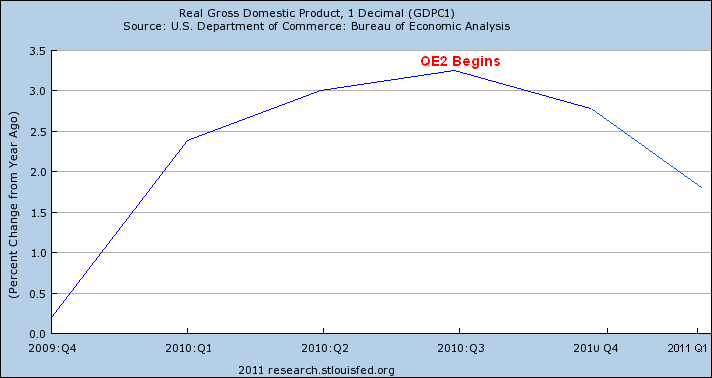
America's reckless money-printing could put the world back into crisis
by Liam Halligan - Telegraph
Last week, Ben Bernanke suggested that the US base interest rate will stay close to zero for an "extended period". It's been there since December 2008. Traders took these words to mean that the Federal Reserve won't hike rates until the first few months of 2012 at the earliest.
Bernanke also pledged to do whatever is required to keep America's economic recovery on track – confirming that the second programme of "quantitative easing", or QE2, would be completed. These two related announcements – the "reprieve" and the "sugar rush" – sent Wall Street into renewed spasms of synthetic joy.
In the real world, US growth is slowing sharply. Annualised GDP rose just 1.8pc during the first three months of 2011, down from 3.1pc the quarter before. America remains mired in sovereign, commercial and household debt. Yet as the Fed chairman spoke, US stocks hit their highest level since before the sub-prime crisis. The tech-heavy Nasdaq, incredibly, closed at a 10-year peak. So the Fed will keep on "printing" virtual money – at least for now. By the end of June, it will have purchased $600bn (£363bn) of longer-term Treasuries, with the US government effectively buying its own debt from funds created ex nihilo. That's on top of the original $1,750bn (£1,048bn) QE scheme, launched in late 2008.
America's base money supply – the bedrock of the world's reserve currency – has doubled in little more than two years. Despite consternation among many US voters, and dismay – rapidly turning to anger – across the world, most of America's political elite refuse even to debate QE. Such is the state of democracy in the "land of the free and the home of the brave". And America is not alone.
Bernanke's utterances caused gold to jump another 2pc. Silver – known as "poor man's gold", another "inflation hedge" – spiked 6.5pc. But the real story was the plunging dollar. Against a basket of five major global currencies, the US currency fell sharply and is now at its weakest since July 2008. The Fed's "real broad dollar index", a 26-currency composite and adjusted for inflation, is testing levels not seen since 1979. Yet still Tim Geithner puffed-out his chest and reaffirmed America's "strong dollar" commitment. "Our policy has been, and will always be, as long as I'm in this job, that a strong dollar is in America's interest," the US treasury secretary said.
That's total nonsense, of course – seeing as a weaker currency boosts US exports and lowers the value of America's external debt. Geithner's words are not only disingenuous, but insulting to America's creditors and trading partners. In fact, Washington's constant berating of Beijing for "currency manipulation" is looking more and more like a diversion tactic. That's a big statement, I know. But it's based on a dispassionate analysis of the facts. I have no personal beef with America. I've spent a sizeable chunk of my life in America and much of my family is American. I love America! I feel the need to write this as quite a few US economists, even those boasting Nobel prizes, have recently accused analysts who don't toe the "Washington line" of being "America-haters".
Such ad hominem tactics are pathetic – the last refuge of intellectual cowards who know they're losing the argument. For the "Washington line" – inflation isn't a problem, we don't need to raise rates and the Fed can print willy-nilly – is not only looking increasingly untenable, but is having a severe negative impact on much of the rest of the world. The way the Obama administration is running America's economy – continued fiscal expansionism, QE2 and "dollar benign neglect" – is not only damaging US relationships abroad, but will ultimately lead to greater pain for domestic voters too. I say this not because I hate America but because, as a citizen of the world, I care about the fate of the largest economy on earth.
This latest dollar weakness is part of a longer-term trend. From the start of 2002 until the middle of 2008, the greenback lost 30pc on a trade-weighted basis. The start of the "sub-prime" crisis proper then sent shock waves around the world. For six months or so, Western investors piled into what they knew, liquidating complex positions and buying "Uncle Sam". The dollar surged, spiralling upward during the so-called "safe haven rally".
Then the Fed began QE, apparently to tackle "deflation". The more pressing need was to bail out Wall Street and rein in the real value of America's burgeoning government debt – which happened as the dollar then fell. The US currency has also been falling pretty steadily since the summer of 2010, after Bernanke gave the first inklings he would launch QE2.
America's currency weakness is based on fundamentals including its vast, and upward-spiralling, $14,000bn debt – and that's just what's "on the books". Nothing material is being done to address this massive problem. The unspoken assumption among politicians on both sides of the aisle is that America can just "monetise" its liabilities by continuing to debase the currency.
So the Fed's actions are undermining the dollar precisely because that's what the White House wants. At the same time, sophisticated investors are exploiting ultra-low US rates by borrowing cheaply in dollars and switching the proceeds to currencies where returns are higher. This "carry trade" is flooding foreign exchange markets with US currency – weakening the dollar further.
Yet "dollar benign neglect" is fraught with economic risks. A weak dollar makes commodities more expensive. It was when the greenback hit it's last trough of $1.60 against the euro in mid-2008 that oil soared to $147 a barrel. Expensive crude damages the world's biggest oil user. And as the dollar falls, America's huge commodity imports cost more, making the trade deficit even worse.
America's currency depreciation trick could also backfire badly if "the rope slips" and, far from a steady decline, the world's pivotal currency goes into free fall. That would plunge America back into recession, or worse – as inflation ballooned amid soaring import costs, forcing the Fed to raise rates in the teeth of shuddering slowdown.
A plummeting US currency would also spark broader chaos as central banks sought to protect the value of their reserves. And after the inevitable downward overshoot, the dollar would snap back, causing the carry trade to "unwind" as dollar borrowers suddenly owed more. The danger then would be that major losses at financial institutions posed renewed systemic threats. Financial markets might then go into a tailspin, reigniting concerns of a fully-blown global slump.
Bernanke's comments last week were made to the press – with the Fed now agreeing to regularly scheduled news conferences for the first time in its 98-year history. Some say this decision to submit to demands for transparency indicates that the power of the US central bank, it's global influence, is on the wane. I'd suggest that, on the contrary, the Fed's global impact may soon reach an all-time high. And that impact won't be pretty. For far from being a "safe haven", an increasingly debased dollar could be the cause of the next global financial crisis.
Reading between the lines of Bernanke's statement, I don't think that last week's Fed missive, as most concluded, confirmed the end of QE2. In my view – and I write this with a sense of trepidation – the Fed's inaugural "meet the press" moment was in fact preparing the ground for the start of QE3.
FSA fails to publish report into Royal Bank of Scotland collapse
by Kamal Ahmed and Harry Wilson - Sunday Telegraph
The Financial Services Authority is to admit defeat in its efforts to publish a comprehensive report on the failure of the Royal Bank of Scotland this spring, and will announce it has called in Andrew Tyrie, the chairman of the Treasury Select Committee, to rescue the project.
Senior sources close to the FSA said that the report on RBS, originally promised by Lord Turner, the FSA chairman, in March, was now delayed indefinitely. The FSA is now aware that the delay is doing it damage and wants to stave off criticism that it has not met its own deadline.
The sources said that such was the legal complexity trying to produce a report that would be cleared by RBS lawyers – fearful of possible legal action in the US – the project now needed a fundamental rethink.
Lawyers acting for Johnny Cameron, the former head of RBS and, it is thought, one of the few people interviewed at any length from within RBS by the FSA, are also thought to be reluctant to give the present FSA report the green light.
The Sunday Telegraph first revealed in March that the FSA was going to fail to meet the original deadline contained in an open letter from Lord Turner last December. Lord Turner was forced to make the December pledge after an original decision to publish a 12-sentence press release was attacked as inadequate from across the political spectrum. Vince Cable, the Business Secretary, ordered a meeting with Lord Turner and told him that the Government expected far fuller disclosure. It was then predicted that the delay could mean publication at the end of April. That deadline has also been missed.
Mr Tyrie, a Conservative MP, has held a series of discussions with Lord Turner and Hector Sants, the chief executive of the FSA. It is expected that Lord Turner and Mr Tyrie will make a joint statement in the near future revealing how the inquiry will progress and reveal that Mr Tyrie will become the "independent validator" of the report.
FSA sources said that the authority wanted the report on one of most damaging collapses in the City's history to be "as transparent and accurate" as possible. They also revealed that the report could not be seen to "pull its punches" on the FSA's own role in the collapse, particularly over giving the go-ahead to the disastrous RBS take-over of the Dutch bank ABN-Amro.
The deal was nodded through by the FSA even though the wholesale funding markets – vital for banking operations – had shut down and the growing financial crisis was creating headlines around the world. RBS was allowed to take its tier 1 capital to about 4pc, which left the bank with a dangerously thin loss buffer as market conditions deteriorated after the collapse of Lehman Brothers in September 2008.
Mr Tyrie will be used as an independent voice in the inquiry process to re-assure the Government, which has demanded details of what the FSA knows about the RBS collapse. The taxpayer was left to pay out billions of pounds in state support for RBS which will not be paid back until the Government sells its 83pc stake in the bank.
So far, the FSA has focused on a very limited number of specific events in the lead up to the collapse of RBS – including its multi-billion pound capital-raising in early 2008, six months before the bank received more than £20bn in direct state support. That is not now seen as sufficient.
Greek and Spanish economies falter ahead of expected rise in interest rates
by Phillip Inman - Guardian
Europe's north-south divide has worsened as figures show Spain and Greece faltering, with rising unemployment and plummeting retail sales. Meanwhile the European Central Bank (ECB) is preparing to raise interest rates on the back of a booming German economy.
Spain's unemployment rate jumped to a European record of 21.3% last month while Greece's retail sales dropped more than 10% year-on-year as both countries demonstrated the difficulties of spurring economic growth while implementing severe public spending cuts. Almost five million workers are out of work in Spain, according to official statistics, despite efforts by the socialist-led government to kick-start the economy and generate jobs. Youth unemployment remains above 40%. The gloom in Madrid was reinforced by retail sales data for March, which showed the country's sharpest decline for more than two years.
Despite the problems facing Spain, Greece and other troubled eurozone nations, the ECB is expected to raise interest rates, possibly as early as next week, after inflation climbed to 2.8%. The inflation figure, published by Eurostat, the EU statistics agency, was up from 2.7% in March. Central bank president Jean-Claude Trichet said this week that policymakers must quash inflation expectations to avert the risk of wage rises leading to even higher prices, adding: "We have risks of second-round effects."
Inflation has remained above the ECB's goal of just under 2% largely owing to higher oil and food prices. Although the bank expects prices to ease next year, it has been worried enough to start raising rates from record lows, increasing them by 0.25 percentage points this month to 1.25% in order to combat inflationary pressures. Economists predict several more such increases by the year's end.
Trichet is at odds with his counterparts in the US and Britain, who have consistently argued the recovery needs to be firmly entrenched before implementing rate rises. A meeting of the Bank of England's monetary policy committee next week is expected to keep rates on hold at 0.5%, despite inflation reaching 4% and three members of the nine-strong committee voting for a rise last time. Trichet infamously refused to cut interest rates in line with the Federal Reserve ahead of the banking crisis before being forced to cut radically following Lehman Brothers' collapse in September 2008.
The EU's broad economic sentiment indicator fell significantly, by 2.3 points to 105.1, for the 27-member European Union, weighed down by a sharp drop in Britain's services and retail sectors. The index fell more moderately by 1.1 points to 106.2 for the eurozone, propped up by Germany, France and the Netherlands, the only countries where the index remains above its long-term average.


