Friday, July 31, 2009

July 31 2009: It's a good idea, but it's wrong


Jack Delano Summer Brake March 1943
Summit, California. Brakeman opening the retainer valve on a car on the Atchison, Topeka and Santa Fe Railroad between Barstow and San Bernardino. From here to San Bernardino is one long downgrade of more than 2,700 feet


Ilargi: In 2006, a Bureau of Transportation report estimated that there were 250 million passenger vehicles on American roads. Five years before, a National Automobile Dealers Association study found that of vehicles in operation in the US, 38.3% were older than ten years, 22.3% were between seven and ten years old, 25.8% were between three and six years old and 13.5% were less than two years old. According to this study the majority of vehicles, 60.6%, of vehicles were older than seven years in 2001.

If we assume that relative numbers have stayed more or less the same between the studies, and into the present, we find that some 150 million US vehicles are over 7 years old, which probably makes them -potential- candidates for the Car Allowance Rebate System (CARS), or Cash for Clunkers, in which the government pays to get an old car off the road when a new one is purchased. While there are long and confusing lists of ineligible cars, something should still already be clear.

Germany has had a similar program running for a number of months now (as have other European nations). It's been a huge success from the start. The Germans reserved $7 billion for their Klunkers(?!), with the money set to run out soon.

So what does the US do? The administration proposed a $4 billion plan, which got cut to $1 billion by the House. At an average of $4000 per vehicle purchased, that takes care of 250.000 cars. The plan was supposed to run until November. Instead, it ran out of cash in one week. Today, another $2 billion was appropriated for the scheme.

Which will be good for another 500.000 cars, for a grand total of 750.000. By then it'll be August. 750.000 out of a total of 150 million potentially eligible vehicles Or are perhaps only 100 million eligible?. A great plan, but it's wrong. Maybe that’s what you get for listening to Alan Blinder. I smell someone making a lot of dough from skimming teh system. Anything that's so poorly organized is ideal for a scam or two. But I'm still wondering: how do you get anything THAT wrong? That must take a Herculean effort. Better take a summer break now.

Then again, it’s all mostly about appearances these days. I think the idea is to overwhelm us with phony numbers till we just give up. In my mind’s eye, I see a big black hole with a huge opaque soap bubble temporarily suspended over it. It'll pop when the days get short.

On the one hand you got your scars:
Recession Worse Than Prior Estimates, Revisions Show
July 31 (Bloomberg) -- The first 12 months of the US recession saw the economy shrink more than twice as much as previously estimated, reflecting even bigger declines in consumer spending and housing, revised figures showed.

On the other hand you got your shoots:
US Economy Shrank Less Than Expected in Quarter
(from BEA): Real gross domestic product -- the output of goods and services produced by labor and property located in the United States -- decreased at an annual rate of 1.0 percent in the second quarter of 2009, (that is, from the first quarter to the second), according to the "advance" estimate released by the Bureau of Economic Analysis. In the first quarter, real GDP decreased 6.4 percent.

You think it might be a good idea to wait for the revised numbers? It might also be worthwhile to see what causes the numbers to drop less:

On the one hand you got your greens:

The economy’s long, churning decline leveled off significantly in the second quarter, as stock markets started to recover, corporate profits bounced back, housing markets stabilized and the rampant pace of job losses tapered off.

On the other hand you got your scorched earth:

Declines in business investment leveled off, and the economy was aided by big increases in government spending at the federal, state and local levels.[..] But consumer spending fell by 1.2 percent as Americans put more than 5 percent of their disposable income into savings. Economists are concerned that consumer spending, which makes up 70 percent of the economy, will not rebound as long as employers keep cutting jobs and trimming wages.

Real imports of goods and services decreased 15.1%, real exports of goods and services decreased 7.0%. And everyone is talking about the recovery around the corner. Listen to them at your own peril. Watch AIG in the weeks to come. Remember, $180 billion went into it already. Turns out, thecompany is simply shifting funds around between subsidiaries to look not yet dead.

Come on, guys, everything that allegedly goes into this assumed recovery is organized along cash for clunkers principles. It's all just a dirty joke.


$2 Billion in New Cash Steered to Clunkers
Congress moved Friday to inject fresh funds into the wildly popular "cash for clunkers" program after it nearly ran out of money, threatening to become a symbol of government bungling. The House approved moving $2 billion from a program that backs loans to renewable-energy companies into the car-repurchase program, which apparently burned through its allotted $1 billion in just a week. The move came just before one of the biggest car-sales weekends of the summer. The House vote capped a chaotic few days in which auto dealers saw a huge surge in sales, but struggled to register their deals with a swamped Department of Transportation computer system. Unsure how to react, Obama administration officials sent mixed signals late Thursday about suspending the program just as dealers braced for heavy buyer traffic.

Even Friday, officials weren't able to calculate how much money remained in the clunkers' kitty, other than to say that the National Highway Traffic Safety Administration, which handles the rebates, has processed $250 million in vouchers. As late as Thursday morning, a NHTSA spokesman was brushing off concerns about the money running out as dealer "paranoia." President Barack Obama, during a brief White House address on the economy, said Friday that the clunker program "has succeeded well beyond our expectations and all expectations." His administration and Congress, he said, were "doing everything possible to continue this program."

Designed to last through October, the cash-for-clunkers program offers rebates of up to $4,500 to consumers who trade in old vehicles to buy new, more fuel-efficient models. What happens now isn't clear, in part because House efforts to expand the clunker fund may face a tougher ride in the Senate, where some Republicans oppose the additional spending and some Democrats hope to tighten the program's environmental standards. Despite its administrative failings, the clunkers program excited recently-flinty consumers and provided a quick jolt to the U.S. economy after 19 months of recession. Car dealers reported their highest weekly sales volumes in nearly two years as consumers appear to have used the program to buy as many as 250,000 new cars.

At Classic Buick, Pontiac and GMC in Arlington, Texas, sales director Will Carter stayed up until 2 a.m. Friday to finish processing the 29 cash-for-clunkers deals -- just in case the program ran out. A few months ago, the dealership was lucky to sell five cars a day. This week, the sales team has been closing 10 or more, putting the dealership on pace for a record sales month, Mr. Carter said. "If there is any part of the stimulus that absolutely needs to stay, this is it," he said.

So many dealers were trying to jam through sales Thursday night that the government's processing Web site, cars.gov, crashed several times, said Chris Lemley, president of Sentry Auto Group, which owns three dealerships in Boston suburbs. "It was sort of like trying to buy U2 tickets in the first five minutes they go on sale." The roughness of the program's launch has provided fodder for Republicans who question the government's readiness for wading deep into other private-sector strongholds, such as health care.

"If this is how the government is going to handle billion- dollar programs affecting all Americans, I ask, whatever will we do if this administration takes control of our health care?" said Rep. Jerry Lewis, a California Republican. He and others complained that the program got underway with no public hearings and little debate. The original clunkers legislation called for putting $4 billion aside for consumers to trade in older cars for more fuel-efficient models. Despite pushback from environmentalists, the efficiency standards in the original bill were weakened under heavy pressure from U.S. auto makers and Midwest legislators. Lawmakers who were skeptical of the program's success, or opposed to the additional spending, also managed to whittle the funding down to $1 billion.

In Germany, with a population roughly one-third that of the U.S., lawmakers in January ponied up nearly $7 billion to entice drivers to get rid of older cars and buy new, more-efficient models. That program has been such a boon that it could run out of money by September. The U.S. program officially kicked off July 1, but the DOT needed nearly a month to put 130 pages of rules in place and to set up an elaborate computer and banking system to register dealers and handle transactions.

With $50 million in administrative funds, the department's National Highway Transportation Safety Administration set up a 250-person phone bank to take calls from consumers and hired Oracle Corp. to handle computer operations. Oracle declined to comment on the system's troubles.\ Not until July 24 were dealers able to register with NHTSA and process claims. Problems began to bubble up immediately. At Koons Automotive Companies, a large dealer chain around Baltimore and Washington D.C., it took three days to get its 16 dealers registered. Koons by early Friday had done 295 clunker deals. But the company had registered only a small fraction on the NHTSA site as vouchers were kicked back or Koons accountants struggled to log onto the system.

"This is a great program, but it's also the worst-run program I've ever seen," said Alex Perdikis, Koons's executive vice president. Earlier this week, fears mounted within the administration and among dealers that the sheer volume of sales could prove larger than the legislation -- or the government's clerks -- could handle. Wednesday, the National Automotive Dealers Association began an informal email poll of members to gauge the surge. By then, nearly 20,000 dealers had registered but official transactions numbered less than one per dealership.

The NADA poll found that actual sales were as high as 14 per dealership, suggesting that more than $900 million had already been used. The association sent its findings to NHTSA early Thursday morning. "That's when the alarms went off," said one DOT official. Concern spread to the White House and its Office of Management and Budget, where officials began to comb through the federal budget for money they might draw on to pay dealers should the program bust its budget. Early Thursday evening, OMB sent out word that there was none to be had.

Transportation Secretary Ray LaHood began briefing lawmakers Thursday afternoon, informing them that the fund was depleting rapidly. Around 4 p.m., Mr. LaHood called NADA President Phillip Brady and told him the department was "terminating" the program at midnight that night, according to NADA spokesman Bailey Wood. A spokeswoman said Mr. LaHood wasn't available to comment. As word spread, lawmakers said they were inundated by phone calls from car dealers and voters in their districts, expressing anger that such a popular program might die. Late Thursday, the White House scurried to announce that the program had not been suspended. Some Senators are expected to push for more aggressive environmental targets for the program as part of any extension.


U.S. Economy Shrank Less Than Expected in Quarter
The American economy shrank at an annual rate of 1 percent from April through June, the government reported on Friday, stoking hopes that the worst recession since the Great Depression was nearly over. The economy’s long, churning decline leveled off significantly in the second quarter, as stock markets started to recover, corporate profits bounced back, housing markets stabilized and the rampant pace of job losses tapered off. Declines in business investment leveled off, and the economy was aided by big increases in government spending at the federal, state and local levels.

“We’re in a deep hole, and now we’ve got to dig ourselves out of it, which is a very difficult task,” Diane Swonk, chief economist at Mesirow Financial, said. But consumer spending fell by 1.2 percent as Americans put more than 5 percent of their disposable income into savings. Economists are concerned that consumer spending, which makes up 70 percent of the economy, will not rebound as long as employers keep cutting jobs and trimming wages.

Friday’s report on gross domestic product — a broad gauge of the country’s output — is the government’s rough draft at measuring the economy, and can be revised sharply up or down. The Commerce Department revised its earlier assessments of the country’s woes, saying that the economy contracted at a pace of 6.4 percent in the first three months of the year, compared with an earlier figure of 5.5 percent. Economists had been expecting the second-quarter economy to contract at a pace of 1.5 percent.

Now, even with jobs still vanishing and wages flat, many forecasters expect the economy to touch bottom sometime in the next few months. Economists say that businesses from small manufacturers to big automakers are poised to rebuild their depleted inventories, which fell by an annualized $141 billion in the second quarter. That restocking could spur economic growth later this year. “We’re going from recession to recovery, but at least early on, it’s not going to feel like one,” said the chief economist at Moody’s Economy.com, Mark Zandi. “For economists, this is a seminal part in the business cycle, but for most Americans, it won’t mean much.”

That is because the job market is expected to remain dismal even after the economy resumes growing. As business picks up after a recession and companies start receiving more orders and restocking their shelves, employers will still resist hiring new full-time workers, and instead pay overtime or rely on part-time employees. To make a dent in the 9.5 percent unemployment rate, economists say, the economy needs to grow at a 3 percent clip and add 300,000 to 400,000 jobs a month — a difficult task after so many months of a recession.

Many economists expect an arduous recovery marked by high unemployment and unsteady growth. Not only does the specter of a jobless recovery presage more pain for the country’s 15 million unemployed workers. It could pose a significant political challenge for President Obama, who has asked Americans to be patient as the government’s $787 billion economic stimulus plan takes effect. “The bar’s pretty high to make people outright happy about the economy,” said the chief economist at Action Economics, Michael Englund.

The Commerce Department’s quarterly assessment offered a tour through a bleak year. The economy withered during each of the last four quarters, its longest contraction since the 1940s. Businesses cut their investments and laid off millions of workers. Imports and exports tumbled. The country’s gross domestic product fell to $14.15 trillion in the second quarter, from $14.5 trillion in the second quarter of 2008.

In interviews, small-business owners across the country say the ground is slowly reforming under their feet, and that business no longer seems to be careening downward. Indeed, business investment in structures like new factories and office buildings fell at a rate of 8.9 percent in the second quarter after declining by more than 40 percent in the previous three months. And investment in equipment and software, which fell 36 percent this winter, dropped a more modest 9 percent in the second quarter.

But many employers who have laid off employees or scaled back say they are not about to increase their spending or start hiring. In Nashville, Jerry Robertson laid off one of his 15 employees, cut his budget for advertising and trade shows and moved into a smaller office space to cut costs at his company, which helps trucking companies manage their operations. His business is down about 10 percent from last year, and clients are still falling off his books. “We do see it not declining as fast as it was, but we don’t see any growth,” Mr. Robertson said. “We’re still going down.”


Falling Imports versus Falling Exports (GDP = -2.38%)
I noted earlier that the oddity of imports versus exports calculation would produce a positive contribution to GDP. Let’s look at the details of this, and find a way to understand what this means. First, off conceptualize the difference between what imports and exports are. At the most basic level, Imports represent our consumption of overseas production, i.e., We buy what they make. Exports are where overseas consumers purchase our production, i.e., They buy what we make. What were the specifics of the GDP data regarding import/export?

-Real imports of goods and services decreased 15.1%
-Real exports of goods and services decreased 7.0%

So in Q2, both consumption by us of overseas goods and services and by them of US made goods and serivces declined significantly. The Differential between imports and exports — who dropped fastest — was the key to this quarter’s GDP data. According to Bloomberg, Decreasing Exports subtracted 0.76% from GDP. At the same time, falling Imports added 2.14%.  Net contribution of the fact that Imports are free falling twice as fast as Exports are = 1.38%.

If they were both falling at the same rate — if Europe and Asia’s consumers were hurting as much as ours –  GDP would have been -2.38%. If it seems weird to you that the ratio of domestic and overseas shrinking economies and their reduced consumption somehow turned into a positive GDP contributor, well, welcome to the wonderful world of government statistics.


Thank God For Government Spending
Today's better-than-expected -1% GDP was tempered, somewhat, by the staggering 11% spike in Federal Government spending (hello stimulus!). Today's chart looks back at the Y/Y GDP change with the same number sans government spending. As you can see from the divergence, the government boost provides a big help.


Stimulus has yet to really boost GDP
The nation's economy is starting to rebound, but the Obama administration's massive stimulus package had little to do with it. The gross domestic product contracted at an annual rate of 1%, a significantly slower decline than the past two quarters. Economists had expected a drop of 1.5%. While government spending at all levels increased in the second quarter, only a small amount of the $787 billion stimulus package had trickled out by June 30.

As of July 3, only $60.4 billion of recovery funds had been distributed, the largest chunk of which went to help states cope with rising Medicaid costs. Much of the $43 billion in stimulus tax relief -- which includes the Making Work Pay tax credit for individuals -- also kicked in during the quarter. "I don't think the effect of stimulus has been very large," said Edward Lazear, an economics professor at Stanford's Graduate School of Business who advised former President George W. Bush. "Very little has gone out."

Non-defense federal government spending provided a 0.15 percentage point boost to GDP, while state and local government spending contributed 0.30 percentage points, according to the Commerce Department. Federal spending jumped nearly 11%, while state and local government outlays increased 2.4%. To be sure, stimulus spending had some effect. Some of the early components of stimulus to be distributed have allowed people to spend more, said Dean Baker, co-director of the Center for Economic and Policy Research. Those who received the $25 increase in unemployment benefits have likely already put those funds into the economy.

And states did put the money they received to use, which contributed to the fastest growth in state and local government spending since the middle of 2007, according to Josh Bivens, an economist with the Economic Policy Institute. Some economists say that the GDP numbers would have been worse without the stimulus funds. Bivens estimated the recovery act money may have contributed as much as 3 percentage points of annualized growth to the quarter.

But others expect the figures to be revised downward in the future. They point to an 8.9% contraction in business spending and a 7% decline in hours worked, which doesn't mesh with a mere 1% decline in GDP. The true test of the stimulus package will come in the fall, when the government reports economic activity for the third quarter. The administration is working to get the money out the door quicker, as complaints mount that stimulus is not having its promised effect. "The third quarter will be a critical time period for assessing the stimulus package," said Mark Thoma, an economics professor at the University of Oregon.

Friday's GDP report comes as some experts are calling for a second stimulus package to further juice the economy. They say the first was not enough to promote a recovery. "It is preventing a collapse," said L. Randall Wray, senior scholar at the Levy Economics Institute of Bard College. "I wouldn't say it is big enough to get us growing." Others, however, say that more government funding will not address the key issues -- such as the housing and financial markets turmoil -- holding back the economy. "You will feel better, but it won't really get at the heart of the problems driving the crisis," said Philip Levy, a scholar at the American Enterprise Institute who worked in the Bush administration.


Recession Worse Than Prior Estimates, Revisions Show
The first 12 months of the U.S. recession saw the economy shrink more than twice as much as previously estimated, reflecting even bigger declines in consumer spending and housing, revised figures showed. The world’s largest economy contracted 1.9 percent from the fourth quarter of 2007 to the last three months of 2008, compared with the 0.8 percent drop previously on the books, the Commerce Department said today in Washington.

“The current downturn beginning in 2008 is more pronounced,” Steven Landefeld, director of the Commerce Department’s Bureau of Economic Analysis, said in a press briefing this week. The revisions were in line with past experience in which initial figures tended to underestimate the severity of contractions during their early stages, he said. The updated statistics also showed that Americans earned more over the last 10 years and socked away a larger share of that cash in savings. The report signals the process of repairing tattered balance sheets following the biggest drop in household wealth on record may be further along than anticipated.

Consumer spending, which accounts for 70 percent of the economy, decreased 1.8 percent in last year’s fourth quarter from the same period in 2007, exceeding the prior estimate of a 1.5 percent drop. Purchases also began sinking sooner than previously projected, registering their first decline at the start of 2008 rather than in the second half. Treasuries headed higher after the report, while stock- index futures declined. Benchmark 10-year note yields were at 3.58 percent at 8:51 a.m. in New York, from 3.61 percent late yesterday. Contracts on the Standard & Poor’s 500 Stock Index were down 0.3 percent at 979.

Residential construction fell 21 percent during the period, almost 2 percentage points more than previously reported, aggravating what was already the worst slump since the Great Depression. The Commerce Department also reported today that the economy contracted at a 1 percent annual rate from April through June after shrinking at a 6.4 percent pace in the first quarter, the most since 1982. The decline in the first three months of the year was previously reported as 5.5 percent.

The National Bureau of Economic Research, the accepted arbiter of U.S. business cycles, last year determined the recession started in December 2007. The private group is based in Cambridge, Massachusetts, Today’s updates are part of comprehensive revisions that take place about every five years and are more extensive than the changes announced at this time each year. Figures as far back as 1929 can be revised.

Over the most recent period, the third quarter of 2008 underwent one of the biggest changes, going from a 0.5 percent decrease in gross domestic product to a 2.7 percent drop. The new reading better illustrates the effect the September collapse of Lehman Brothers Holdings Inc. had on the economy and credit markets. The deeper deterioration last year underscores why Federal Reserve Chairman Ben S. Bernanke and his colleagues at the central bank cut the benchmark rate to a record low and extended credit to non-banks for the first time since the 1930s.

The new GDP data also help explain why the unemployment rate shot up 2.3 percentage points last year, the biggest annual jump since 1982. The revisions showed that the 2001 recession was less severe than originally estimated, reflecting a smaller decline in business investment. The economy actually grew 0.1 percent from the fourth quarter of 2000 to the third quarter of 2001, erasing the 0.2 percent drop previously reported.

Personal income was revised up over the last decade, after the government boosted its adjustments for the underreporting and non-reporting of income using more recent data from the Internal Revenue Service. The increases in the most recent years reflect gains from rents, interest and proprietors’ income. The government changed the way it accounts for natural disasters, such as Hurricane Katrina, eliminating much of the prior volatility in income calculations.

Higher incomes and less spending translated into bigger savings. The savings rate for 2008 was revised up to 2.7 percent from 1.8 percent. The rate shot up to 5.2 percent in the second quarter, the highest level since 1998. The government revised corporate profits down for 2006-2008 and up for 2004 and 2005. Finally, Commerce shifted food services, which include meals purchased at restaurants or served in schools, out of the food category. As a result, the Fed’s preferred inflation gauge -- which tracks consumer spending and excludes food and fuel -- was pushed up by 0.2 percentage point for the three-year period from 2006 to 2008.

The costs of meals away from home are not as volatile as fresh food, the government said, and therefore services should be included in the measure commonly known as the core index.


Is This What's Coming Next?
In yesterday's CHART OF THE DAY we noted the similarities between this current rally and the famous rally between 1929 and 1930.


Today, David Rosenberg picks up on the same thing, and fills it out a little more.


Five more banks fail
Regional banks in Oklahoma, Florida, Ohio, Illinois and New Jersey fall, bringing the national tally up to 69 for 2009. The closures cost the FDIC $912 million.

Regulators shut down five regional banks Friday, the Federal Deposit Insurance Corporation said, bringing the total number of banks to fail in the United States to 69 this year. Friday's bank closures will cost the FDIC fund $911.7 million, bringing the total cost for failed banks to $15.13 billion this year. That compares with $17.6 billion in all of 2008. First State Bank of Altus, based in Altus, Okla., was shut down and Herring Bank, headquartered in Amarillo, Texas, will take over all of the deposits of the failed bank. As of June 19, the First State Bank of Altus had total assets of $103.4 million and deposits of $98.2 million. The failed bank was the first to go down in the state of Oklahoma in 2009.

Meanwhile, Integrity Bank, headquartered in Jupiter, Fla., was shuttered and Stonegate Bank, based out of Fort Lauderdale, Fla., will assume all of the deposits of Integrity Bank. As of June 5, Integrity Bank had total assets of $119 million and total deposits of $102 million. The failed Florida bank was the fourth to fail in the state so far this year. The third bank to go down Friday was the Peoples Community Bank, based in West Chester, Ohio. The First Financial Bank, National Association, headquartered in Hamilton, Ohio, will take over all of the deposits of the failed bank.

The failed bank was the first bank to be closed in Ohio in 2009, and as of March 31, had total assets of $705.8 million and total deposits of $598.2 million. The fourth bank to fall Friday night was the First BankAmericano, based in Elizabeth, N.J., and the Crown Bank, of Brick, N.J. will take over the deposits. As of July 16, First BankAmericano had total assets of $166 million and total deposits of $157 million. The failed N.J. bank was the second bank in the state to fall in 2009.

The fifth and biggest bank of the night to fail was Mutual Bank in Harvey, Ill., which had total assets of $1.6 billion and total deposits of $1.6 billion. Mutual Bank's 12 branches will reopen on Saturday as branches of United Central Bank of Garland, Texas, which has assumed all deposits from Mutual Bank. The number of bank failures so far in 2009 has almost tripled last year's total of 25. Smaller regional banks have been hammered in the downturn. Many of the banks failed because local residents and commercial real estate developers that took out loans have been unable to pay them back. 


FDIC tests toxic assets sale program
The U.S. Federal Deposit Insurance Corp launched the first test of its Legacy Loans Program that could eventually help banks rid their balance sheets of toxic assets so they can raise new capital and increase lending, the agency said on Friday. Officials at the FDIC, which insures the deposits of U.S. banks and acts as the receiver for failed institutions, said they will take final bids in late August or early September and declined to say which bank's toxic assets were involved in the test.

In the test transaction, a receivership will transfer a portfolio of residential mortgage loans to a limited liability company in exchange for an ownership interest in that entity, the agency said in a statement. FDIC spokesman Andrew Gray declined to comment on the size of the asset pool. He said bidders must sign a confidentiality agreement in order to participate. Royal Bank of Scotland and Deutsche Bank AG are the advisers to the FDIC on the program. In its early stages, the pilot program is soliciting interest for the transaction and potential bidders are going through a qualification process, officials said.

No open and operating institutions are currently participating, FDIC officials said. Accredited investors will be offered an equity interest in the limited liability company under two options. The first is an all-cash basis, which is how the FDIC has recently sold receivership assets, with an equity split of 20 percent to the investor and 80 percent to the FDIC. The other option is a sale with leverage, under which the equity split will be 50-50 between the investor and the FDIC.

The FDIC said it will be protected against losses by the limits on leverage amount, the mortgage loans collateralizing the guarantee, and the guarantee fee. "The FDIC will analyze the results of this sale to see how the Legacy Loans Program can best further the removal of troubled assets from bank balance sheets, and in turn spur lending to further support the credit needs of the economy," the agency said. FDIC officials did not rule out additional sales.

The test pilot differs from previous receiverships sales due to the inclusion of a leverage aspect that hasn't been utilized since the era of the Resolution Trust Corporation, a government trust that liquidated assets in the 1980s and 1990s during the savings and loans crisis. The FDIC is also offering two leverage ratios for investors -- 6-1, which comes with certain performance strings attached, and 4-1, which has no strings attached.

For example with a 6-1 leverage, if the transaction price is $700 million, a note will be issued for $600 million and the remaining $100 million will be split evenly between the investor and the FDIC.
An investor who opts into the 6-1 leverage ratio will be required to meet certain performance thresholds and redirect some cash flows to lower the note in order to protect the lender, which is the FDIC. For an all cash transaction, the investor would be liable for 20 percent, or $140 million, based on a $700 million price.

Investors might find the 6-1 leverage option too onerous, said University of Louisiana finance professor Linus Wilson, who questioned why investors would want to partner up with the government and put up a 20 percent stake equity without cheap leverage. "Thus, 4 to 1 leverage may be the more popular choice," Wilson said. Officials said the note could be structured so that it is marketable instrument, similar to a mortgage-based security.

If the test proves successful, open and operating institutions will be able to shed troubled loans as long as the manager follows certain loan-servicing requirements under either the Home Affordable Modification Program guidelines or FDIC's loan modification program. The Legacy Loans Program is part of the government framework called the Public-Private Investment Program, which also includes a separate program under the Treasury Department to sop up troubled securities. The Treasury unveiled PPIP last year with the goal of enticing private equity firms who were sitting on the sidelines awaiting rules on when and how they could participate.


Limits on Bank Bonuses Face Senate, Obama Skepticism
Restrictions on financial industry bonuses heading to a vote in the U.S. House may be rejected by the Senate and the Obama administration, which are reluctant to increase government’s role in deciding compensation. The House, emboldened by New York Attorney General Andrew Cuomo’s report yesterday that showed nine banks getting U.S. aid paid $32.6 billion in bonuses last year, started debate today and probably will pass a bill requiring regulators to ban pay practices that encourage “inappropriate risks.” A panel in the House, where Democrats hold a 256-178 advantage, approved the measure along party lines July 28.

The bill must pass the Senate and be signed by President Barack Obama to become law. White House press secretary Robert Gibbs, who hadn’t read Cuomo’s report, said yesterday the administration is concerned the measure may give regulators too much say on incentive pay. Michael Oxley, former chairman of the House Financial Services Committee, said senators are more likely to back the say-on-pay measure that gives investors a non-binding vote on compensation.

“It is difficult for me to believe that the Senate would be particularly interested in passing that version, despite the report,” Oxley, co-author of the Sarbanes-Oxley corporate governance law, said in an interview. “I don’t think it’s going to influence the Senate.” The House in March passed a bill to set a 90 percent tax on bonuses at companies getting at least $5 billion in aid. The legislation, responding to public outrage over retention bonuses at American International Group Inc., died in the Senate after Obama said the U.S. shouldn’t “govern out of anger.”

Public outrage over Wall Street compensation reignited after Goldman Sachs Group Inc. set aside $11.4 billion for compensation and benefits for the first half of this year, a 33 percent rise from a year earlier and enough to pay every worker $386,429 for that period. Cuomo analyzed 2008 bonuses at banks that received $175 billion in U.S. aid and found that 4,793 employees were paid more than $1 million in bonuses last year. The 51 members of Citigroup Inc.’s senior leadership committee got an average of $4 million each, according to Cuomo.

The report underlines “why we’re trying to pass this bill,” House Financial Services Committee Chairman Barney Frank said yesterday in an interview. “This is precisely the kind of thing that should be subject to legal restriction.” The House measure goes further than administration proposals to regulate compensation. It bars incentive-pay plans that “could threaten the safety and soundness of covered financial institutions,” or that “could have serious adverse effects on economic conditions or financial stability.” The Senate wouldn’t take up the measure until it returns from its recess, which begins Aug. 10 and ends Sept. 7.

“History teaches us that it is a lot tougher to stampede the Senate than the House,” said John Olson, a partner at the Gibson, Dunn & Crutcher law firm in Washington. “If Mr. Cuomo was playing federal politics and trying to influence the Senate, he would have released this report after Labor Day.” The rules, with details to be set later, would cover every U.S. financial institution with at least $1 billion of assets. In addition to banks, credit unions and other financial companies, it also may cover hedge funds.

“We should tread very lightly,” said Senator Mark Warner, a Virginia Democrat, speaking before Cuomo’s report was released. Banks might avoid congressionally mandated pay restrictions if they can set the “right standards” and then be willing to engage in self-policing, he said. Hedge funds and other money managers should be exempt from limits because “if you think you are paying too much you can take your money out,” said Phillip Goldstein, principal at Bulldog Investors in Saddle Brook, New Jersey. “It’s the same thing with baseball. You see the price on the tickets and if you think it’s too much, don’t go to the game. I can’t believe anybody who took Eco 101 could support this.”

Goldstein won a court decision in 2006 throwing out an SEC rule requiring fund managers to provide information such as their business address and assets under management. “If this is going to be an issue, then as soon as Congress started handing out the money they should have been there to say that when it comes to compensation, we want to be party to this,” said Peter Sorrentino, a senior portfolio manager at Huntington Asset Advisors in Cincinnati, which manages $13.8 billion including shares of Citigroup, Goldman Sachs, JPMorgan Chase & Co. and Wells Fargo & Co.


Regulators Are Getting Tougher on Banks
Federal regulators have escalated the number of wounded banks they have essentially put on probation, with some of the targeted banks complaining that the action is too harsh. The Federal Reserve and the Office of the Comptroller of the Currency, two of the primary U.S. banking regulators, have issued more of the so-called memorandums of understanding so far this year than they did for all of 2008, according to data obtained from the agencies under Freedom of Information Act requests.

At the current rate of at least 285 so far, the Fed, OCC and Federal Deposit Insurance Corp. are on track to issue nearly 600 of the secret agreements for the full year, compared with 399 last year. Memorandums of understanding can force financial institutions to increase their capital, overhaul management or take other major steps. Such sanctions typically aren't publicly disclosed to avoid possibly rattling depositors and shareholders. Institutions hit with memorandums this year range from giant Bank of America Corp. to regional bank Colonial BancGroup Inc., based in Montgomery, Ala., to Berkshire Bancorp Inc., a New York bank with just 12 branches.

The sharp increase comes as Congress considers changes proposed by the Obama administration that would overhaul the way the U.S. government oversees banks. Many bankers and analysts believe those changes would result in an even more assertive regulatory apparatus. Regulators have been criticized for going too easy on banks and securities firms. Regulators say getting tougher now could prevent some struggling banks from failing as borrowers fall behind on their payments and the U.S. economy slogs through recession. A total of 64 banks have failed this year, up from 25 in 2008. "Regulators' natural response is: Oh my goodness, we've got to toughen up," Charles Plosser, president of the Federal Reserve Bank of Philadelphia, said in an interview.

Some bankers counter that the regulatory squeeze is making it even harder for them to make good loans that would help them recover. Others say banks are being forced to meet arbitrary standards that exceed what regulators normally require. "It's frustrating and aggravating," said Pat Sheaffer, chairman and chief executive officer of Riverview Bancorp Inc., of Vancouver, Wash., which has $920 million in assets and 18 branches. In January, the Office of Thrift Supervision issued Riverview a memorandum of understanding that requires the bank to increase its total risk-based capital, a measurement of financial strength, to 12% from 10.7% as of Dec. 31. Mr. Sheaffer said there was little dialogue with the agency before the requirement was imposed.

James Miller Jr., CEO of Fidelity Southern Corp., said he was surprised to be hit with a memorandum of understanding in December because the Atlanta bank's exposure to residential real estate is low in comparison to other banks in the area. Regulators want Fidelity to reduce its residential real-estate construction lending to no more than 100% of total capital, down from about 120%. Since the agreement, the bank has lowered its exposure to 110%. "I am not about to say anything about my regulators," Mr. Miller said. The bank got $48.2 million in capital from the taxpayer-funded Troubled Asset Relief Program right after it signed the memorandum. "I concluded that regulators were satisfied with how we were running our bank," he added.

Steven Rosenberg, Berkshire's chief executive, disagreed when regulators approached him about a memorandum of understanding that would change how certain assets are classified and the amount of reserves set aside to cover potential losses. He relented and then disclosed the agreement publicly. "You don't fight with the guys who regulate you," Mr. Rosenberg said. The increase in memorandums of understanding has been especially sharp at the Fed. Through June 30, the agency has issued 99 memorandums, compared with 94 for all of 2008.

Fed governor Daniel Tarullo, a close adviser to President Barack Obama during last year's campaign, now heads a committee in charge of the Fed's bank-supervision division. Mr. Tarullo has pushed for the Fed's 12 regional banks to take a more harmonized approach to bank regulation, according to people familiar with the matter. In the past, the Fed has faced criticism that its regulation was too uneven, with examiners in some areas of the U.S. accused of being too easy on banks, while examiners in other regions were much tougher.

"There is an awful lot of talk among bankers that ... 8, 10 and 12 [percent] will be targets FDIC will want to see going forward, even for healthy banks," said Ted Awerkamp, chief executive of Mercantile Bancorp Inc., referring to three ratios of financial strength known as Tier 1 capital, Tier 1 risk-based capital and total risk-based capital. The Quincy, Ill., bank holding company entered a memorandum with the Fed earlier this year. A separate agreement with the FDIC last year for a Naples, Fla., bank owned by Mercantile required that bank to attain capital ratios that are well above the minimum levels usually required by regulators.

Memorandums of understanding can lead to sterner, public sanctions if a bank is seen as not doing enough to correct problems. Colonial, which has been battered by bad real-estate loans, disclosed in March that it received memorandums from the FDIC, Federal Reserve Bank of Atlanta and Alabama banking regulators. On Monday, Colonial announced it "consented" to a cease-and-desist order from Alabama and the Federal Reserve Board of Governors related to "the issues of capital, liquidity and allowance for loan losses."


After Rescue, New Weakness Seen at A.I.G.
The dozens of insurance companies that make up the American International Group show signs of considerable weakness even after their corporate parent got the biggest bailout in history, a review of state regulatory filings shows.

Over time, the weaknesses could mean trouble for A.I.G.’s policyholders, and they raise difficult questions for regulators, who normally step in when an insurer gets into trouble. State commissioners are supposed to keep insurers from writing new policies if there is any doubt that they can cover their claims. But in A.I.G.’s case, regulators are eager for the insurers to keep writing new business, because they see it as the best hope of paying back taxpayers.

In the months since A.I.G. received its $182 billion rescue from the Treasury and the Federal Reserve, state insurance regulators have said repeatedly that its core insurance operations were sound — that the financial disaster was caused primarily by a small unit that dealt in exotic derivatives. But state regulatory filings offer a different picture. They show that A.I.G.’s individual insurance companies have been doing an unusual volume of business with each other for many years — investing in each other’s stocks; borrowing from each other’s investment portfolios; and guaranteeing each other’s insurance policies, even when they have lacked the means to make good. Insurance examiners working for the states have occasionally flagged these activities, to little effect.

More ominously, many of A.I.G.’s insurance companies have reduced their own exposure by sending their risks to other companies, often under the same A.I.G. umbrella. Echoing state regulators’ statements, the company said the interdependency of its businesses posed no problem and strongly disputed that any units had obligations they could not pay. “There is absolutely no concern about the capital in these companies,” said Rob Schimek, the chief financial officer of A.I.G.’s property and casualty insurance business. The company authorized him to speak about these issues.

Nothing is wrong with spreading risks to other companies, a practice known as reinsurance, when it is carried out with unrelated, solvent companies. It can also be acceptable in small amounts between related companies. But A.I.G.’s companies have reinsured each other to such a large extent, experts say, that now billions of dollars worth of risks may have ended up at related companies that lack the means to cover them.

“An organization like this one relies on constant, ever-growing premium volume, so it can cover and pay for the deficits,” said W. O. Myrick, a retired chief insurance examiner for Louisiana. If A.I.G.’s incoming premiums shrink, he warned, “the whole thing’s going to collapse in on itself.” Mr. Myrick has not fully examined all the A.I.G. subsidiaries but said his own recent review of many state filings raised serious concerns, particularly about the use of reinsurance to “bounce things around inside the holding company group.” “That is a method used by holding companies to falsify the liabilities,” he said.

A.I.G.’s premiums have, in fact, been declining in important lines. Its ratings have fallen, and customers tend to steer clear of lower-rated insurers. To woo them back, A.I.G. has in some cases lowered its prices, competitors say. A.I.G. executives insist they would rather lose a customer than drive down prices dangerously. A.I.G. has also pledged a share of its life insurance premiums to the Fed, to pay back about $8 billion. Details have not been provided, but consumer advocates say it is not clear how the life companies will pay future claims if their premiums are diverted.

“Eventually, there’s going to be a battle between the policyholders and the feds,” said Thomas D. Gober, a former insurance examiner who now has his own forensic accounting firm that specializes in insurance fraud. “The Fed is going to say, ‘We want our money back,’ but the law says, ‘Policyholders come first.’ It’s going to be ugly.” Mr. Gober is a consultant for a lawsuit on behalf of A.I.G. policyholders, filed in California Superior Court in Los Angeles. The lawsuit seeks a court order requiring all A.I.G. subsidiaries doing business in California to put enough money to cover their obligations into a secure account controlled by the state treasurer.

The goal is to keep money from being moved out of California or used to finance A.I.G.’s other activities, said Maria C. Severson, a lawyer for the plaintiffs. The lawsuit also seeks to bar A.I.G. companies from soliciting new business without full disclosure of their financial condition. The condition of A.I.G.’s individual companies is hard to see in the parent company’s filings with the Securities and Exchange Commission. Those filings simply tally all the individual subsidiaries’ financial information.

The companies’ weaknesses emerge in their filings with state insurance regulators — particularly when several are reviewed together. But that appears not to happen often, because there are so many. A.I.G. has more than 4,000 units in more than 100 countries. Responsibility for A.I.G.’s 71 American insurance companies is spread among 19 state insurance commissions, which do not conduct examinations simultaneously. As a result, Mr. Myrick said, a conglomerate like A.I.G. “can keep moving assets around to clean up one company” at a time, when examiners were looking. He said that it would take a coordinated, multistate examination of all the insurance companies to catch this.

Mr. Schimek, speaking for the insurance companies, said that in 2005, a team of examiners had at least considered A.I.G.’s property and casualty businesses as a group. “It was a thorough examination,” he said. “I have absolutely no concern about the integrity of the financial information that’s been filed under my watch.” State regulators confirmed that they believed the A.I.G. subsidiaries under their authority were solvent.

Mike Moriarty, deputy insurance superintendent for New York State, said that while A.I.G. subsidiaries did not report all their reinsured obligations on their balances sheets, state regulators could “follow the trail of liabilities” and make sure they did not get lost in the holding company. Obligations “can’t be hidden from state insurance regulators,” Mr. Moriarty said.

One A.I.G. subsidiary, the National Union Fire Insurance Company of Pittsburgh, shows what can happen by heavily relying on affiliates. Its most recent regulatory filing in Pennsylvania said it had more than enough money to pay its obligations. But at the end of 2008, more than a third of National Union’s portfolio was invested in the stock of other A.I.G. companies, which are not publicly traded. National Union might not be able to sell all of these shares, and it is not clear what it could get for them. Many states bar insurers from investing that heavily in related companies.

Meanwhile, National Union has $42.1 billion in obligations looming off its balance sheet. These have been transferred to 56 other A.I.G. companies, through reinsurance. National Union will have to pay any of these claims and then collect from its relatives. But it is not clear that the affiliates could pay promptly. National Union’s biggest reinsurance partner is American Home Assurance, an A.I.G. subsidiary that has taken $23.1 billion of obligations off National Union’s hands. In a New York filing, American Home reports total assets of $26.3 billion, but part of that consists of assets that cannot be used to pay claims, like furniture. It too includes a number of investments in other A.I.G. companies.

In addition, American Home has “unconditionally” guaranteed the obligations of 16 other A.I.G. subsidiaries, bringing the total it might have to pay to $140.6 billion. Normally, when an insurance company weakens, regulators in its home state will first measure its capital. They may demand a weak company rebuild its capital, and if it fails, eventually bar it from selling new policies.
Like New York regulators, Pennsylvania regulators say they do not see a problem.

“The insurance companies remain strong and are probably the most valuable assets within the A.I.G. structure,” said Joel Ario, Pennsylvania’s insurance commissioner. “To the best we know it, we think the companies are sound.” But policyholder advocates said they feared state regulators were deferring to the wishes of the Fed and Treasury, to use the insurance operations to pay back the taxpayers. “The insurance commissioners, for whatever reason, are letting them do this,” Mr. Myrick said. “I’d be jumping out of my shoes.”


Bond Worry: Will China Keep Buying?
Shaky auctions of Treasury notes this week reignited concerns about whether the government can attract buyers from China and elsewhere to soak up trillions in new debt. A fuse was lit this week when traders noted China's apparent absence from direct participation in two Treasury bond auctions. While China may have bought Treasurys just before the auctions, market participants read the country's actions as a worrying sign that China and other foreign investors may be ratcheting back purchases at a time when the U.S. is seeking to fund a $1.8 trillion budget deficit.

This week alone, the U.S. deluged the bond market with more than $200 billion in record-size sales. The U.S. has had little trouble finding buyers in recent months. But that demand is fading, and the Treasury market has become volatile. Many are selling in favor of riskier assets such as corporate bonds, stocks or even higher-yielding debt of other countries. This portends higher interest rates for the Treasury, and it may need to find alternative sources of cash like issuing more inflation protected Treasury bonds.

Tension on Wall Street trading desks began building late last week when the Treasury surprised the market with plans for a record week of sales. A Monday sale of $90 billion in Treasury bills with maturities of as much as a year went well. But China appeared absent from the following two sales, which totaled $81 billion of debt, traders say. By Thursday morning, trading-desk heads were frantically working with clients to ensure a better fate for the $28 billion seven-year note auction. It did fare far better, allaying some concerns.

"We believe by maintaining the deepest, most liquid market in the world, we will continue to attract capital from a broad array of investors," said Andrew Williams, a spokesman for the Treasury Department. The seven-year Treasury note rose after the auction, gaining 3/32 point Thursday to 99 25/32, which lowered its yield to 3.285%. The 10-year Treasury also gained in price on the day, up 6/32 to yield 3.641%. Details about the auctions aren't revealed by the government until weeks later. Overseas buyers initially are lumped together into a category known as "indirect bidders," giving little insight into the origins of demand. It may be months until more thorough data on foreign-government buying are released by the U.S. Treasury.

Foreign investors had been substantial bidders in recent Treasury auctions, even though their holdings of Treasury debt had started to wane. But this week's auctions renewed worries that central banks and other buyers will start selling more aggressively. "If this trend continues, it could reflect foreign buyers' increasing concerns about the creditworthiness of the U.S.," said James Bianco, president of Bianco Research. The worries over China shine a light on the potential vulnerability of the U.S. as it tries to fund is budget hole. Last year, China led foreign investors in selling mortgage securities guaranteed by government entities Fannie Mae and Freddie Mac, according to Treasury Department data. They also sold corporate bonds as the global financial crisis ramped up. They have not dipped back into these asset classes despite a huge rally in corporate bonds and mortgage debt this year.

While no one at State Administration of Foreign Exchange, which manages China's $2 trillion, would comment on the latest Treasury auctions, the government has left little doubt it fears the portfolio is at risk. Clipped comments from government officials, amplified by state media editorials, point to a worry the U.S. will ultimately address its massive debt obligations by permitting inflation to rise or letting the U.S. dollar sink -- factors that would erode the value of Treasurys owned by foreign investors such as China.

At economic talks in Washington this week, senior Chinese officials gave their Obama administration counterparts an earful about the burgeoning U.S. budget deficit. China made clear it wants the U.S. to "protect its investment assets" for the good of the bilateral relationship, as the state-run Xinhua news agency reported. The gravity of Beijing's concern was reiterated with blanket coverage of the talks in Chinese newspapers, which generally praised Washington for treating seriously its concerns. Global Times, a nationalistic English-language paper, published a front-page photo showing U.S. Federal Reserve Board Chairman Ben Bernanke appearing anxious, perched on the edge of a chair and listening as Chinese Vice Premier Wang Qishan makes a point.

The Chinese are also in a bind. If they sow doubts about the solvency of the U.S. government, they risk driving down the value of the $800 billion in U.S. Treasurys they already own. The Chinese government's Treasury strategy is a closely guarded secret, and analysts were hard-pressed to identify any evidence that might suggest an adjustment was suddenly under way. "We worry about the devaluation of the U.S. dollar, but not at this stage," said Yang Hui, a bond salesman at Citic Securities Co. in Beijing.

The Federal Reserve's holdings in a facility set up to support the commercial-paper market fell to $67.3 billion in the week ended July 29 from about $106 billion last week, according to data released Thursday. This week, three-month paper was maturing, and companies likely took their funds out of the Fed's Commercial Paper Funding Facility. "We are seeing a significant improvement in sentiment around commercial paper, which is encouraging people to leave the Fed's protective custody," said Joseph Abate, money-markets strategist at Barclays Capital in New York. The facility held about $334 billion at the end of 2008.


Wall Street Analysts Keep Telling Big Earnings Lie
At a time when the financial industry’s credibility is at an all-time low, you would think Wall Street’s finest would break their necks providing transparency. Not so. Stock analysts continue to promote corporate earnings lies, insisting that net income isn’t really what investors need to know. Instead, their earnings estimates ignore often huge expenditures that can’t help but affect a company’s health. In analystspeak, Intel Corp. wasn’t hit with a $1.45 billion fine from the European Union in the second quarter for anticompetitive practices.

After setting aside funds to cover the fine, which Intel is appealing, the semiconductor-maker had a quarterly loss of $398 million, or 7 cents a share. Disregarding the fine altogether, analysts maintain the company earned 18 cents a share, beating their average estimate of 8 cents. As Wall Street tells it, the employee stock options Google Inc. granted in the second quarter didn’t cost its shareholders $293 million. Google, according to generally accepted accounting principles, earned $1.48 billion, or $4.66 a share, in the period. Not enough for Wall Street, which prefers to say the company earned $5.36 a share, leaving out the cost of stock options.

Business journalists know what’s going on and in their stories emphasize net income -- which accounting authorities say is where the focus should be. Still, if reporters want to show how the latest report compares with earnings estimates, they are stuck using analysts’ predictions. Viacom Inc., an entertainment company, this week reported second-quarter net income of $277 million, or 46 cents a share. Analysts had estimated profit as if money Viacom paid out in severance in the period wasn’t the real thing. On that basis, Viacom earned 49 cents a share, beating the average estimate by 1 cent.

Time Warner Inc., a rival of Viacom for entertainment dollars, said it earned $519 million, or 43 cents a share, in the quarter. Analysts insist Time Warner earned 45 cents, excluding, according to Bloomberg data, costs related to litigation and asset sales. Lawyers must work for nothing. By similar Wall Street reckoning, the expense of cutting jobs and selling an asset that reduced McGraw-Hill Cos. second quarter earnings per share by 10 percent was immaterial.

Analysts also say investors should ignore $129 million that Textron Inc., maker of small airplanes, helicopters and golf carts, charged against net income in the latest quarter. Included was the cost of shutting a plant for an eight-seat jet Textron decided not to build. General Electric Co., which makes jet engines and electric power equipment and has a financial services arm, had a second- quarter profit of 24 cents a share. GE and the analysts emphasized earnings from continuing operations, which at 26 cents a share, exceeded their estimate by 2 cents. A $194 million loss from discarded businesses was discarded.

Wall Street’s big earnings lies must exasperate investors. They already have lost faith in the reported earnings of banks that are the center of the financial system. Exactly how impaired are banks’ impaired loans? The Financial Accounting Standards Board, under political pressure, has ruled that the banks decide. Might as well ask a six-year- old who took the cookies.

The argument is that “adjusted” earnings make for a smoother picture of company performance. Cooking the books to smooth out earnings from quarter to quarter is what hoodwinked shareholders of Fannie Mae and Freddie Mac several years ago. The companies, which support the mortgage market by buying loans, ended up charging billions against earnings and executives were fired. Fannie and Freddie subsequently suffered from the collapse of the mortgage market, and are now wards of the government. Investors who bailed out after the fraud was revealed were the lucky ones.


Billions in Lehman Claims Could Bury an Elusive Insurer
Next to a Chinese restaurant in Burlington, Vt., lurks a quiet guardian of Wall Street — an obscure insurance company that is supposed to protect big-money investors in the event of a catastrophic failure of a major brokerage firm. A failure, for instance, like the one that brought down Lehman Brothers nearly 11 months ago. Now, after years in the shadows, the insurer, the Customer Asset Protection Company, could finally be put to the test, and questions are starting to swirl.

The worry is that the company, which has never paid out a claim, might be unable to cope with the Lehman bankruptcy. If it were overwhelmed by claims, the banks and brokerage companies that own Capco, as it is known, could end up owing billions of dollars. Capco representatives dismiss such concerns, but state insurance regulators are keeping an eye on the company. Officials at the New York State Insurance Department are concerned about the company’s ability to withstand the Lehman bankruptcy, the largest in history.

By some industry estimates reviewed by the insurance department, Capco could face nearly $11 billion in claims but has only about $150 million with which to meet them. The state is examining whether the company sold policies without the means to cover them, according to a person with direct knowledge of the inquiry who had signed confidentiality agreements. The issue has even reached Washington, where a member of the Senate Finance Committee, Robert Menendez, has sounded an alarm. Mr. Menendez, Democrat of New Jersey, wrote the Treasury secretary, Timothy F. Geithner, in June to express his concern.

“It has become clear that this entity is thinly capitalized,” Mr. Menendez wrote in the letter. Capco, he said, potentially posed “systemic risk.” Capco was created in 2003 by Lehman and 13 other banks and brokerage companies as a kind of marketing tool. The pitch was that while Capco would not insure customers against investment losses, it would compensate them if the firms failed. Capco promises to provide virtually unlimited coverage above the $500,000 offered by the Securities Investors Protection Corporation and its equivalent in Britain.

Capco is virtually unknown even in financial circles, but it is being thrust into the spotlight by the events at Lehman. Creditors and former customers are battling over who will get what and when from the fallen bank, including more than $32 billion of assets that have been tied up in Lehman’s London prime brokerage unit. Untangling the mess could take years. Some former Lehman clients, which include big hedge funds, are looking to Capco for answers — and money. Dewey & LeBoeuf, the law firm that represents Capco, said in a statement that Capco had no current policies outstanding and was “preserving all assets to address claims that might arise out of the insolvency of Lehman Brothers Inc. and Lehman Brothers International (Europe).”

The law firm called worries about Capco’s potential exposure to Lehman “speculation.” Capco, which is private, is something of a financial mystery. Its members include Wall Street giants like Morgan Stanley and Goldman Sachs, banks like JPMorgan Chase and Wells Fargo, smaller brokerage firms like Robert W. Baird & Company and Edward Jones, and Fidelity, the mutual fund giant. Capco was initially registered in New York but later moved to Vermont, where state law enables it to operate without disclosing much about its finances.

Capco’s owners referred questions about the company’s liability to Dewey & LeBoeuf. Since it stopped writing policies on Feb. 16, most of Capco’s owners have purchased account protection for their clients through private insurance companies like Lloyd’s of London. Pershing, a unit of Bank of New York Mellon, told clients in a December notice that their Capco insurance would expire and that the firm had a new policy with Lloyd’s to “provide our customers and their investors with extra comfort that their assets are safe.”

It’s unclear who actually serves as the current president of Capco, and the company’s main phone number connects to a recording that tells callers they’ve reached a “nonworking number at Morgan Stanley.” A unit of Marsh & McLennan, the giant insurance services company, is listed as Capco’s administrator, but no contact information is listed on Capco’s Web site. The unit is based in the same Burlington building as Capco.

Brokerage companies used to buy account protection insurance from large insurance companies like Travelers and the American International Group. But in 2003, those insurance companies stopped offering such policies, saying it was impossible to calculate their liability. Enter Capco. The Capco members played up their coverage when pitching their brokerage services to clients, especially large hedge fund customers who could lose billions of dollars if a firm went under. Although Capco’s finances were never disclosed publicly, the company was initially a given high rating by Standard & Poor’s.

That rating, however, was cut to junk status last December, and the ratings were withdrawn altogether in February. In its report, S.& P. said it was concerned about potential claims from customers of Lehman’s London unit, which “could create a liability for Capco that exceeds the insurer’s resources.” Charles Schwab, UBS and Merrill Lynch never opted for Capco, arguing that the arrangement seemed risky. Schwab requested the company’s financial statements from the insurance department through a Freedom of Information Act request in 2004, but was told the books were confidential.

The New York State Insurance Department later told Capco’s members that the company would eventually have to release the information. Before that happened, however, Capco relocated to Vermont, a haven for so-called captive insurance companies, whose owners are the ones buying the policies. “Right away, the whole Capco thing just did not pass the smell test,” said Robert Meave, an outside consultant for Schwab at the time, who evaluated the insurance company. “Schwab was not about to go to their clients and tell them we’re providing account protection and, oh by the way, they were owners of the insurance company.”

Firms who sought coverage elsewhere, mainly through Lloyd’s of London, could buy only up to $150 million of insurance per account and a maximum of $600 million for the entire firm. As a result, some customers moved their money to firms that offered Capco coverage. “Let’s face it, none of us could have foreseen an event like Lehman, but we didn’t feel the capitalization of Capco as it seemed to be forming was going to be adequate in the extremely unlikely event that something happened,” Mr. Meave said.

Owners of the assets tied up in Lehman’s London unit, including pension funds and university endowments, believe they may have claims against Capco if all of their money is not returned by Lehman’s liquidator. If Capco can’t pay out the claims and files for bankruptcy, several customers said they would bring lawsuits against the other brokerage houses. “The bottom line is, this insurance should have never been sold to clients, and it just shows how Wall Street again miscalculated the risks involved with one of their own going under,” said an adviser working on the Lehman bankruptcy who was not authorized to speak for the company.


The Road to Financial Serfdom: The Official Disconnect of Main Street from Wall Street and the Financial Mainstream Media
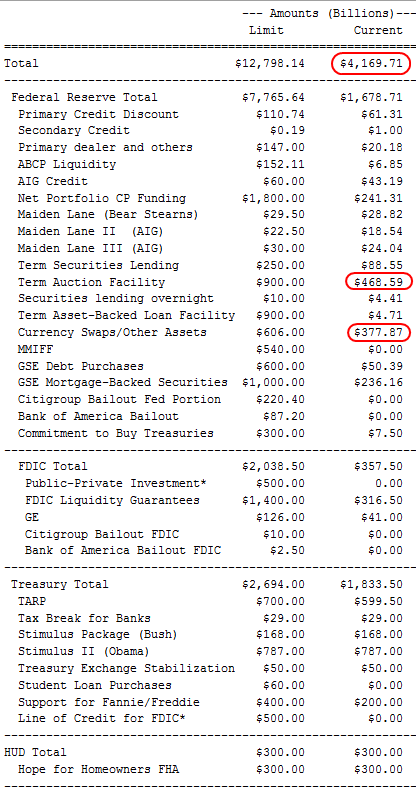
On Thursday with the S&P 500 inching closer to the 1,000 mark it is near impossible to silence the “recession is over” media hype.  Of course, this is the same media that missed the biggest economic collapse since the Great Depression but here they are predicting the end of the recession.  The problem of course is they do not define the end of the recession clearly.  In their mind’s eye, the end of the recession means Wall Street profits and largesse pouring into the banking coffers.  What about jobs?  What about $14 trillion in lost household net worth?  The U.S. Treasury and Federal Reserve are suddenly neo-Keynesians but only when it comes to saving themselves which is convenient.  If you think of the stimulus plan for example, it was passed in February and had a price tag of $789 billion.  This may seem gigantic but compared to the $13.5 trillion banking and Wall Street bail out it is relatively small.

Yet many people forget how that money was spent or will be spent:

stimulus

Now the above gives you a general sense of the plan.  Much of the money sent to states is already spent.  Not much stimulus occurred here because states used the funds to patch up brutal deficits like those being experienced in California.  Also, a large portion of the money was in tax cuts.  That amount is $282 billion.  Much of that money is already factored into the current economy.  Yet the stimulus bill was more like a band aid and less of a stimulus plan.  The overall idea of a stimulus bill is to create jobs but when you dig into the bill, there really wasn’t much money dedicated to this.  However, let us now look at the Wall Street and banking bail out:

bailout-list

*Source:  Bloomberg

In fact, if we look at only two line items here, the Term Auction Facility and the Currency Swaps program, these two dwarf the 2009 stimulus bill.  So why is the stock market rallying yet 26,000,000 people are unemployed or underemployed?  Because Wall Street has become a casino and most of the “bail out” funds have gone to the rigged banking system.  Keep in mind this is the same banking system that created collateralized debt obligations trying to convert toxic waste mortgages into “solid investments” and sold them off to so-called investors.  This is the same industry that hungered for subprime mortgage debt and allowed the real estate industry to give loans to anything and everything.  This is the same Wall Street that held the American public financially hostage last September and October.  This is the same industry that offered wicked incentives to the real estate industry for finding any loan even if it was fraudulent to put into their mortgage-backed security portfolios.

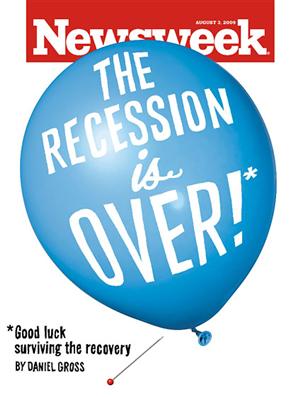
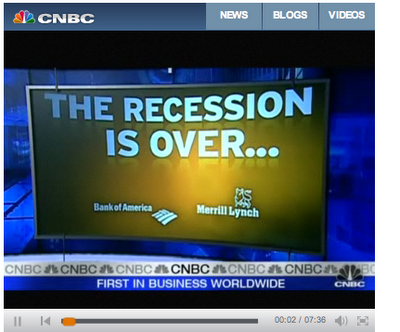
So on the one hand, we have a stimulus bill of $787 billion that people can feel and then you have $13.5 trillion committed to the banking and Wall Street bail out with already $4+ trillion used.  And you wonder why the stock market is up 46.5 percent in four months?  The stock market is no longer connected to main street.  Take a look at some mainstream media analysis of this:

newsweek-recession-over

the-recession-is-over

*Source: Futurnomics

What can be more telling than that CNBC screen capture stating the recession is over and then, right beneath it you see the Bank of America and Merrill Lynch logos?  The recession may be over for Wall Street and banks thanks to the $13.5 trillion committed but Main Street is still very much in a recession.

Keep in mind the U.S. Treasury and Federal Reserve have already committed this money and we still have the $3 trillion commercial real estate bubble that will burst and we have covert action like Plan C where they are preemptively getting ready to use taxpayer money to bail out more toxic financial waste.

Why is all this failing so miserably for the public?  We have the worst of Keynesian thought mixed in with the worst of free market thinking.  In a nut shell, Keynesians believe that in difficult economic times the government should step in to create an environment that will help economic conditions by stimulating work and demand.  In war, this works perfectly as it did after World War II and issued in 30 years of prosperity for the U.S.  Yet using too much of this during peacetime will create problems like the 1970s stagflation.  That is, politicians will use Keynesian mixed-market planning in times of political desperation like when Nixon stated, “I am now a Keynesian” and was re-elected for a second term in a very difficult economic climate.  An advisor to Nixon at the time Milton Friedman chastised his action but that is how politicians will operate in desperate times.

After that, the school of free market thought entered and de-regulation was put up on a mantle.  This led to economic recovery but also gave us the S&L crisis and was a precursor to our current financial de-regulated mess.  Unfortunately, it would seem that we are using the worst of both systems.  We are using Keynesian principals to bail out the so-called free market banks.  They are using both theories of Hayek and Keynes in completely unjustified ways.  We really have no idea how things will end but many Americans are feeling as if they are on path to financial serfdom.

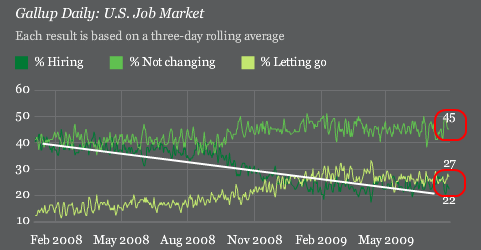
We have bankruptcies rising at colossal speed.  The 30 year housing bubble has burst with deep consequences.  We keep borrowing money every day from our foreign lenders.  Unemployment is still rising with the real unemployment rate closer to 17 percent.  Keep in mind that even though we are not flying off the edge, companies are not hiring.  That is the second part of the equation that is leading to modern serfdom.  Sure, companies may not be laying off current employees at the peak levels of this recession but they are not hiring either:

gallup-poll

*Source:  Gallup Poll


As usual, it pays to look at who is doing the hiring instead of clamoring around Wall Street and the mainstream media analysis like middle school girls.  As you can see from the above, those letting people go is still high.  We went from about 40 percent of those surveyed in February of 2008 saying they were hiring to the current 22 percent.  Those letting go was about 11 percent in February of 2008 and now it is near 27 percent.  But again, who needs a job when you have trillions funneling into Wall Street.  And what good is a tax cut when you are unemployed?

The road to financial serfdom is paved with bad intentions here.  The U.S. Treasury and Federal Reserve are operating under the premise of “what is good for Wall Street is good for America.”  It is not.  When are we going to investigate Wall Street with a strong arm?  And don’t you think it would make sense to investigate why things failed before committing $13.5 trillion to the cause?  Interesting how they already know how much money they need right?  That is why you shouldn’t be surprised when you get reamed with another trillion for commercial real estate, more trillions in bad toxic mortgage debt, and the government running to bail out Wall Street for bad bets.

You cannot be dogmatic in these cases but it is incredible what is happening.  Looks like the financial overlords on Wall Street want to make Americans into their financial serfs.  Who needs a job when you can watch CNBC all day and watch them drink champagne while they cheer big earnings for banks since trillions has been given to this industry?  Hard to lose money with a trillion safety net.


Don't Be Fooled
by Michael Panzner

I was originally going to write about something else, but after a loyal Financial Armageddon visitor alerted me to the following Financial Times commentary, "Insight: Learn to Love the Recovery," by Tim Bond, head of asset allocation at Barclays Capital, I changed my mind. Frankly, I couldn't believe this piece of propagandistic excretia was written by a senior financial industry executive who makes decisions about where to invest. Because some FT readers might be fooled into thinking Mr. Bond had something useful to say, I felt duty-bound to respond to his "insights" with a few brief comments of my own (interspersed with his italicized text):
Never has a bull market climbed a steeper wall of worry. In spite of a proliferation of positive economic indicators, the consensus remains gloomy. Bullish economists are than hens’ teeth.

The average forecast for third-quarter US gross domestic product growth is a weak 0.8 per cent, which would be by far the slowest first quarter of any recovery on record. Since 1945, the average annualised real US growth rate in the first two quarters of recovery is 7 per cent. History provides abundant evidence that the deeper the recession, the stronger the bounce. Even the recovery from the Great Depression conformed to this rule, real US GDP grew 10.8 per cent in 1934 and 8.9 per cent in 1935.


There are so many inconsistencies and logical fallacies in the above paragraph that it's hard to know where to begin. Among other things, Mr. Bond assumes that the consensus is correct in seeing a third-quarter uptick in GDP. That may or may not be the case, but given how wrong economists have been about every aspect of this downturn so far, I'd lean towards the latter. Even if they are right, what evidence does he have that a third-quarter rebound will be the turning point, rather than the equivalent of an economic dead-cat bounce? Moreover, his assumption that the postwar time frame is the relevant reference period when it comes to forecasting the kind of recovery we might eventually expect to see is laughably ignorant given the extraordinary upheavals of the past two years. Paradoxically, he also makes reference to the upturn that followed the Great Depression, conveniently ignoring the fact that the earlier downturn dragged on for more than twice as long as the current one has before things turned around.
Yet today’s consensus assumes this time things will be different. The persistence of such pessimism is striking given a strong Asian recovery is visible, with output, employment and demand all following V-shaped trajectories, and regional industrial production rapidly bouncing back above the previous peak. Yet this recovery is dismissed by western analysts, who appear unable or unwilling to believe the region is capable of endogenous growth. That 2009 will be the second year in a row in which the increase in Chinese domestic demand exceeds that of the US is a point roundly ignored.

Actually, anybody who's been paying attention knows that most mainstream forecasters still seem to believe that what we are going through right now is "more of the same" -- that is, the same kind of (admittedly severe) cyclical downturn we've seen in the decades since World War II, rather than a bursting-credit-bubble-induced secular unraveling. The fact that Mr. Bond fails to grasp that the alleged V-shaped rebound in China and its sphere of influence is anything other than a steroidally-inflamed mirage spawned by a government-ordered blast of reckless spending and an XXX-rated orgy of forced bank lending makes you wonder why he still has a job (oops, I forgot: competence is not a prerequisite when it comes to those who are paid to make "forecasts" for a living).
The fate of the Chinese economy is supposedly in thrall to the US consumer, in spite of clear and persistent evidence to the contrary. The US economy, which provides a home to 17 per cent of China’s exports, is still seen as the arbiter of growth in Asia. This obstinate adherence to an outdated assessment of economic dependence is not the only gaping intellectual flaw.

I suppose in one respect he's right: China is no longer as in thrall as it was to the US consumer; rather, the country now seems to be dependent on the whims of 1) panicky authorities, worried about the domestic social consequences of a global collapse in growth and trade; 2) corrupt and overextended lenders, who have apparently mistranslated the words "bad loan" and "malinvestment" into "any borrower will do"; and, 3) speculators, who've decided that all they need to do to get through these troubled times is to buy a lot of stocks, commodities, real estate, etc. -- using tons of borrowed money -- and they will invariably make a killing.
The 9.5 per cent US unemployment rate is also viewed as an obstacle to recovery. This objection ignores the many contrary examples of high unemployment rates and subsequent recoveries, not least in the US. Thus in 1982, US unemployment hit 10.8 per cent, yet GDP soared at an average annual pace of 7.7 per cent over the next six quarters.

Mr. Bond uses a baseless assumption -- the current unemployment rate is at or near its peak -- and a bogus comparison -- today's unemployment rate means conditions are similar to what they were back in 1982 -- to make a ridiculous argument. I wonder: Does this reflect the sort of analytical talent you need to manage other people's money?
Similarly, few commentators consider the possibility that the large post-Lehman rise in US unemployment was a mistake on the part of panicky managements. Yet this is precisely what trends in labour productivity growth, not to mention common sense, tell us occurred. In the first half of 2008, labour productivity growth averaged 3.3 per cent, while the unemployment rate rose to 5.6 per cent. At that point, there was no evidence US companies were overstaffed. Thereafter, output collapsed, yet business productivity growth remained positive, registering an average yearly pace of over 2 per cent, as companies shed labour at a faster pace than they reduced output. Businesses, like markets, panicked after Lehman went under. Employment and output were both reduced far more than it turned out to be necessary, as businesses temporarily and understandably assumed a worst case scenario.

Again, Mr. Bond makes a number of dubious assumptions and ridiculous assertions. Was it really "a mistake" that "panicky" managements slashed payrolls, or was it an entirely rational response to epic declines in global cross-border trade, orders, and revenues, a sudden seizing up of many traditional financing mechanisms, and a dramatic about-face in the spending habits of overleveraged consumers, among others? While Tim Bond and his fellow economic revisionists might have a different spin on things, my recollection is that much of corporate America -- not to mention Wall Street and Washington -- remained upbeat on the outlook for the economy up until the very moment the bottom fell out, sucked in by the reassurances of mainstream prognosticators who failed to see the meltdown coming until it was too late?
Just as global output is performing a V-shaped recovery, there is a big risk US employment will do the same, with monthly payrolls showing surprising growth by the end of 2009.

If Mr. Bond engaged in even a modicum of research that went beyond crunching massaged and mangled economic statistics and hobnobing with clueless policymakers and delusionists in the financial industry -- say, by reading a small town newspaper or talking to people on the streets about what is really going on, he would quickly realize just how out-of-touch and ignorant he sounds -- then again, maybe not -- when he makes statements like those in the paragraph above.
If unemployment is one half of the bearish consensus, de-leveraging is seen as the other main obstacle to recovery. Yet increases in private leverage never play a significant role in recoveries. Indeed, since 1950, US private sector borrowing ex-mortgages has declined an average 0.1 per cent of GDP in the first year of recovery, with non-financial business borrowing declining 0.6 per cent of GDP.

The fact that Mr. Bond is effectively discounting the role that leverage played in creating the mess we are in, and takes no real account of the fact that the financial industry is almost completely dependent on government largesse while many lending and market mechanisms are in disarray or have broken down, suggests to me that he is experiencing a degree of denial -- or, perhaps, incoherence -- that is breath-taking. The fact that total debt as a percentage of GDP is at record extremes and the overleveraged consumer, who represents about two-thirds of the U.S. economy, has neither the will nor the wherewithal to spend more or increase his borrowing appears not to mean much to Mr. Bond, who keeps insisting, bizarrely, that the postwar period is the correct frame of reference. Who in their right mind would argue that the events of the past two years bear even a passing resemblance to what has occurred over the past six decades?
A regression of the household savings rate on the wealth-to-income ratio tells us the former has made the appropriate adjustment to declines in the latter. In fact, the rally in the stock market, the low level of interest rates and the stabilisation in house prices all tend to limit the risk of a further sizeable increase in the savings rate. So over the rest of this year, the standard cyclical timing of a US economic turning point tells us pessimistic expectations are likely to collide with the economic reality of a strong recovery. The net result is almost inevitable, in the shape of an inexorable continuation of the equity rally.

In many respects, Mr. Bond's final paragraph is the pièce de résistance, a fitting climax to a stuporous journey through economic la-la land. In fact, some might say the collage of bogus relativistic comparisons, irrelevant details, distorted "facts," circular reasoning, and logical inconsistencies is like a WTF?-Wet Dream stoked with lashings of LSD. Is he really saying that a few months worth of a few seasonally-adjusted data points represents "stabilization in house prices"? Is he suggesting that current debt levels and the long-term trend of historical savings rates relative to disposable income are not all that important in assessing whether an "appropriate adjustment" has been made in the savings rate? Why does the "standard cyclic timing of a US economic turning point" matter when the events of the past two years have been neither standard nor cyclical? And since when is a "rally in the stock market" a driver for "an inexorable continuation of the equity rally"?

Great job, Mr. Bond. Can't wait to hear what you have to say next.


Causes of Depression Yet To Be Addressed
More disruptions for the US dollar and UK Pound, international financial system too weak, GDP numbers are phony, more devaluation and default, Globalization a disaster, Purging the system still a good idea, Abolish the Fed, Gold and Silver your only safe haven, What can the market possibly do under such stress?....

As we enter August we are getting closer and closer to real disruptions with the US dollar, as well as problems with the British pound, as both economies feel the sting of rising inflation within a progressive depression. The stimulus package has exhausted itself for this year so the economy in the US can at best stay neutral at a minus 4% of GDP. The causes of our depression have yet to be addressed as the Treasury and the Fed flood banking, Wall Street and insurance companies with funds to keep them afloat. The deterioration continues unabated as Wall Street and banking report higher earnings by laying off workers and by playing accounting games.

US debt is on it way to causing a retest of USDX to 71.18. The will cause higher interest rates. There will be a furious effort to re-liquefy the US economy causing ever more inflation. The entire international financial system is in no condition to meet such a challenge. The US Treasury is so busy trying to find buyers for Treasuries they have little time to solve anything, as unemployment at 20.5% throttles the nation. The economy is not going to recover by saving the anointed few in banking and Wall Street. Americans and Brits are no longer buying the ridiculous fairy tale of green shoots.

People are catching on that the economy and the markets are being temporarily rigged. By the end of October we believe banks in the US, UK and Europe will be in serious trouble again. That should really knock markets and the world economy to new lows. It could also corrupt any improvement in GDP anywhere. The problems of 2007 and 2008 will return, because the façade of the public bailout of banking and Wall Street will crumble again. Further impoverishment is on the way. More and more will be laid off and they’ll be no new jobs available. Savings will be exhausted and most homes that have been financed will be under water.

You must put in dehydrated and freeze dried foods, a water filter and plenty of guns, ammo and clips. All stocks and bonds should be sold, except gold and silver shares and Canadian and Swiss Treasuries. All cash value life insurance policies and annuities should be sold. We’ll deal with pensions later. All IRA’s, Roth’s and 401(k)’s that you control should be in gold and silver shares, funds and coins. The phony GDP numbers won’t fool actuality. You cannot have a recovery without an expanding jobs market and we are going the opposite way.

Devaluation and default are in the air and it is only a matter of time before it happens. Be out of dollar and pound denominated investment except gold and silver mining shares and gold and silver coins. Convert as fast as possible. Following the collapse of both the US and UK economies, New York’s, Wall Street and the “City of London” will cease to be the centers of world financial powers. Then will come the real investigations and trials of those who stole from the people and committed treason. And, all the kings’ horses and all the king’s men couldn’t put the Illuminati together again.

Globalization has been a disaster for the US, Europe and the UK and Canada. It may have brought relative prosperity to the third world and transnational conglomerates, but overall it has simply been a method of redistribution of wealth. This deliberate policy by internationalists will eventually push us back into tariffs, a device that helped keep competition fair, not free. We found out in the late 1700s what damage British Colonialism, known as British mercantilism, visited upon our young economy.

The one-worlders who brought us free trade, globalization, offshoring and outsourcing brought us the collapse of our financial system. Due to their control of the Fed and the Treasury Department, Goldman Sachs and JP Morgan Chase brought about the demise of Bear Stearns and Lehman Bros., and caused Merrill Lynch to be bought out. It is handy when you have the power to destroy more than half of your competition. Not that they were not broke, they were, but so were GS and JPM. All these firms and banks and many others used 30 to 50 times leverage, which has and is insanity.

Making excuses for these players doesn’t wash. All they are doing is borrowing money at zero interest rates from the taxpayer, and these are the people who caused this disaster. Contrary to what the banks say, it will take a lot longer to work out from under their debts. They are just starting to get hit with credit card debt, commercial real estate debt and face three more years of foreclosures in residential real estate. We might add that former Treasury Secretary Paulson, on loan from Goldman Sachs, made sure that banks and Wall Street were rescued along with a cluster of insurance companies. Very little was done to assist some of the deserving public.

Those who were saved were the ones who approved subprime, no-doc and option ARM pick-and-pay loans, along with the rating services, which committed fraud jointly in the sale of collateralized debt obligations. In addition, Paulson, who threatened Congress with insurrection in the streets if his demands were not met, raised $700 billion from Congress. This is the same Paulson who strong-armed the FASB to change the accounting rules from mark-to-market from mark-to model to allow financial institutions to falsify their books. We might also add that while he led Goldman he allowed 50 to 1 leverage and he was a major player in securitizing loans.

Banking leverage over the past ten years has risen form 19% to 50% versus tangible equity and is currently about 45%. In England it is 55%. UK bank assets are 5 times GDP, whereas they are 2 to 1 in the US. It is not cavalier to demand a purging of the system. No matter what is done by the Fed and the Treasury the music must be faced with a deflationary depression. Yes, unemployment would go to 40%, but it is going to go there anyway. Little effort is being made to deleverage the banking system and that is one of the major problems. Remember, those banks and those on Wall Street and in insurance that were rescued by the taxpayer were all elitist firms.

U6 unemployment minus the birth/death ratio is 20.5%. Job losses are now equal to or greater than at any time since WWII. All job growth since 2002 has been totally wiped out. The average workweek is 33 hours as more and more companies request employees to take unpaid leave. That government says amounts to more than 9 million people, or 5.8% of the workforce. Those figures are greatly understated as factories work at 65% of capacity utilization. The average length of official unemployment is 24.5 weeks, the longest since stats began in 1948.

Unemployment is spreading at an unprecedented rate: 92% of this year’s stimulus was spent to pay down debt, as savings jumped to 6.9%. That spells sufficiently scared. That should shortly send consumption to less than 70% of GDP. The corporate bottom line is being fattened by layoffs. These problems are going to get considerably worse before they get better. Homeland Security is going to change their program that allowed local police to enforce federal immigration laws. The law is very effective – catching some 60,000 illegal aliens annually, most of who are deported. Now we cannot have an effective law like that can we? Thus, it is being done away with. It increased deportation by some 24%.

There is no question that special inspector general Neil Barofsky’s quarterly report to Congress made intelligent heads spin. Our projection of the government’s financial exposure at $14.8 trillion was woefully short of Mr. Barofsky’s $23.7 trillion estimate. Incidentally, all of Mr. Barofsky’s figures are official releases of data. If we had the time we’d come close to the same numbers. Regarding our estimate, we saw only two similar estimates, one at $12.8 trillion and the other at $14.5 trillion.

It should also be kept in mind that all government figures are bogus, thus, Mr. Barofsky’s real figure could be $30 trillion. He said that the federal government has devoted $4.7 trillion just to save the financial sector. We ask, what is the real figure? Perhaps $8 or $10 trillion? We’ll never really know, will we? That is because the Fed, a private corporation, says it is a state secret and won’t release any information. That is why we desperately need HR 1207 passed. The Fed has to be abolished; otherwise it will totally destroy the world financial system. If you are curious Mr. Barofsky’s estimate puts every American $88,000 deeper into debt, essentially to rescue the shareholders of the Fed.

One of the things that deeply disturbs Congress and we suppose is one of the reasons Ron Paul’s HR 1207 has 276 sponsors, is that the Fed absolutely refuses in detail to discuss the quantity and quality of assets backing all of their programs. This means, at this time, losses to taxpayers could be upwards of $50 trillion. Worse yet, the Comptroller’s Office doesn’t – can’t account for $12 trillion in an audit of the Fed. They won’t even tell us who the TARP recipients are and how they used the funds. In the final analysis neither the Treasury nor the Fed have any credibility left. They either lie or stonewall on every issue. These are the people who are running the financial sector of our economy.

On Thursday, the S&P 500 broke out of a large head and shoulders reversal pattern, which dates back to last summer. The question is will the breakout persist or reverse. Industrial production and unemployment are at the lowest levels since the Great Depression. Commercial paper and bank credit have been collapsing for two years and bank non-performing assets continue to rise.

For the past year treasuries owned by foreigners has stayed steady at $1.7 trillion. T-bill holdings have increased from $226 billion to $586 billion. Custodial holdings of foreign central banks at the Fed of GSE, Agency and mortgage debt has fallen from $968 billion to $807 billion. T-notes have increased from $226 billion to $586 billion. T-notes and bond holdings rose from $412 billion to $618 billion and GSE mortgage debt has increased an eye popping $639 billion from zero. This is where the Fed is training for its demise. Could it be that foreign central banks are finally preparing for dollar devaluation and all that money the Fed and Treasury has been printing for banking and Wall Street?

The Reuters/University of Michigan Surveys of Consumers says July sentiment fell to 66.0 from 70.8 in early June. Expectations fell to 63.2 from 69.2 in June. The current conditions index fell to 70.5 from 73.2 in June. Our Illuminists, Treasury Secretary Geithner, says the Treasury is not in a position to give an estimate of taxpayer losses due to bailouts. Not only is the housing market not stabilizing, but it is getting worse. The housing crisis as bad as it is shows that rental vacancies are surging and rents are declining. The bottom is a long way off at the end of 2012. Housing prices will fall 20% to 30% more.

Capital One’s shares jumped as a result of better than expected earnings. This was accomplished by not declaring costs of paying back TARP funds and by not increasing provisions for loan losses. The income was created out of thin air, a fantasy. Their earnings were really flat, or less than declared. This bank, like many other banks, has serious problems and is to be a voided like all bank shares should be avoided. This is an example of the lies and chicanery being employed to deceive by almost all large banks, probably on orders from the Fed.

This week the Treasury will borrow $203 billion. If they do that each month that would aggregate $2.4 trillion. If this happens weekly that is $10.5 trillion a year.

World economies, particularly those of G-7 countries, excepting Canada and Germany, are so buried in debt that they cannot respond positively to further economic stimulus. The current debt driven crisis within the G-7 means the euro won’t survive if Ireland, Spain, Italy and Portugal default. The mainstream economists are finally realizing that the system has to be purged, something we believe the ECB-eurozone is already attempting. The growth of their M4 will determine which direction they will go in.

Next the mainstream will finally discover the manipulation of all markets by the Fed and the outrageous suppression of gold and silver prices. That is why gold and silver are so important. They are your only safe haven.

Last week markets were pushed upward by phony earnings reports, particularly by financial institutions. The Dow gained 4%; S&P 4.1%; the Russell 2000 rose 5.6% and Nasdaq rose 4.7% as the 2-year credit crisis wears on and the economy feebly chugs along. Cyclicals rose 10.1%; transports 6.7%; consumers 3.3%; utilities 5.5%; banks 0.6%; broker/dealers 6.7%; high tech 4.5%; semis 3.6%; Internets 5% and biotech 26.9%. Gold bullion gained $14.40 and the HUI gold index rose 3.8%.

Two-year T-bills rose 1 bps to 0.96%; the 10-year notes rose 1 bps to 3.66% and the 10-year German bund rose 8 bps to 3.48%. Freddie Mac’s 30-year fixed rate mortgage rates rose 7 bps to 5.20%; the 15’s gained 5 bps to 4.68% and the one-year ARMs rose 1 bps to 4.77%.

Fed credit fell 41.1 billion. Year-on-year it is up 128%. Fed foreign holdings of Treasury, Agency debt rose $4.8 billion to a record $2,787 trillion. Custody holdings for other central banks under a new secret formula has risen 19.3% ytd and is up 18.4% yoy. M2, narrow money supply, fell $15 billion, up 8.5% yoy. Total money market fund assets increased $8.9 billion to $3.656 trillion. Assets are up 8.2% annualized. Total commercial paper fell $3.4 billion having fallen 63% annualized. Asset backed CP fell 44.5 billion yoy, a fall of $313 billion. The dollar declined 0.7% to 78.77 this past week.

Most professionals and investors are surprised to see the Dow over 9,000 again. Stocks have again become totally divorced from reality and economic fundamentals that when the next drop comes, which it will, most will be caught flatfooted. There is a total disconnect between the equities market and the credit market. Of course, the summer’s thin volume has masked the upside moves.

The Treasury has borrowed last week and will this week some $235 billion, a colossal sum. The Rasmussen survey tells us 25% of those polled say the stimulus helped the economy; 31% said it has hurt the economy. The week before last the Fed pumped $80.2 billion into the bond market and other markets as well. Last week they removed $33 billion. The more important earnings releases are already history, so we ask what can the market do for an encore?


S&P Says It Can’t Be Sued Over Lehman Bond Ratings
Standard & Poor’s, Moody’s Investors Service and Fitch Ratings sought dismissal of a lawsuit by two California investors, claiming they weren’t responsible for the plaintiffs’ investment decisions. The investors spent $40,000 on highly rated Lehman Brothers Holdings Inc. bonds that turned out to be worthless. The ratings services issue their opinions at the request of bond issuers and to provide information to the public, said Floyd Abrams, an attorney speaking for the ratings services, at a hearing today in federal court in Sacramento, California. “Ratings go out to the world,” Abrams told U.S. Magistrate Judge Dale A. Drozd. “A rating is issued, and investors take what they need.”

S&P, Fitch and Moody’s face investor lawsuits and criticism by lawmakers for grading mortgage bonds too high and maintaining the ratings months after home-loan defaults surged in 2007. The California Public Employees’ Retirement System, or Calpers, the largest U.S. public pension fund, sued July 9 in a case in state court in San Francisco over $1 billion in losses it blamed on “wildly inaccurate” risk assessments. Ronald Grassi, a retired California attorney, and Sally Grassi, a retired teacher, sued the New York-based companies in federal court in January for negligence, claiming they gave high ratings to the Lehman bonds to curry favor with the investment bank, which filed the biggest bankruptcy in U.S. history in September.

The Grassis said in court filings that they had sought safe investments and bought the bonds because they held A ratings from the companies. Ronald Grassi, speaking in court today, said investors are a “limited group” to whom the ratings services owe a legal duty. “This is issuing false opinions for profit,” Grassi said. Credit ratings are statements of opinion protected by the Constitution’s First Amendment, the companies said in court filings. They noted the dismissal of claims brought by Enron Corp. investors who alleged that the companies published false and misleading credit information about the now-defunct energy trader.

The ratings companies said they can’t be sued for negligence because they had no direct dealings with investors and made no attempt to induce them to purchase the securities. The Grassis haven’t shown that the companies knew their assessments were faulty or acted with malice, lawyers said in court papers. “Generalized accusations of wrongdoing, no matter how harsh, cannot support a claim in this case,” lawyers for S&P argued in court papers. “Plaintiffs must allege who at S&P made negligent and/or fraudulent misstatements.” Drozd told Grassi that “the only thing that really matters” is whether he could show that the ratings services had a legal obligation to investors.

“Your brief is interesting and well-done but light in legal authority,” Drozd told Grassi. At the end of the hearing, Drozd said he will make a recommendation to a another judge who will issue a ruling on the request by the ratings services to dismiss the case. “I’m going to take the motion under consideration, but it’s not going to be quick,” Drozd told the lawyers. Calpers, in its state court complaint, said S&P, Moody’s and Fitch used methods to analyze medium-term notes and commercial paper that were “seriously flawed in conception and incompetently applied.”


Default Increase Curbs Bankruptcy Lending as Recoveries Dwindle
Companies on the verge of bankruptcy are finding it harder and more expensive than ever to get loans to help nurse them back to health. With corporate defaults at a six-year high, so-called debtor-in-possession financings dropped to about 23 percent of businesses failing to make debt payments so far this year, the lowest since at least 2003, according to a strategist at Bank of America Merrill Lynch. Lenders are charging those entering Chapter 11 reorganization a record 7.25 percentage points over benchmark interest rates, on average, even with borrowing costs for issuers of junk-rated bonds the cheapest since September.

DIP loans provide funds to continue operating normally while in Chapter 11. Less available financing will give fewer companies this option and drive more into liquidation, said Darin Schmalz, a director on the Fitch Ratings leveraged finance team in Chicago. “The playbook is changing,” said Steven Smith, global head of leveraged finance and restructuring at UBS AG in New York. “Very little new capital is flowing into restructuring and Chapter 11 reorganization right now, which is potentially a huge problem. It’s very hard to reorganize companies without new capital.”

The number of businesses filing for liquidation under Chapter 7 of the bankruptcy code rose 60 percent to 30,035 last year, the most since at least 2000, according to the U.S. Courts Web site. Retailers Linens ‘n Things Inc. and Mervyns LLC said last year that they would liquidate rather than reorganize. Richmond, Virginia-based Circuit City Stores Inc. announced it would go out of business in January after seeking court protection in 2008. The worst credit squeeze since the Great Depression has helped increase U.S. companies’ default rate on bonds to 13.2 percent for the last 12 months, the highest since it reached 16.4 percent in 2002, according to Fitch.

In the leveraged loan market, the trailing 12-month U.S. default rate rose to 8.2 percent at the end of the second quarter, from 2.1 percent a year earlier, according to New York- based Moody’s Investors Service. DIP financing helps companies to move through Chapter 11 more successfully, according to a 2000 study written by Sandeep Dahiya of Georgetown University; Kose John of New York University’s Stern School of Business; Manju Puri, now at Duke University’s Fuqua School of Business in Durham, North Carolina; and Gabriel Ramirez, now with Kennesaw State University’s Coles College of Business in Georgia. Those receiving loans are likely to exit reorganization more quickly, they found.

Creditors of Delphi Corp., the former General Motors Corp. car-parts unit that filed for Chapter 11 in 2005, won an auction for some of the company’s assets by bidding the value of the DIP loans they were owed. On July 30, a court approved the sale of the Troy, Michigan-based company’s assets to the lenders and the automaker. Elliott Management Corp. of New York and Greenwich, Connecticut-based Silver Point Capital LP were among investors making the so-called credit bid. Delphi owed about $3.3 billion on the three classes of its bankruptcy loan as of July 21, according to a regulatory filing. The two firms will lead a $750 million financing that will be offered through syndication to other lenders, said John Butler Jr., Delphi’s lead bankruptcy lawyer.

The DIP market may also be tested by New York-based CIT Group Inc., which received a $3 billion loan this month to stave off insolvency. The 101-year-old commercial-finance firm has $1 billion in notes maturing in August. CreditSights Inc., a New York-based debt researcher, said July 28 that the company “remains at risk” for filing bankruptcy even if a tender for the debt succeeds. The offer is “intended to provide CIT with liquidity necessary to ensure that its important base of small and middle market customers continues to have access to credit,” the company said in a July 20 statement.

CIT asked owners of the notes to agree to take a loss through a debt tender. If the offer is accepted, the company may start debt-for-equity exchanges, according to a person familiar with the matter. Providers of emergency credit to the company include Boston-based hedge fund Baupost Group LLC and Pacific Investment Management Co., which oversees $842 billion in Newport Beach, California. The money managers’ decision to lend to CIT at an annual interest rate of at least 13 percent may help protect their investment in its bonds. Businesses such as Eaton Vance Corp. are competing with traditional DIP lenders, including New York- based JPMorgan Chase & Co. and Bank of America Corp. of Charlotte, North Carolina, after financial companies worldwide ran up more than $1.5 trillion in writedowns and credit losses since the start of 2007.

Boston-based Eaton Vance, the largest manager of investments designed to minimize taxes, is raising $1 billion to invest in DIP loans, the firm said in May. Aladdin Capital Holdings LLC of Stamford, Connecticut, a hedge fund overseeing $15 billion, said in February that it began offering bankruptcy credit to take advantage of “massive dislocation” in the market. “You’re seeing disparate groups of hedge funds putting up competing proposals,” said UBS’s Smith. “You’re seeing more interest and a little bit more competition, which is having the impact of improving terms to the debtor.”

Increased competition isn’t pushing bankruptcy-financing costs down to pre-credit crunch levels, even after yields on speculative-grade bonds relative to benchmarks fell to below “distressed” levels, or 10 percentage points, on July 23. The decline marked the narrowest spread since Sept. 25, when the collapse of Lehman Brothers Holdings Inc. led credit markets to freeze, according to Merrill Lynch & Co.’s U.S. High- Yield Master II Index. The gap was 9.33 percentage points as of yesterday. The difference between the average cost of DIP loans and benchmark interest rates so far this year compares with 5.3 percentage points in 2008, according to the Bank of America Merrill Lynch report. It never exceeded 4 percentage points before last year.

While DIP financings have reached a record $16.2 billion this year, many are so-called roll-ups of borrowings that existed before the bankruptcy filings, according to the Bank of America Merrill Lynch report by strategist Jeffrey Rosenberg. Roll-ups now account for 64 percent of total bankruptcy loans, up from 36 percent in 2008, Rosenberg wrote. Before last year, the proportion of rolled-up loans never exceeded 10 percent. Lenders seek the feature to improve their standing relative to creditors who don’t participate in a debtor-in-possession transaction, Smith said. Doing so gives them a higher priority for getting repaid, creating a new set of “winners and losers.”

Lyondell Chemical Co., which filed for Chapter 11 on Jan. 6, received a record $8 billion in loans at an interest rate of 10 percentage points over the benchmark after the DIP market had “ceased to operate,” a lawyer representing the Houston-based company, Mark Ellenberg of Cadwalader, Wickersham & Taft LLP, said during a Jan. 7 bankruptcy hearing in New York, according to a transcript. Roll-ups, including commitments from borrowers, made up about 40 percent of the bankruptcy credit, according to Mark Cohen, head of restructuring at Deutsche Bank AG in New York. Last week, Lyondell’s DIP roll-up was trading at 83.5 cents on the dollar. The portion of the DIP that wasn’t rolled up was trading at 42 cents on the dollar.

DIP financing may recover as credit markets begin to heal, Cohen said. Eddie Bauer Inc., a unit of the Bellevue, Washington-based retailer that filed for Chapter 11 last month, received a $100 million loan costing 4 percentage points more than the London interbank offered rate, the common benchmark for such credits, according to Bloomberg data. Banc of America Securities LLC was the lead arranger of the deal. “Market pricing is coming down; new investors are coming in,” Cohen said.

Still, shrinking bankruptcy financing and rising defaults pushed 12-month recovery rates, or the amount of face value an investor can expect to receive from a loan after default, to 43.9 percent in June, down from 65 percent a year earlier, according to Moody’s. The level is lower than any annual average since the ratings company began compiling the data in 1990. “Recovery values tend to drop as bank lending standards tighten,” said John Lonski, chief economist at Moody’s in New York. “If you’re a creditor and you see the value of collateral falling, you are going to tighten credit.”


Canada's GDP shrinks in May
Canada's economy contracted at a faster pace than expected in May, according to figures released Friday. Statistics Canada said Canadian gross domestic product fell by 0.5 per cent in the fifth month of 2009 as the country's manufacturers and oil pumpers led the reverse economic charge. Analysts were thinking the national economy would slip for the month, but only by 0.3 per cent. "Over the last four months, the goods-producing industries have contributed the most to the decrease in real GDP, while the output of the service sector has remained essentially unchanged," said Statistics Canada in a press release.

By comparison, April saw Canada's economy contract by 0.2 per cent on a revised basis. Overall, Canadian GDP will tumble for the current year, according to the Conference Board of Canada. The Ottawa-based business think tank predicts that the country's economy will shrink by 2.7 per cent, after subtracting inflation, in 2009. But, the Conference Board said in its most recent forecast, that Canada will see an economic expansion of 2.8 per cent in 2010.

Canada's goods-producing sector continued a long-term losing streak in May as manufacturing activity fell by 1.6 per cent in May compared to April. Since May 2008, however, manufacturing GDP has contracted by a hefty 15.8 per cent. The automobile segment, hard hit by the recession, has decimated Canadian manufacturers. Statistics Canada noted that approximately half of the manufacturing decline in May was attributable to fewer cars and trucks getting built and sold in this country.

"About half of the decrease was due to a 21 per cent drop in motor vehicle manufacturing, following three months of recovery, and an 8.2 per cent decline in parts production. The temporary closure of two assembly plants, combined with the discontinuation of the production of a model line in Canada, contributed to this decline," the agency said. As North American car makers start up idle plants, the contraction in the automobile segment could moderate, experts have said previously.

Petroleum producers also did less work in May, according to Statistics Canada. Output in the sector dropped by 2.3 per cent, the fourth consecutive month in which activity among energy firms slipped in Canada. Comparing year-to-year, that portion of Canada's GDP attributable to oil and gas production was eight per cent smaller in May 2009 versus May 2008, Statistics Canada said. In fact, of all the segments followed by Statistics Canada, only non-durable manufacturing (0.2 per cent), health care (0.2 per cent), real estate and finance (0.4 per cent), retail (0.6 per cent) and government administration (0.1 per cent) posted gains in May.


Japan jobless rate up amid record deflation
Unemployment in Japan surged to a six-year high as the country set a new record for core consumer price deflation in June, data released on Friday showed. The 1.7 per cent year-on-year fall in consumer prices, excluding fresh food, and the 5.4 per cent jobless rate highlight the continuing troubles of the world’s second-largest economy, despite a sharp rebound in industrial output over the past four months.

While the falling energy prices that have been the main driver behind the decline are no bad thing for resource-poor Japan, analysts increasingly worry that deepening deflation – fuelled by job insecurity and massive manufacturing over-capacity – could undermine economic recovery. The fall in “core-core” consumer prices, excluding food and energy, accelerated to 0.7 per cent in June. More recent July price data for urban areas of Tokyo showed a fall of 1.1 per cent. Although there has been record growth in industrial production over the past quarter – including a 2.4 per cent month-on-month rise in June – output is still down by more than one-fifth since last year, leaving large excess capacity which will put pressure on prices.

Meanwhile, South Korea reported a 5.7 per cent month-on-month rise in industrial production, more than double the pace economists had expected, and Thailand reported a 3 per cent rise. In Japan consumer sentiment is likely to remain vulnerable to the continued rise in unemployment, already at a level last seen in June 2003, and expected to pass the 5.5 per cent record rate set then. Labour industry data released on Friday showed that work availability was already at a record low, with only 43 jobs on offer for every 100 applicants.

With the Bank of Japan’s policy interest rate already at 0.1 per cent, the central bank has little room to manoeuvre. The Organisation for Economic Co-operation and Development has called for the Bank of Japan to “fight deflation through a strong commitment to implement effective quantitative measures”.

However, the BoJ remains relatively relaxed. In a speech last week, Hirohide Yamaguchi, central bank deputy governor, said “large short-term” price changes could not be avoided after a shock such as that suffered by Japan, but that the BoJ expected deflation to moderate in the six months to March 2010 as the economy recovered. “The bank therefore thinks it unlikely at present that prices will continue to decline and thereby lead Japan’s economy into a deflationary spiral,” Mr Yamaguchi said.


Unemployment Rises and Prices Fall in Europe
Unemployment in the 16 countries using the euro rose to a 10-year high of 9.4 percent in June, according to data released Friday. The increase was less than expected, however, following measures by some governments to combat the economic crisis. The European Union’s statistics office also said on Friday that inflation in the euro area had moved much further into negative territory than forecast in July, with consumer prices falling at an annualized rate of 0.6 percent.

The drop raised worries about deflation and heightened expectations that the European Central Bank will maintain its loose monetary policy. The jobless rate for the euro region rose from the revised figure for May of 9.3 percent, as 158,000 people lost their jobs in the month, Eurostat said. With the preliminary reading of May unemployment at 9.5 percent, economists had expected June’s figure to be 9.7 percent, but the number was still the highest since June 1999.

The smaller-than-expected unemployment rate probably resulted from various state programs to preserve jobs through such means as subsidizing part-time shifts or training programs, analysts said. “Unemployment would have been much higher still if not for the short-time working schemes and related measures adopted in euro zone countries,” said Martin Van Vliet, an economist at ING. But, he added, “With the economy still in recession and any recovery likely to be sluggish, unemployment, unfortunately, looks set to continue to rise this year and next.”

Many analysts also said July’s deeper-than-expected fall in consumer prices increased the risk of deflation. Analysts had expected July inflation to be minus 0.4 percent because energy and food were more expensive a year ago and the crisis has eroded firms’ pricing power. July was only the second month of negative inflation since the creation of the currency area in 1999, after prices fell 0.1 percent in June. “We feel that the European Central Bank is underplaying the risk of deflation,” said Ken Wattret, an economist at BNP Paribas.

High joblessness and falling prices mean the E.C.B. could keep its lax monetary policy, with its main rate at 1 percent, and unconventional monetary measures in place. The E.C.B. has said consumer prices are likely to fall for a few months in mid-year, but that price growth will resume later. This view was echoed by the International Monetary Fund’s report on the euro zone, published on Thursday. The lower-than-expected unemployment, combined with a significant fall in prices, could mean more purchasing power for consumers. “Falling prices will provide a welcome boost to real incomes,” said Jennifer Mckeown, economist at Capital Economics.

But the depth of recession was underlined by Eurostat’s calculation that 3.17 million people in the euro zone had lost their job since June 2008, when unemployment was at 7.5 percent. The economy shrank 2.5 percent in the first three months of 2009 from the previous quarter, with a smaller contraction expected later in the year and a modest revival in 2010. Eurostat said since June 2008, the smallest increases in unemployment were registered in Germany, from 7.3 percent to 7.7 percent, and the Netherlands, from 2.7 percent to 3.3 percent.

In Spain, hit by the collapse of the construction sector, the jobless rate soared over the period from 11 percent to 18.1 percent — the highest in the euro zone. In the wider, 27-nation European Union, the unemployment rate was 8.9 percent in June, up from 8.8 percent in May and 6.9 percent a year earlier. Since June 2008, more than 5 million people have lost their job in the E.U., highlighting the severe crisis in non-euro countries such as the Baltic republics and Hungary.


Recession Robs Spain's Youth of Jobs and Hope
The ongoing economic crisis has pummelled Spain. Small businesses feel abandoned by the government, layoffs are swelling the ranks of the desperate, and a whole generation of recent college graduates is facing a future without prospects. It was early July when it finally happened and nothing came out of the ATM. With a sinking feeling, Iñigo Ortega went into his usual bank to print out his statements. The bank's maintenance fee had been debited from his account, and there was nothing left -- his savings were gone. It had taken only three months to go completely broke.

As recently as March, Ortega, 36, was employed as the head of a small but upscale architectural firm on La Castellana, Madrid's grand boulevard, making €3,000 ($4,280) a month. But the firm specialized in luxury restorations and renovating hotels in historic buildings, and it had been getting fewer and fewer lucrative contracts. It wasn't really a surprise, seeing that the worsening economic crisis was keeping millions of foreign tourists away. The most creative designer on the firm's six-person team was the last one to be let go. And it was Ortega's bad luck that he had been working for the last four years as a freelancer without a set contract that would have entitled him to claim unemployment benefits.

"My job's gone, my money's gone and so is my hope," Ortega says bitterly as he leafs nervously through his documents. He has sued the owner of the architectural firm for the social security contributions he never paid, overtime hours, holiday pay and a settlement. He doesn't want to accept the fate of being "in my late thirties and dependent on my parents again, like a kid still in school." Ortega got the job after eight years of university followed by internships with some of the best firms in the business. But now it was all for nothing. At first he was needed. Ortega created a hip Web site for his boss and taught him computer drafting. But now the boss doesn't need him. He doesn't know what the future holds and is trying to figure out how he can "scrape through from day to day."

Generación Ni-Ni

Tens of thousands in Spain are currently in the same dire straits as Ortega. As the country faces the worst recession since the Spanish Civil War ended 70 years ago, first-time jobseekers are being hit especially hard. No other country in Europe has as many young people out of work: almost 37 percent of people under 25 and a quarter of those under 30. Sociologists have already created a name for this group -- "generación ni-ni," the neither-nor generation. The term meant to describe young people who are neither studying nor working and don't have something in their lives that they can get excited about. It's a true zero generation -- zero jobs, zero prospects. A recent survey of Spaniards between the ages of 18 and 34 showed that 54 percent of those polled view themselves as neither-nors.

Take Eva Reina López, for example. She's 20; her father's an electrician and a widower. Reina did everything right. After getting her secondary school degree, she no longer wanted to be a burden on her father, who had raised her alone since she was six. So, instead of enrolling at one of Madrid's universities -- which had been her father's dream for her -- Reina followed her boyfriend to a small city in León Province nestled in the mountains of northwestern Spain. And there -- in her mother's hometown and where Spain's socialist Prime Minister José Luis Rodríguez Zapatero began his political career -- Reina learned how to weld. After six months of training at a company called Coiper, which manufactures towers for wind turbines, she secured an employment contract for six more months. The government in Madrid is promoting wind power as Spain's great industry of the future.

In January, it was all over. Coiper can no longer find buyers for its products. The government froze subsidies for sustainable-energy ventures after the economic crisis hit, which has caused wind-farm construction to stagnate. As a new employee, Reina wasn't entitled to claim unemployment benefits, and she only received welfare payments of €400 a month through June. Her boyfriend and other permanent employees have had their working hours reduced. Now they sweep the empty production rooms, waiting for the news that the company is shutting down for good. "There aren't a lot of choices here in Ponferrada," Reina says. "What will we do if everything here closes?"

"We've hardly even started our careers, and we're already disillusioned," says Noa Beade, 24. Like others her age, Beade gets upset whenever she gives some serious thought to her career prospects. A year ago, Beade received a journalism degree from San Pablo CEU, a respected private university. She has also completed four internships, speaks English fluently and spent six months in Paris learning French on Europe's ERASMUS student exchange program. But even with all these qualifications, she didn't land any of the several dozen jobs -- or unpaid internships -- she applied for directly out of college. A drop in advertising revenues has crippled the Spanish media. Instead of hiring, they're laying people off.

Beade's father, who lives in Galicia and also works in the wind energy industry, paid €4,057 to allow her to take a special course in financial journalism at Madrid's public Complutense University. He wanted his daughter to make it further in life than he and his wife, who works as a dietician in Vigo. The certificate helped Beade land another internship, this time working for a business news service for three months. She's not sure if she'll be paid while there.

The Building Bubble Bursts

It's a vicious circle. In the 10 years before the global credit and economic crisis hit, more jobs were created in Spain than in the rest of Europe put together. But after 14 years of uninterrupted growth, the crisis hit Spain harder than other countries.

Spain's boom was marked by an intoxicating degree of consumption resulting from demand pent-up during the almost four decades of the Franco dictatorship. But it primarily came in the construction industry. Around 800,000 new apartments were built every year, more than in all of Germany, France and Italy combined. Blue-collar workers were able to buy homes on credit, and middle-class families piled up debt in order to be able to pass an apartment on to every child. Even outside of the upper class, a second or even third home on the sea or in the mountains wasn't unheard of. And it was all on credit. People chased after quick profits by buying and reselling apartments, which could bring in double their initial price once they were ready for use. The value of property shot up twenty-fold as soon as a town zoned it for construction.
.
But last year, after the summer holidays, the real estate market's gigantic bubble burst. The same banks that had recently been handing out mortgages with abandon were now only reluctantly granting credit for building projects, and interest rates were skyrocketing. There are now a million vacant apartments. Likewise, people who piled up debt now have to pay off the absurdly inflated original price of their properties rather than the substantially lower current value. Many of them can no longer afford their loan payments. Of course, they would love to sell off their properties, but no one is buying.

Everything in Spain seems to be somehow connected to the construction industry. Even the soccer teams have real-estate speculators to thank for their world-class players. The real-estate market once generated an outsize proportion of Spain's GDP. But now that the building sector has collapsed, Spain's economic miracle is viewed as more of a curse.

Construction, the supply industry and tourism were primarily responsible for creating 7 million jobs. Most of these required very little specialized training, and at least 5 million immigrants were brought into the country to do the hard work. When the recession hit, foreigners were the first to be laid off. Next to go were the temporary workers, who could be let off with only a small compensation package. Out of a total of 19 million employees, 7 million have these "dirty jobs," and 12 million are "mileuristas," meaning that they work for under €1,000 a month. Over the last 12 months, almost 2 million people have lost their jobs. Unemployment has shot up from less than 8 percent in 2007 to today's 18.7 percent. The ranks of the unemployed have swelled to almost 4 million. That's more than there are in Germany, which has twice as many inhabitants as Spain.

Belt-Tightening

At the beginning of the year, Ortega had just moved into a bright new apartment with a view of Retiro Park, Madrid's green lung near the Prado Museum. The architect shares the apartment with his sister. It's a blessing for him that she still has a job as an optician and can cover his share of the rent. In the mornings, when he jogs through the park and the nearby upscale neighborhood of Salamanca, Ortega notices more and more "For Sale or Rent" signs on the grand old buildings.

Many clothing and furniture stores in the once splendidly decorated shopping streets are also empty. Their windows are now plastered with posters bearing pictures of the prime minister and reading: "Thanks to Zapatero and his vision for the future." They've been placed there by political groups, such as the far-right Frente Nacional (National Front) party, that wouldn't have any following if it weren't for the recession.

Status-conscious people in Madrid used to like to show off in fancy cars. But now, even with the government's €2,000 subsidy for people buying new cars, sales have nosedived. Sales of BMW's, which are especially popular in Spain, dropped a further 39 percent in May. And trendy restaurants that used to require reservations a week in advance have started offering discounted daily menus just to get some lunchtime business on weekdays.

"We don't feel like celebrating anymore," says José Ignacio Recoder, 64, who owns a family business that makes diamond-cutting machines primarily for the construction industry. Like most companies in Spain, Recoder's has made drastic cuts in services. The company used to employ 60 people and boasted annual sales of €12 million, but now he's had to lay off a third of his workforce.

Small and medium-sized companies make up the bulk of Spain's business world. The prime minister has promised them tax cuts, but "that's no help to us if we're losing money," Recoder says. The federal government has provided local governments with €8 billion to create hundres of thousands of jobs building roads and renovating town halls and schools. But Recoder doesn't have much faith in this plan. "It would do a lot more good if the towns and the government would pay their invoices on time," he says.

Governments in Spain currently owe such businesses around €32 billion. While the average payment delay in Germany is 40 days, it's 94 days in Spain. The courts are overburdened, and larger companies are also able to delay paying their smaller suppliers by 180 days or more without consequences. "We have to pay value-added tax for income that we haven't received yet," Recoder complains. He speaks for many small employers who are being choked by the crisis because banks refuse to grant them short-term credit. Recoder is depressed about not having a better inheritance to leave to his five children after a long life of work.

A Fraying Social Safety Net

For the moment, most unemployed people in Spain are relying on their families for support. But there are still nearly a million households without a single regular income, and 600,000 people are already dependent on charity. Recoder's oldest son, who is a partner in the family's crippled business, must also support his grown daughters. Both of them have lost their jobs -- and become new members of the neither-nor generation. Beade needs a minimum of €700 a month to live in Madrid, where she shares a €1,200 flat with three friends. If she doesn't find a paid job in the fall, she'll have to move back in with her parents in the cheaper region of Galicia.

Eva Reina López would like to stay in the small village of La Rivera de Frogoso, where she shares a two-room apartment with her boyfriend for just €250. Her grandmother lives nearby, and she often invites the young couple over for meals. They've dropped any plans for vacations or going out in the evenings. Things have gotten even tighter because Reina's father just lost his job, too, and can no long support her. After more than 30 years of hard work, all he has left is 24 months of unemployment benefits.

The wind turbines let Reina down, even though Prime Minister Zapatero continues to preach "less oil and more renewable industry, less brick and more computers" as his country's new growth model. But the International Monetary Fund predicts a very slow recovery for Spain. "Who knows if I'll find something else," Reina says. In order not to waste away in the ranks of the neither-nors, she's registered for a correspondence course in social work. And Ortega, the architect, lost his lawsuit. In the judge's eyes, he was unable to prove that he'd been fired since he got his pink slip verbally and with no witnesses. "I feel bad," he says, "like a total failure." If Madrid gets to host the 2016 Olympic Games, maybe there will be work for him again.


Rural Medical Camp Tackles Health Care Gaps
It was a Third World scene with an American setting. Hundreds of tired and desperate people crowded around an aid worker with a bullhorn, straining to hear the instructions and worried they might be left out. Some had arrived at the Wise County Fairgrounds in Wise, Virginia, two days before. They slept in cars, tents and the beds of pickup trucks, hoping to be among the first in line when the gate opened Friday before dawn. They drove in from 16 states, anxious to relieve pain, diagnose aches and see and hear better. "I came here because of health care - being able to get things that we can't afford to have ordinarily," explained 52-year-old Otis Reece of Gate City, Va., as he waited in a wheelchair beside his red F-150 pickup. "Being on a fixed income, this is a fantastic situation to have things done we ordinarily would put off."

For the past 10 years, during late weekends in July, the fairgrounds in Wise have been transformed into a mobile and makeshift field hospital providing free care for those in need. Sanitized horse stalls become draped examination rooms. A poultry barn is fixed with optometry equipment. And a vast, open-air pavilion is crammed with dozens of portable dental chairs and lamps. A converted 18-wheeler with a mobile X-ray room makes chest X-rays possible. Technicians grind hundreds of lenses for new eyeglasses in two massive trailers. At a concession stand, dentures are molded and sculpted.
 
The 2009 Remote Area Medical (RAM) Expedition comes to the Virginia Appalachian mountains as Congress and President Obama wrestle with a health care overhaul. The event graphically illustrates gaps in the existing health care system. "We're willing to sleep in pickup trucks or cars and deal with the elements to at least get some kind of health care," Reece adds. He earned a six-figure income working for an international industrial supply firm until an accident five years ago left him disabled. Joining him for dental, vision and medical checks are his wife, daughter, son-in-law and three grandchildren.

"Tomorrow, I'm going to see the doctor to get my ear and my nose fixed!" grandson Jacob shouts excitedly. His nose appears battered and his ear has an oozing scab. Before the gate opened, Loretta Miller, 41, of Honaker, Va., got four hours' sleep behind the wheel of her parked minivan. She was No. 39 in line for her eighth RAM expedition. Her visit last year saved her life. "They done an ultrasound and told me that my gallbladder was enlarged and was ready to burst and it could kill me," Miller recalls. "They told me if I hadn't got help when I did, literally I could have died."

Medical, dental and vision help is often elusive for the 2,700 people seeking treatment during the three-day RAM event. Just over half of the people attending this year have no insurance at all, according to a survey of the patients conducted by RAM. Forty-seven percent could be considered underinsured, given unaffordable copays or gaps in coverage provided by Medicare, Medicaid and conventional insurance plans. Only 11 patients have dental insurance, and just seven have vision coverage.

"There's no doubt about it. There is a Third World right here in the United States," concludes Stan Brock, RAM's founder. Brock has organized similar medical expeditions in Asia, Africa and South America. "Here in the world's richest country, you have this vast number of people, some say 47 million, 49 million, that don't have access to the system and that's why [this] is necessary." About 1,800 volunteers provide the medical, dental and logistical help, including hundreds of doctors, dentists, nurses, assistants and technicians.

Miller is ecstatic when her number is called. The divorced hairdresser and mother of two is uninsured and in pain. But she had taken the time, even with little sleep, to put on makeup, braid her blond hair and dress in a white lace tunic. She walked briskly through the gate for what would turn out to be five hours in dental chairs, given the extraction of an abscessed tooth, three fillings and a root canal. More than half of those seeking help sign up for dental exams and procedures. They fill the more than 70 dental chairs while hundreds wait their turn under tents nearby. Hundreds more out in the grassy parking lot hope they'll get their teeth cleaned and fixed before the event ends.
    
Dental health greatly affects general health, says Dr. Terry Dickinson, who directs the Virginia Dental Association and the RAM dental effort at the Wise fairgrounds. "The infection in the mouth certainly has been shown to have an effect on systemic diseases," Dickinson explains. "So it's really critical that these folks be able to get infected teeth out and infection treated in the mouth because it's going to help them with their overall health." The extent of infections is staggering. Dickinson and his team pull 3,857 teeth in 30 hours of work spread over 2 1/2 days. Some patients lose all their teeth. A 4-year-old had cavities filled in every tooth.

Terrible teeth, obesity, smoking, high blood pressure and diabetes are common among the people seeking help here. That raises an important question. Are they at fault for their poor health? "There's enough blame to go around for everybody. I think patients certainly have to have personal responsibility for what they're putting in their mouth, but we are also trying to create a better access care system. How are you going to get providers, whether it be dentists or physicians or anybody else, into these areas where economically these communities are struggling?" Dickinson asks.

That's a reference to the costs of medical and dental schools and the debts that graduates incur, which can be $100,000 and more. There's pressure to practice in more lucrative places beyond rural regions like Appalachia. "There are areas of the country, and certainly Wise County is one of them, where there just aren't [enough] physicians," says Dr. Susan Kirk, an endocrinologist and diabetes specialist with the University of Virginia Health System, which provides specialists for the Wise RAM event. "We provide indigent care at the University of Virginia, but that's six hours away."

RAM founder Stan Brock is impatient with those who suggest the people seeking help in Wise are somehow at fault and unworthy of care given poor health habits. "The rest of the population is not exactly in the best of shape themselves," Brock asserts. "They're eating well and, therefore, they're putting on weight and, therefore, they've got heart disease and the rate of diabetes in this country is going up. But, in the case of the well-to-do and the well-insured, they can afford to take care of it." At the end of her long day with dentists, Loretta Miller was still numb with Novocain but grateful for the care she could not otherwise afford.

"It's well worth the drive and the wait," Miller said, close to 12 hours after her number was called. "You get tired and stuff. But you think about all the trips and the money it would have cost to have all this done. I couldn't have had it done." She then laughs about standing in line again at 5 a.m. the next day so she can get eyeglasses to "see what they've done." RAM organizers say they spent about $250,000 providing care worth about $1.5 million. In 10 years in southwest Virginia, they say, they've treated more than 25,000 people. They have eight more expeditions planned this year, from Virginia to California.

------------------    
By the Numbers

A survey of RAM attendees by the event's organizers provides some insight into who is left out of conventional medical, dental and vision care.
What: Health care providers saw 2,715 patients and performed 2,671 medical exams, 1,088 eye tests and 1,850 dental exams. They extracted 3,857 teeth and put in 1,628 fillings.
Who: Patients came from 16 different states; 30 percent were repeat patients. Of the patients, 51 percent are uninsured, 40.3 percent are on Medicaid or Medicare, and just 7.3 percent have employer or private insurance. Fewer than 1 percent of patients have dental or vision insurance. Twenty-six percent of the people are employed, 40.6 are unemployed, 4.7 percent are retired and 4.8 percent are children.
Cost: The organizers paid about $250,000 out of pocket to run the event, and they provided an estimated $1.5 million worth of care.


Living in Tents, and by the Rules, Under a Bridge
The chief emerges from his tent to face the leaden morning light. It had been a rare, rough night in his homeless Brigadoon: a boozy brawl, the wielding of a knife taped to a stick. But the community handled it, he says with pride, his day’s first cigar already aglow. By community he means 80 or so people living in tents on a spit of state land beside the dusky Providence River: Camp Runamuck, no certain address, downtown Providence.

Because the two men in the fight had violated the community’s written compact, they were escorted off the camp, away from the protection of an abandoned overpass. One was told we’ll discuss this in the morning; the other was voted off the island, his knife tossed into the river, his tent taken down. The chief flicks his spent cigar into that same river. There is talk of rain tonight. Behind him, the camp stirs. Other tent cities have sprung up recently around the country, but Rhode Island officials have never seen anything like this. A tea kettle sings.

A heavily pierced young person walks by without picking up an empty plastic bottle, flouting the camp compact that says everyone will share in the labor. The compact may be as impermanent as this sudden community by the river, but for now it is binding. The chief speaks, the bottle is picked up. The chief, John Freitas, is 55, with a gray beard touched by tobacco rust. He did prison time decades ago, worked for years as a factory supervisor, then became homeless for all the familiar, complicated reasons.

Layoffs, health problems, a slip from apartment to motel room. His girlfriend, Barbara Kalil, 50, lost her job as a nursing-home nurse, and another slip, into the shelter system. A job holding store-liquidation signs beside the highway allowed for a climb back to a motel, but it didn’t last. Weary of shelters, the couple pitched a pup tent in Roger Williams Park, close to a plaque bearing words Williams had used to describe this place he founded: “A Shelter for Persons in Distress.” But someone complained, so Mr. Freitas set off again in search of shelter. The March winds blew.

Down South Main Street he went, past the majestic court building and the upscale seafood restaurant, over a guardrail to a gravelly plot beneath a ramp that once guided cars toward Cape Cod. Foul-smelling and partially hidden, a place of birds and rodents, it was perfect. He and Ms. Kalil set up camp with another couple in early April. Word of it spread from the shelters to Kennedy Plaza downtown, where homeless people share the same empty Tim Hortons cup to pose as customers worthy of visiting that doughnut chain’s restroom. The camp became 10 people, then 15, then 25. No children allowed.

“I was always considered the leader, the chief,” Mr. Freitas says. “I was the one consulted about ‘Where should I put my tent?’ ” By late June the camp had about 50 people. But someone questioned the role of Mr. Freitas as chief, so he stepped down. Arguments broke out. Food was stolen. “There was no center holding,” recalls Rachell Shaw, 22, who lives with her boyfriend in a tidy tent decorated with porcelain dolls. “So everybody voted him back in.” The community also established a five-member leadership council and a compact that read in part: “No one person shall be greater than the will of the whole.”

It is now late afternoon in late July, a month after nearly everyone signed that compact. The community remains intact, though the very ground they walk on says nothing is forever. Here and there are the exposed foundations of fish shacks that lined the river long ago. Some state officials recently stopped by to say, nicely but firmly, that everyone would soon have to leave. The overpass poses the threat of falling concrete, and is scheduled for demolition. The officials have shared the same message with a smaller encampment across the river.

For now, a game of horseshoes sends echoing clanks, as outreach workers conduct interviews and raindrops thrum the tent tops. The chief lights another cigar and walks the length of the camp to tell residents to batten down, explaining its structure as he goes. Here at the end, nearest the road, are the tents of young single people and substance abusers; this way, rescue vehicles won’t disrupt the entire compound.

Here in the center are a cluster of couples, including two competing for the nicest property, with homey touches like planted flowers. Here too are the food table, the coolers, the piles of donated clothes — what can’t be used will be taken by camp residents to the Salvation Army — and the large tent of the chief. Plastic pink flamingos stand guard. Farther on, the recycled-can area (the money is used for ice and propane); the area for garbage bags that will be discreetly dropped in nearby Dumpsters at night; and, behind a blue tarp hung from the overpass, a plastic toilet. The chief says the shared task of removing the bags of waste tends to test the compact.

Finally, near some rocks where men go to urinate, live a gay couple and some people who drink hard. Timothy Webb, 49, who says he used to own a salon in Cranston called Class Act, cuts people’s hair here. Then, at night, he and his partner, Norman Trank, 45, sit at a riverside table, a battery-operated candle giving light, the moving waters suggesting mystery. “It’s what you make of it,” Mr. Trank says. Dark clouds have brought night early to Providence. Heavy drops thump against tarp. Water drips from the overpass, onto the long table of food.

In the last couple of hours the chief has resolved a conflict about tarp distribution, hugged a pregnant woman who mistakenly thought she had been kicked off the island, conferred with outreach workers and helped with dinner preparations. He is also thinking about tomorrow. Tomorrow, an advance party for the chief will leave to claim another spot across the river that turns out not to be on public property. Many in the camp will decide it’s time to move on anyway, to a spot under a bridge in East Providence. Camp Runamuck will begin its recession from sight and memory.

At least tonight there is a communal dinner: donated chicken, parboiled and grilled; donated corn on the cob; donated potatoes. People line up with paper plates. The rain falls harder, pocking the river’s gray surface, surrounding the dark camp with a sound like fingers drumming in impatience. The chief hears it, but what can he do? He finishes his dinner and lights another cigar.


Thursday, July 30, 2009

July 30 2009: Let's hear you say it


Harris & Ewing Ten times round the world 1938
Greyhound bus, Washington, D.C.


Ilargi: New York Attorney General Andrew Cuomo today published a report entitled "'The Heads I Win, Tails You Lose' Bank Bonus Culture". The numbers tell their own story. In 2008:
  • JPMorgan Chase: $25 billion in TARP funding,, earned $5.6 billion, paid $8.69 billion in bonuses
  • Goldman Sachs: $10 billion in TARP funding, earned $2.3 billion, paid $4.8 billion in bonuses
  • Morgan Stanley: $10 billion in TARP funding, earned $1.7 billion, paid $4.5 billion in bonuses
  • Citigroup: $45 billion in TARP funding, lost $27.7 billion, paid $5.33 billion in bonuses
  • BoA/Merrill Lynch: $45 billion in TARP funding, lost $23.6 billion, paid $6.9 billion in bonuses

In total, 4613 bankers and traders received bonuses of more than $1 million at these 5 financial institutions, all of which would in all probability have collapsed if not for taxpayer assistance. The TARP funding is by no means the only way they got access to the public trough. While some have returned TARP funds, the other types of funding, while there's no doubt they add up to a far higher total than the combined $135 billion in TARP funds, exist in a much more opaque territory. There are numbers available of what the banks received from the AIG bail-out; Goldman Sachs, for example, was handed $13 billion.

And while of course all the Wall Street smartheads would call it a distorted comparison, it IS fair to simply take bonuses minus earnings, and claim what you have left as the part of the bankers' million dollar+ bonuses paid directly out of the pockets of the millions of Americans who have lost their jobs while and since the bonuses were paid.

The exact amount of public funding received by the financials is not the only element in this ongoing tale that remains murky. Another is the true value of the often toxic paper, for instance Level 3 and off-balance sheet, that the banks still hold in their vaults.

What becomes ever more clear is that paying traders and bankers million dollar bonuses is ridiculous, and that it should be, if it isn't already, a criminal offence, if and when the source of the money is the American people. Who, in case you missed it, lost an estimated $20-30 trillion in wealth in 2008, and have kept on bleeding since.

President Obama recently claimed that when banks repaid TARP funding, he didn’t have much say over them anymore. Well, sir, the numbers released today are from before that time. Let's see you demand the return of that $30+ billion. If you don't, we'll have yet another indication whose side you are really on. Or would you like to make us believe that the TARP money was handed out without the stipulation that is wouldn't be used in this way, that you are once again powerless. If so, let's hear you say that, so we all know where we stand when the next bail-out arrives.


Bonus Report Says What We Already Know
The bailout bonus bonanza continued on Thursday as a public official issued an apparently damning report on 2008 payouts at the country's most troubled banks. New York Attorney General Andrew Cuomo released a study titled "'The Heads I Win, Tails You Lose' Bank Bonus Culture," blasting financial firms for paying bonuses that far exceeded profits for the entire year, when the banks were making money at all.

Most of the figures highlighted by Cuomo has been available for months in annual reports, though he provides additional details in an appendix of the report. Unsurprisingly, Citigroup and Bank of America's Merrill Lynch, two firms that remain in the crosshairs of the bonus debacle, got the brunt of Cuomo's criticism. He notes that Citi distributed $5.33 billion while Merrill paid out $3.6 billion in bonuses. Those two firms lost a combined $54 billion last year, and required government bailouts totaling $55 billion.

Executives at financial firms have argued that employees' bonuses should factor in the performance of their individual units, as well as that of the overall company. Others, as Cuomo notes, have maintained that they neither requested nor wanted bailout funds, but were pressed by regulators to accept them. Still, Cuomo says their arguments for outsized bonuses are groundless. "[E]ven a cursory examination of the data suggests that in these challenging economic times, compensation for bank employees has become unmoored from the banks' financial performance," he writes in the report. JPMorgan Chase, Goldman Sachs and Morgan Stanley paid out bonuses that Cuomo calls "substantially greater" than the banks' net income as well.

JPMorgan earned $5.6 billion, paid $8.69 billion in bonuses and received $25 billion in TARP funding. Goldman earned $2.3 billion and paid out $4.8 billion in bonuses, while Morgan Stanley earned $1.7 billion and paid $4.5 billion in bonuses. Each of those two former investment banks received $10 billion in TARP funding.

Others, like State Street and Bank of New York Mellon, paid bonuses that Cuomo calls "more in line" with earnings. For example, State Street earned $1.8 billion, paid bonuses of $470 million and received $2 billion in TARP dollars.


Nearly 5,000 on Wall Street Got Million-Dollar Bonuses in ’08
The Wall Street millionaire club had nearly 5,000 members in 2008. At least 4,793 bankers and traders were paid more than $1 million in bonuses last year even as profits at the biggest banks dwindled and they accepted tens of billions of dollars of taxpayer money, according to a report released on Thursday by the New York attorney general’s office. Wall Street bonuses have come under intense scrutiny from lawmakers and regulators who say they believe that freewheeling pay practices contributed to the financial crisis.

Banks have long paid their executives bonuses to supplement smaller salaries, but governance experts say that the nine-figure payouts during Wall Street’s worst year in decades shows the link between pay and performance has been frayed. The House of Representatives is scheduled to vote on Friday, ahead of its August recess, on a compensation reform bill. The new rules call for a "say-on-pay" vote for all public companies and additional requirements that compensation committees be made up of independent directors, and would order regulators to restrict "inappropriate or imprudently risky" pay packages at larger banks.

Ever since public furor erupted last spring over bonuses at the troubled insurance giant American International Group, lawmakers have paid close attention to Wall Street pay. Both Congress and the Obama administration introduced tough pay guidelines for financial executives, and the Treasury Department created a position of a federal compensation czar to review pay packages at companies that received multiple bailouts. Kenneth Feinberg, who reviewed the payouts to victims of the terrorist attacks on Sept. 11, 2001, has recently been meeting with several Wall Street firms. The pay for the top 100 highest-compensated employees at the General Motors, Chrysler and five of the most deeply troubled financial companies must win his approval.

The figures released on Thursday by the New York attorney general, Andrew M. Cuomo, provided the most detailed accounting yet of Wall Street’s millionaire ranks. In the report, Mr. Cuomo said that 738 bankers and traders at Citigroup took home bonuses of $1 million or more in 2008 even as the bank posted a $27.7 billion loss. In all, Citigroup paid $5.33 billion in bonuses; it received $45 billion in bailout funds. Bank of America and Merrill Lynch, whose merger brought the combined company to the brink of collapse, paid 868 employees bonuses worth at least $1 million. Both banks, whose compensation packages are being reviewed by a federal pay czar, turned to the government twice for bailouts, receiving a total of $45 billion.

Merrill’s bonuses totaled $3.6 billion in a year that it lost $27.6 billion, the report said, while Bank of America paid $3.3 billion in bonuses on $4 billion in earnings. Wall Street’s more profitable firms were more generous, even though they also received government support. At Goldman Sachs, 953 bankers and traders took home bonuses worth at least $1 million last year, including 212 employees who received more than $3 million. The investment bank paid a total of $4.8 billion in bonuses last year, the report said, more than twice its earnings of $2.3 billion. The bank got $10 billion in bailout funds.

Morgan Stanley paid nearly 428 employees bonuses of at least $1 million, including 290 who received more than $2 million. Morgan Stanley, which earned $1.7 billion last year and received $10 billion in federal aid, paid $4.5 billion in bonuses. JPMorgan Chase paid 1,626 employees bonuses of more than $1 million in 2008 and received $25 billion in federal assistance. The bank earned $5.6 billion, while its bonuses totaled $8.69 billion.


Pinched States Wrestle With More Cuts
Pennsylvania state workers may go without paychecks. Georgia is mowing its highway shoulders less. And Arizona is planning to sell its House and Senate buildings. Just a few weeks after many states struggled to balance their budgets for the new fiscal year, plunging tax revenues are forcing more cuts. Dwindling taxes are also spurring ugly political fights in states such as Pennsylvania and North Carolina that haven't yet passed balanced budgets, as is required by law in all states except Vermont. Arizona officials announced a tentative budget deal late Wednesday.

At least 10 states already are projecting new budget gaps totaling more than $3 billion, on top of $139.2 billion in shortfalls legislators across the country had patched up before the fiscal year began July 1, according to the left-leaning Center on Budget and Policy Priorities. In addition, California adopted spending cuts and other measures this week to close its remaining $24 billion shortfall. Normally, states wouldn't be grappling with budget gaps until they begin planning for the next year's budget, said Elizabeth McNichol, a senior fellow at the Washington-based think tank.

But the recession has states closely watching revenues that continue to tumble, said Corina Eckl, director of the fiscal program for the National Conference of State Legislatures. "It's like falling down a flight of stairs," she said. "It hurts, but you are anxious to get to the bottom." They aren't there yet. Georgia said this month that revenue in June was down 15.7% compared with June 2008. For the full fiscal year that ended June 30, revenue was down 10.5%. Gov. Sonny Perdue, a Republican, said the state must cut $900 million from its current $18.6 billion budget, taking spending down to about 2005 levels.

He has ordered budget cuts and furloughed state workers. So mowing is less frequent, state agency phones are being answered more slowly and there is a backlog in processing some state income-tax refunds, said Bert Brantley, the governor's communications director. The governor is also asking local school districts to make teachers take unpaid time off on three days this year that would otherwise be used for planning. "We've done everything we could to protect education, but the numbers just don't work," Mr. Brantley said.

In Colorado, the latest estimate shows that tax revenues can't support currently budgeted general-fund spending of more than $7 billion this year. So Gov. Bill Ritter, a Democrat, plans to order $400 million in additional budget cuts next month, said his communications director, Evan Dreyer. Last week, the governor announced four dates this year that state offices will be closed, starting Sept. 8, as he and other workers take unpaid furlough days. An unusually large number of states failed to make their July 1 budget deadlines, experts said, and a handful of those are still struggling to reach agreements.

In Arizona, legislative leaders and Gov. Jan Brewer announced a plan to fill a $3.4 billion shortfall, in part by selling state-owned buildings -- including prisons, as well as the House and Senate buildings -- to investors, and then leasing back and eventually repurchasing the buildings over 20 years. The sale-leaseback deal could garner the state as much as $735 million. "I look at it as taking out a mortgage," said Arizona House Majority Leader John McComish, a Republican. "It's more like a loan using a state asset as collateral." Arizona voters will also get to weigh in on a temporary increase in the state sales tax.

In North Carolina, another state without a budget deal, Gov. Bev Perdue last week rejected a proposal by fellow Democrats in the Legislature to impose a temporary income-tax surcharge on all taxpayers, rather than just the wealthy, to cover a gap that has grown by $1.5 billion since March. "We've gone back to the drawing board," said her press secretary, Chrissy Pearson. In Pennsylvania, state workers are about to start moving from partial paychecks to no paychecks if a budget isn't passed by Friday.

Gov. Ed Rendell, a Democrat, said Wednesday that he will sign a stopgap measure as early as Monday while he wrestles with Republicans in the state Senate over whether to increase taxes. State revenues are unlikely to bounce back soon even if the national recession ends quickly, said Joseph Henchman, director of state projects of Washington-based The Tax Foundation, which tracks fiscal policies. As a result, he said, "I think we are more likely to see some broad-based tax increases" in the coming months.


States Look for Economic Relief Selling Government Buildings
It's the solution that no one wants: selling the buildings at the heart of Arizona's state legislature. But like other recession-battered states, the Grand Canyon state is desperate to close a huge budget gap -- and so the two, 50-year-old buildings home to Arizona's State Senate and House of Representatives grace the list of possible properties that the state could sell to help close a more than $3 billion budget gap next year.

"There are really no good options to get out of this mess that anyone's happy about," said Kevin McCarthy, a longtime Arizona resident and the president of the Arizona Tax Research Association (ATRA), a Phoenix-based finance policy group. "In a normal time period, as a taxpayer organization, it would be an understatement to say we'd be strongly opposed to something like this," McCarthy said. "But in Arizona these days, there's nothing normal." Arizona is one of at least a handful of states -- including California, Connecticut and Pennsylvania -- considering or moving forward with state property sales.

"States are having to make some extremely difficult decisions in light of continuing declining revenues," said Todd Haggerty, a research analyst with the National Conference of State Legislatures. "A lot of states are looking at their third or fourth of year of projected budget gaps. You can only cut so much before you have to start finding other sources of revenue." Connecticut is considering selling government properties as part of a larger effort to sell off state assets, including equipment, to bridge a projected $8.5 billion budget gap over the next two years.

"The governor has said that many of these properties are quite desirable and this is something she wishes she did not have to do," said Adam Liegeot, a spokesman for Connecticut Gov. Jody Rell. "But the fact is the state of Connecticut is having an $8.5 billion problem that both Republicans and Democrats must come together and address." In Arizona, the state governor's office says the state's two legislature buildings are at the bottom of the list of 32 properties, including prison and state fairgrounds, being considered for sales. But if the buildings are sold, there wouldn't actually be a major move involved: Phoenix residents shouldn't expect to see their local representatives carting cardboard boxes full of files and potted plants out of the buildings.

Instead, as first reported by the Arizona Republic, lawmakers are considering leasebacks of the properties; they would sell the properties but then continue to use them through lease agreements that would eventuallly result in the state regaining ownership of parcels. The initial sale of the properties could bring the state between $350 million and more than $700 million in new revenue, said Paul Senseman, a spokesman for Arizona Gov. Jan Brewer. The catch? ATRA's McCarthy says that back-of-the-envelope calculations show that the state could end up paying between $60 million and $70 million a year on the leases. Over a 20-year lease, that would add up to as much $1.4 billion.

Senseman said the government officials are aware that the proposal, which has bipartisan backing but has yet to receive formal approval, would ultimately end up costing the state money. "Gov. Brewer has stated that she is certainly not fond of one-time [funding] mechanisms, but she inherited a massive budget deficit when she became governor in January and has had to take very dramtic steps to deal with it," he said. The consequences of leasebacks -- a financing strategy that isn't uncommon among municipal governments -- aren't the only pratfalls facing states looking to sell properties. There's also the, ahem, awful real estate market, particularly in Arizona and California, which have seen some of the country's highest rates of foreclosure and plummeting real estate prices.

"We're in a fiscal crisis, but it might be shortsighted for them to be selling property now in one of the lowest points in the market, versus holding on to property when values increase and can appreciate," said Steve Geller, a California real estate lawyer. State officials, however, are more optimistic. Fred Aguiar, the secretary of the State and Consumer Services Agency, said the Golden State properties are unique enough to draw top bidders.

The state, which was grappling with a more than $20 billion budget shortfall, is planning to sell 11 properties, including the Ronald Reagan building in Los Angeles, the Civic Center in San Francisco and the Orange County Fairgrounds. (Other candidates for sale, including San Quentin State Prison and the Los Angeles Coliseum, were ultimately left off the state's list.) California Gov. Arnold Schwarzenegger signed a bill authorizing the sales on Monday.

The value of the combined properties, which house a total of 17 buildings on 8.1 million square feet, is estimated between $600 million and $1 billion, Aguiar said. "The state is more interested in getting out of the real estate business than remaining in the real estate business," Aguiar said. "Besides the cash, if it's an old building, the new landlord takes over the responsibility of maintaining the building."

Aguiar said that California, like Arizona, is looking to keep using the properties through leaseback agreements. Pennsylvania, in contrast, was ready to give up two of its properties for good. It has already sold its Philadelphia state office building for $25.2 million and plans to close a $4.6 million sale of its Pittsburgh state office building later this year. Employees from both buildings will move to leased space within their respective cities.

In addition to revenue generated from the sales, the state will save millions in maintenance and upgrade costs for the two buildings, said Ed Myzlewicz, press secretary for the Pennsylvania Department of General Services. "It was clearly evident for us if we were to continue to run both these buildings it would be at an enormous cost to taxpayers," Myzlewicz said. "We began to compare business models, and it was clear to us it would be more economically feasible for us to lease space."


New weekly US jobless claims rise
The number of US workers claiming unemployment benefits rose last week, but remain below levels seen during the depths of the recession, raising optimism that the labour market could slowly be starting to heal.
New jobless claims rose by 25,000 to 584,000, official figures showed on Thursday. That increase was slightly more than economists expected, but the total number of Americans claiming benefits fell for the third week running. Continuing claims declined by 54,000 to 6.2m.

"Obviously claims are still high and pointing to substantial payroll losses, but things appear to be gradually improving," said Abiel Reinhart, an economist at JPMorgan Chase. The less volatile four-week average of first-time unemployment claims declined last week, dropping by 8,250 to 559,000. Economists noted that last week was the first in more than a month that jobless figures were not distorted by shifting shutdowns in the auto sector. Some warned, however, that the decline in continuing claims could be due to workers that have been unemployed for a long time falling off benefits payrolls. For the week ending July 18, the insured unemployment rate held steady at 4.7 per cent.

Analysts have been keeping a close watch on jobless claims ahead of next week’s non-farm payrolls report. In June, figures showed that the US economy shed another 467,000 jobs, pushing the unemployment rate to a 26-year high of 9.5 per cent. That is expected to climb to 9.6 per cent for July with another 340,000 jobs lost. States suffering the most from growing benefits claims included Florida, California and Michigan, which continues face job cuts from the car industry. Although the worst could be over for the labour market, the slow pace of improvement has caused fears that a labour market recovery could lag painfully behind the rest of the economy.

Rising unemployment is also a drag on the overall economy because it saps consumer spending, which represents nearly three-fourths of gross domestic product "The improvement is still unusually modest, leading to fears that the US economy is set for another jobless recovery," said Paul Ashworth, an economist at Capital Economics. "Even if GDP starts to expand again in the second half of this year, employment probably won’t start rising again until the end of 2009." In the first quarter the US economy contracted at an annualised rate of 5.5 per cent and analysts are expecting official figures to show on Friday that output fell by a more moderate 1.5 per cent in the second quarter.


Unemployed Over 26 Weeks
by CalculatedRisk

The DOL report this morning showed seasonally adjusted insured unemployment at 6.2 million, down from a peak of about 6.9 million. This raises the question (and frequent emails) of how many unemployed workers have exhausted their regular unemployment benefits (Note: most are still receiving extended benefits). The monthly BLS report provides data on workers unemployed for 27 or more weeks, and those workers have exhausted their regular unemployment benefits (and maybe even the extended benefits). So here is a graph ...


The blue line is the number of workers unemployed for 27 weeks or more. The red line is the same data as a percent of the civilian workforce. According to the BLS, there are almost 4.4 million workers who have been unemployed for more than 26 weeks (and still want a job). This is 2.8% of the civilian workforce. Notice the peak happens after a recession ends, and the of long term unemployed peaked about 18 months after the end of the last two recessions (because of the jobless recovery). This suggests that even if the current recession officially ended this month, the number of long term unemployed would probably continue to rise through the end of 2010.


Cash-for-clunkers program to be suspended

The U.S. government will suspend the popular cash-for-clunkers program after less than four days in business, telling Congress that the plan would burn through its $950-million budget by midnight, several sources told the Free Press. The Michigan delegation was holding an emergency meeting convened by Rep. John Dingell, D-Dearborn, to discuss their next steps. The U.S. Department of Transportation did not immediately comment on its plans for the program, or what would happen to deals in progress. The decision to suspend the plan came after auto dealers warned the government today that it was in danger of losing track of how many trades had actually been made.

The plan offering owners of old cars and trucks $3,500 or $4,500 toward a new, more efficient vehicle has proven wildly popular, with 22,782 trades certified by federal officials since Monday. But the National Highway Traffic Safety Administration told dealers Wednesday that a vast majority of transactions submitted were being rejected for incomplete or illegible paperwork. A survey of 2,000 dealers by the National Automobile Dealers Association, the results of which were obtained by the Free Press, found about 25,000 deals not yet approved by NHTSA, or about 13 trades per store. With 23,005 dealers asking to be part of the program, auto dealers may have already arranged the sale of more than the 250,000 vehicles that federal officials expected the plan to generate. Bill Golling, owner of Golling Chrysler-Jeep-Dodge in Bloomfield Hills, said his store had sold 80 vehicles already under the program.

"It’s working so well I’ve got people mad at me because I can’t take care of them," he said. Since the program was to run as long as there was money left in the $950-million pool, dealers have been concerned the fund could run dry before they were reimbursed for all their deals – which requires them to junk the clunker. "That’s something we’re watching very closely," said NHTSA spokesman Rae Tyson earlier today. "We need to make sure that there’s enough money in the system to cover the transactions that have already occurred. We certainly don’t want dealers to get stuck."

The plan was officially launched on Monday, but Congress allowed dealers to start taking trades after July 1. NHTSA requires dealers to get several pieces of information from buyers, including proof of insurance and registration, and disable clunkers by destroying its engine before applying for reimbursement. Joe Serra, owner of Serra Automotive Group in Grand Blanc, said the system for submitting deals simply didn’t work. "Their capacity to accept the applications is not adequate," Serra said. "Dealers are spending all day trying to submit the applications. … I have not spoken to one dealer that has received approval, and or has been funded, for even a single transaction."

Ken Czubay, Ford Motor Co.’s vice president of U.S. sales and marketing, said many Ford dealers are worried that they will be out thousands of dollars per car if they sell a vehicle to the consumer, disable the engine, and find out later the funding has been exhausted. "I think it was a well-intended program … and frankly the program at this very early stage has to be viewed as a huge success," Czubay said. "We are going to be working with the government to say, are we accomplishing all the things we want?"

Several Michigan lawmakers have vowed to press for more money for the program, which had originally been set for $4 billion. But Sen. Dianne Feinstein, D-Calif., has said she would block any additional money unless the program was changed to boost the gains in fuel economy between old and new models. Federal officials also said today that the government would honor any deal agreed to before changes made in a federal database of mileage figures last Friday. The U.S. Environmental Protection Agency updated its data on 30,000 old models, disqualifying 76 models that had previously met the program’s standards of getting no more than 18 m.p.g. Deals made after Friday would have to rely on the updated data – if they can get in.


The Health Care Bill Dies?
by Matt Taibbi

The AP reports that "after weeks of secretive talks, a bipartisan group in the Senate edged closer Monday to a health care compromise that omits two key Democratic priorities but incorporates provisions to slow the explosive rise in medical costs." The deal was likely to "exclude a requirement many congressional Democrats seek for large businesses to offer coverage to their workers" and a "provision for a government insurance option." The Wall Street Journal says that "individuals familiar with the negotiations suggested" Senate Finance Committee Chairman Max Baucus "would like to unveil a deal later this week. But unclear Monday was whether" ranking Republican Sen. Charles Grassley "would sign onto the deal and pave the way for committee action next week."
via USNews.com: Political Bulletin: Tuesday, July 28, 2009.

Well, as the French would say… Quelle surprise! It’s funny, earlier this summer I was watching the Federer-Roddick Wimbledon Final. Great match in a way, final set was 30 games long, one of the all-time epic battles. And yet, as I watched it, I thought to myself, "This has to be the least suspenseful epic sporting event of all time." Because there was never any doubt in my mind that Federer was going to win the match. I simply could not envision a scenario where anything else than a Federer victory could happen. I think I even turned it off at 7-7 in the final set, figuring I could catch Federer’s award ceremony later on.

It’s the same with this health care bill. Who among us did not know this would happen? It’s been clear from the start that the Democrats would make a great show of doing something real, then they would fold prematurely, ram through some piece-of-shit bill with some incremental/worthless change in it, and then in the end blame everything on Max Baucus and Bill Nelson, saying, "By golly, we tried our best!"

Make no mistake, this has nothing to do with Max Baucus, Bill Nelson, or anyone else. If the Obama administration wanted to pass a real health care bill, they would do what George Bush and Tom DeLay did in the first six-odd years of this decade whenever they wanted to pass some nightmare piece of legislation (ie the Prescription Drug Bill or CAFTA): they would take the recalcitrant legislators blocking their path into a back room at the Capitol, and beat them with rubber hoses until they changed their minds.

The reason a real health-care bill is not going to get passed is simple: because nobody in Washington really wants it. There is insufficient political will to get it done. It doesn’t matter that it’s an urgent national calamity, that it is plainly obvious to anyone with an IQ over 8 that our system could not possibly be worse and needs to be fixed very soon, and that, moreover, the only people opposing a real reform bill are a pitifully small number of executives in the insurance industry who stand to lose the chance for a fifth summer house if this thing passes.

It won’t get done, because that’s not the way our government works. Our government doesn’t exist to protect voters from interests, it exists to protect interests from voters. The situation we have here is an angry and desperate population that at long last has voted in a majority that it believes should be able to pass a health care bill. It expects something to be done. The task of the lawmakers on the Hill, at least as they see things, is to create the appearance of having done something. And that’s what they’re doing. Personally, I think they’re doing a lousy job even of that. I lauded Roddick for playing out the string with heart, and giving a good show. But these Democrats aren’t even pretending to give a shit, not really. I mean, they’re not even willing to give up their vacations.

This whole business, it was a litmus test for whether or not we even have a functioning government. Here we had a political majority in congress and a popular president armed with oodles of political capital and backed by the overwhelming sentiment of perhaps 150 million Americans, and this government could not bring itself to offend ten thousand insurance men in order to pass a bill that addresses an urgent emergency. What’s left? Third-party politics?


Fannie Med
The details of the Senate Finance Committee’s hush-hush health talks aren’t fully known, but leaks suggest that one all-but-certain highlight will be new federally created health "cooperatives" to compete against private insurers. The onus is on Republican negotiators Chuck Grassley and Mike Enzi to explain why this isn’t merely the House "public option" in a better suit. North Dakota Democrat Kent Conrad floated the co-op concept last month, to attract Republicans who oppose President Obama’s state-run plan. According to Mr. Conrad, these nonprofits—modeled on local electricity or rural farm co-ops—fulfill the liberal goal of competing against private insurers, yet avoid "government control," since they will be member-owned. Presto, a Beltway splitting of the political baby.

And in theory, health-care co-ops needn’t be destructive. Blue Cross and Blue Shield began as nonprofit health insurers, and some state Blues still are. Organizations like the Group Health Cooperative of Puget Sound are consumer-owned and compete with private plans. But the Senate is talking about government-sponsored co-ops, and that means multiple devils are in the details. Mr. Conrad confirmed this week that the current plan is to have the feds provide $6 billion in start-up cash, then appoint an "interim" national board to set policies for a network of state or regional co-ops. Mr. Conrad said this new network could attract 12 million people, making it the third-largest health insurer in the country.

Here’s where the trouble starts. At least with the public option, Washington acknowledges that taxpayers are subsidizing public plans. With co-ops, the government role is more subtle, if nearly as corrosive. Start with Mr. Conrad’s $6 billion in "seed money," which is more than the total annual revenue of all but 20 of the nation’s private plans. This would provide a lower cost of capital than private firms and an implicit claim on any other money the co-ops need. The feds may also exempt co-ops from the taxes that private insurers pay, which average about 1.2% of premiums. This would let co-ops offer lower prices and poach customers with government-subsidized premiums.

The Senators may also exempt co-ops from the state mandates that now drive up the cost of private policies. We’ve long wanted the feds to let individuals or groups (such as the National Federation of Independent Business) form risk pools and buy insurance across state lines free of these costly requirements. But liberals have killed attempts at such Association Health Plans, which suggests their goal in exempting these "government-sponsored health enterprises" from state mandates is merely to give them another pricing edge.

Mr. Conrad suggests the federal board overseeing this network would be temporary, meaning at some point government appointees would be replaced by elected private directors. Mr. Grassley is said to be resisting federal control, but even if he succeeds for now, neither he nor Mr. Conrad can bind a future Congress. When was the last time government supervision became less onerous over time, especially in health care? All of which makes these co-ops sound a lot like a health-care Fannie Mae and Freddie Mac, which Congress created because there was supposedly no secondary mortgage market. The duo proceeded to use their government subsidy to dominate the market and drive out private competitors.

And all of this is before Congressional liberals get their hands on these co-ops. "We’re going to have some type of public option, call it ‘co-op,’ call it what you want," Senate Majority Leader Harry Reid said earlier this month. New York’s Chuck Schumer wants $10 billion to seed a single, nationwide co-op that will be governed by a federal board and have the authority to impose price controls. At the very least, liberals will demand to load up co-ops with the minimum-coverage mandates they’ve already included in the House and rival Senate legislation—from maternity care to government-funded abortion.

Messrs. Grassley and Enzi and Maine’s Olympia Snowe are under great pressure to agree to a deal, as Democrats grow more desperate to get political cover for reform that is sinking fast in the polls. The co-op idea might have begun as a benign proposal, but it is likely to become a mini-me public option. Senate Republicans can best serve the cause of bipartisan reform and fiscal sanity by opposing any form of new government health care, and urging Mr. Baucus to turn to the Plan B of helping the uninsured with tax credits.


Healthcare reform looms large in Texas
At Ben Taub General Hospital in the rich U.S. oil hub of Houston, 52 people wait in a holding room designed for 26, in beds crammed so close together that patients can touch one another. "They can't even go to a doctor, most of these people," because they lack health insurance, said Angela Siler Fisher, an associate medical director there. "We are their doctor." The Texas Medical Center -- which is the size of Chicago's downtown Loop and has its own distinct skyline -- draws patients from around the world to its private rooms and specialized, cutting-edge treatments.

Houston, the fourth-largest American city, is a case study in the extremes of the U.S. healthcare system. It boasts the immense medical center that offers top-notch care at its 13 hospitals, but also has a higher ratio of uninsured patients than any major U.S. city: about 30 percent. Cancer patients can get advanced radiation treatment, yet others need an emergency room just to fill a prescription. "We've got wonderful access to high-technology procedures -- the best around -- if you are insured," said Guy Clifton, neurosurgery professor at the University of Texas Health Science Center.

President Barack Obama's top domestic priority is to overhaul the U.S. healthcare system and expand coverage to most of the 46 million uninsured Americans. That would mean nearly 6 million Texans, including the one in six U.S. uninsured children who live there, could get health insurance for the first time if the plan is enacted. The president's $1 trillion healthcare reform bill faces opposition in Congress, as well as in Texas, which has the highest uninsured rate in the nation - about 25 percent. Polls show many Americans are skeptical it will succeed. While debate rages on, the problems remain.

In recent years, the emergency room at Ben Taub has become the safety net for the nearly one in three people -- or 1.7 million -- in the Houston area who lack health insurance. The hospital's holding room is where the "less sick" wait to see doctors. On any given day, patients could include diabetics waiting for dialysis, the mentally ill seeking psychiatric medicines and women with complications from pregnancy. The room is almost always packed. "You see this guy sitting in a gown in his boxers?" said Fisher, associate medical director of Ben Taub's emergency room. "That's the level of privacy."

Uninsured patients are a huge financial burden for the U.S. healthcare system. They accounted for nearly 20 percent of 120 million U.S. emergency room visits in 2006, the most recent year tracked by the U.S. government. While public emergency rooms are legally bound to care for critically ill patients, emergency treatment is expensive -- especially when you factor in ailments that could have been avoided with proper primary care.

Even without national action, several U.S. states are moving toward universal health coverage on their own -- including Connecticut, Vermont, Maine and Massachusetts. But comprehensive coverage is unlikely to come to Texas without federal action. Texas Gov. Rick Perry opposes what he calls "Obamacare" as a federal intrusion on his state's right to set healthcare priorities. In the meantime, local officials have no choice but to seek their own solutions.

Houston's Harris County Hospital District -- which operates the largest public primary health care network in Texas -- has built community clinics to relieve pressure on its crowded emergency rooms. The clinics are open to the uninsured and others who can't foot the bill for their treatment. "We are already the model for health reform," said David Lopez, the district's chief executive officer. "Our incentive is to integrate to provide care at a reasonable cost."

The county is opening two new health clinics this year that will provide primary care to 137,000 people annually. The additions will bring the its facilities to 13 community healthcare centers, 13 clinics in homeless shelters and eight in public schools, in addition to three hospitals. In May, it opened the gleaming 66,000-square-foot (6,000 square meter) El Franco Lee Health Center in a densely populated area with a high percentage of Latinos and immigrants from China and Vietnam.

The center offers an array of services including prenatal, psychiatry, podiatry, dental care, optometry and radiology. "We're catching up with a lot of unmet demand," said center director Ricci Sanchez. "A lot of them were crowding the emergency rooms. A lot of them were not seeking care at all." Houston's economy has been resilient through the U.S. recession, with the help of record oil prices last year, a boon to energy companies like ConocoPhillips headquartered there.

But that prosperity has not trickled down to working class Texans or the illegal immigrants who make up about 8 percent of the state's workforce, according to the Pew Hispanic Center. Some Texans point to illegal immigrants -- Texas has the second-highest undocumented population next to California -- as the main reason behind crowded emergency rooms and soaring costs. But Lopez said the facts don't support that. He cited a study that found undocumented patients accounted for 10 percent of his hospital district's annual $1.1 billion budget.

Health officials blame soaring costs partly on the lack of primary care. The district pays $174 per patient visit in its clinics, versus $11,700 for an average 6-day hospital stay. "These clinics easily save our hospital system millions of dollars a year in costs," said John Martinez, a spokesman for the hospital district. Overall savings are hard to estimate but the health centers provide patients with a "medical home." "The cost of taking care of them is a lot more efficient than waiting for them to get sick and admitting them to the hospital," Martinez said.

In Ohio last week, Obama touted the Cleveland Clinic as a model for the kind of low-cost, high-quality care he wants to offer through his 10-year plan to create a government-run insurance program to compete with private insurers. Harris County's clinic-building effort is "exactly the right move," and statistics indicate that such efforts have spurred a decline in emergency room usage, said Clifton, who has studied the politics of health policy in Washington. "To make ERs work and primary care work you have to get them covered," he said. "But if we don't deal with cost, and we are not dealing with costs, this is going to end very badly."


Senate Probes Banks for Meltdown Fraud
A Senate panel has subpoenaed financial institutions, including Goldman Sachs Group Inc. and Deutsche Bank AG, seeking evidence of fraud in last year's mortgage-market meltdown, according to people familiar with the situation. The congressional investigation appears to focus on whether internal communications, such as email, show bankers had private doubts about whether mortgage-related securities they were putting together were as financially sound as their public pronouncements suggested. Collapsing values for many of those securities played a big role in precipitating last year's financial crisis.

According to people familiar with the matter, the Senate Permanent Subcommittee on Investigations also has issued a subpoena to Washington Mutual Inc., a Seattle thrift that was seized by regulators in last year's financial crisis and is now largely owned by J.P. Morgan Chase & Co. It appears likely that several other financial institutions also have received subpoenas. Subcommittee investigators declined to comment. A Goldman Sachs spokesman declined to comment on the subpoena. Deutsche Bank declined a request for comment.

J.P. Morgan Chase spokesman Thomas Kelly declined to comment on whether the firm, which acquired the banking assets of Washington Mutual last September, had received any subpoenas, saying only "we cooperate with government agencies." A subpoena from the subcommittee raises a number of factual questions and asks for various company correspondence, according to a person who reviewed it. The subpoenas are the latest in a series of moves by Congress to trace the roots of the financial crisis. Goldman has been a favorite target for criticism in Washington.

A House panel voted this week to allow regulators to bar banks from offering executive-pay plans that encourage too much risk. The move came after Goldman Sachs reported record profits for the second quarter and said it has set aside $11.4 billion during the first half of the year to compensate employees. Earlier this week, a bipartisan group of 10 members of Congress sent a letter to Federal Reserve Chairman Ben Bernanke, questioning whether Goldman Sachs is being too lightly regulated and too generously backed by taxpayers.

An idea for taxing high-value health insurance plans has even become known on Capitol Hill as the "Goldman Sachs tax," after criticisms of its executives' $40,000 health plans. A Goldman Sachs spokesman declined to comment on the criticisms from Congress. The subcommittee is headed by Sen. Carl Levin (D., Mich.), who has been a driving force behind many of its probes.


FDIC Poised to Split Banks to Lure Buyers
The Federal Deposit Insurance Corp., grappling with the worst banking crisis since the 1990s, is poised to start breaking failed financial institutions into good and bad pieces in an effort to drum up more interest from prospective buyers. The strategy, which is likely to begin soon, is aimed at selling the most distressed hunks of failed banks to private-equity firms and other types of investors who may be more willing than traditional banks to take a flier on bad assets. The traditional banks could then bid on the deposits, branches and other bits of the failed institution that are appealing.

"We want banks to participate in the resolution process, but we know it's a tough time for banks to participate in the resolution process," said Joseph Jiampietro, a senior adviser to FDIC Chairman Sheila Bair. He made the comments Wednesday during a presentation to a community-banking conference in New York sponsored by Keefe, Bruyette & Woods Inc., a boutique investment firm that specializes in financial services. Regulators have seized 64 banks this year as the credit crisis continues to wreak havoc on small institutions that have been hit hard by the collapse in housing prices and deteriorating commercial real estate. Although the banks are technically seized by other regulators, it is the FDIC's job to dispose of the assets in a cost-effective manner.

The FDIC has found buyers for most of the failed institutions, but many prospective bidders are leery of taking on bad loans from a shuttered bank. That remains the case despite the FDIC's efforts to encourage bidders by providing loss-sharing agreements in about 40 of this year's bank failures. Just last week, State Bank & Trust Co. of Pinehurst, Ga., entered into a loss-share transaction with the FDIC on about $1.7 billion of assets of Security Bank Corp., which owned six banks in Georgia that had a combined $2.8 billion in assets. But those types of deals aren't providing enough comfort to the FDIC, which wants to see a more-vibrant auction process.

"There are certain situations when assets are so distressed and make up a significant percentage of the balance sheet that strategic buyers are hesitant to participate in the process," said Mr. Jiampietro. Details of the FDIC's latest effort to generate more bidding interest still are being worked out, but "we hope this will have greater appeal to strategic buyers," said James Wigand, deputy director of the FDIC's division of resolutions and receiverships, who also spoke at the conference. The agency is considering several structures, including transferring the bad assets to a new entity established by the FDIC that will then be sold off. Another option, the FDIC officials said, is to allow traditional bidders to team up with buyers for the distressed assets.

Mr. Jiampietro said the FDIC is "pretty far along" in determining the best structure to entice bidders, and such a transaction could take place in the coming weeks. Sanford Brown, a banking-industry lawyer at Bracewell & Giuliani LLP in Dallas, said the new structure may give comfort to banks that like a failed bank's deposits and real estate, but are leery of taking on its loans. "There are relatively few bidders in a lot of these situations, and in some cases there is only one bidder," he said.

The strategy could provide an opportunity for private-equity firms that complain they are being hamstrung in their efforts to buy failed banks. This month, the FDIC proposed guidelines for private-equity investors that could make it more difficult for them to compete against traditional banks for failed institutions. Among other things, private-equity investors would be required to hold higher capital reserves than traditional banks. Although the proposals are aimed at deterring private-equity investors from buying and flipping failed banks, the firms contend that they would create an uneven playing field between private equity and traditional banks.


Unemployment spreads distress in U.S. home loans
Cities in the U.S. Sun Belt states of California, Florida, Nevada and Arizona dominated the record foreclosure spree in the first half of the year, but distress in other regions emerged as joblessness spread, RealtyTrac said on Thursday. Metro areas with populations of at least 200,000 in those four states accounted for 35 of the 50 highest foreclosure rates. Mortgages have failed the fastest in the areas with the greatest overbuilding, purchases by speculators and reliance on riskier loan products to improve affordability.

But the source of the mortgage trouble has swung from lax lending standards to unemployment. Some of the areas with the most severe foreclosure activity have started to show improvement as price cuts and first-time buyer tax credits lure purchasers. With the unemployment rate near a 26-year high and many employers cutting wages, more consumers in areas that were initially spared in the foreclosure explosion are now behind in their home loan payments.

More than 20 percent of areas with above-average foreclosure activity were in Oregon, Idaho, Utah, Arkansas, Illinois and South Carolina in the first half of the year. That shift points to growing unemployment more than to fallout from subprime and adjustable-rate loans, RealtyTrac said in its midyear metropolitan foreclosure market report. While total foreclosure activity kept rising, "some of the markets that had the highest saturation of foreclosures over the past few years have seen declining rates, while new markets like Provo, Utah, and Boise, Idaho, have seen large increases," James J. Saccacio, chief executive officer of RealtyTrac, said in a statement.

"As unemployment rates increase in different parts of the country, it's very likely that we'll see similar patterns develop elsewhere," he said. Home prices through May plunged more than 32 percent from their mid-2006 peak, with losses varying sharply depending on region, according to Standard & Poor's/Case-Shiller indexes. A rise in foreclosure properties pressure prices of other homes for sale. "As unemployment rises, we are seeing a change in the financial profile of the people seeking our help," Suzanne Boas, president of Consumer Credit Counseling Service of Greater Atlanta, said this week.

"We are serving an increasing number of people who work in professional services and skilled trades," she said. "These people have maintained solid incomes their entire lives, but are now in financial trouble and are reaching out for counseling to help avoid foreclosure." In June, 72 percent of homeowners who got foreclosure prevention counseling from the agency, which serves all 50 states, were either unemployed or reported a drop in income.

RealtyTrac this month reported a record 1.9 million foreclosure filings on more than 1.5 million properties in the first six months of this year. The pace picked up after various temporary freezes ended in March. The company forecasts 4 million filings for the year. Las Vegas, Nevada, had the highest metro foreclosure rate, with 7.45 percent, or one of every 13 households with a loan, getting at least one filing in the first half of the year. Filings include notice of default and auctions.

Cape Coral-Fort Myers area in Florida had the second highest rate and Merced, California was third. Both reported a slight decrease in foreclosure activity from the previous six months but a higher pace than the first half of 2008. Other metro areas in the top 10 were the California cities of Riverside-San Bernardino-Ontario, Stockton, Modesto, Bakersfield and Vallejo-Fairfield; the Phoenix metro area and Orlando, Florida, metro area.

Foreclosure activity rose in all but Stockton and Modesto from the prior six months and from the first half of 2008. Stockton had a 4 percent drop in the first half from the prior six months and a nearly 13 percent fall from the first half of 2008. Other hard-hit areas showed declining foreclosure activity in the first half, including Detroit and Cleveland, RealtyTrac said.


Foreclosures Spread As Unemployment Rises
The foreclosure crisis has entered a new phase. It’s spreading beyond the wreckage of the housing bubble to metro areas in Oregon, Idaho, Utah, Arkansas, Illinois, and South Carolina where unemployment is rising, according to RealtyTrac’s Midyear 2009 Metropolitan Foreclosure Market Report released this morning.

California, Florida, Nevada, and Arizona continue to have the highest foreclosure rates in the nation. But some parts of Michigan, Ohio, Indiana, and California are seeing improvement, the report said. "While some of the markets that had the highest saturation of foreclosures over the past few years have seen declining rates, new markets like Provo, Utah, and Boise, Idaho, have seen large increases," James J. Saccacio, chief executive officer of RealtyTrac said in a prepared statement. "As unemployment rates increase in different parts of the country, it’s very likely that we’ll see similar patterns develop elsewhere."

Unfortunately, the loan modifications being encouraged by the Obama Administration are being severely outpaced by new foreclosure starts. This graphic from the Center For Responsible Lending tells the story. The blue line represents the number of modifications. The yellow bars indicate the loans that are more than 60-days delinquent, and the red bars represent foreclosure starts.

loanmodchart.jpg


Fannie, Freddie Won’t Repay All Aid, Lockhart Says
Fannie Mae and Freddie Mac, the largest U.S. mortgage-finance companies, won’t be able to repay all of the $84.9 billion in federal aid they have received since being seized by the government last year, their regulator said. "Some assets and senior preferreds will have to be left behind as they come out of conservatorship, and that means some of those losses will never be repaid," Federal Housing Finance Agency Director James Lockhart said at a speech in Washington today. "Their book is so large, it’s hard for me to see that they will be able to repay all of that."

Fannie Mae and Freddie Mac, which have posted $150 billion in losses going back to the third quarter of 2007, will continue losing money "for at least the next year or so," and won’t return to "strong profits" for another two to three years, Lockhart told reporters after his speech. "It’s hard to predict at this point," Lockhart said. He said Washington-based Fannie Mae and McLean, Virginia- based Freddie Mac have asked the Treasury "from time to time" to reduce their annual dividend obligations to the government, currently at 10 percent.

With Fannie Mae and Freddie Mac owning or guaranteeing almost half of the U.S. residential mortgage debt, the government seized the companies in September as losses mounted and pledged $100 billion for each to keep them afloat. In February, the government doubled its capital commitment for each company to $200 billion, which the Treasury makes through preferred stock purchases when the value of the companies’ assets drop below the amount owed on their obligations.

Fannie Mae was created in the 1930s under President Franklin D. Roosevelt’s "New Deal" plan to revive the economy. Freddie Mac was started in 1970. The companies were designed primarily to lower the cost of home ownership by buying mortgages from lenders, freeing up cash at banks to make more loans. They make money by financing mortgage-asset purchases with low-cost debt and on guarantees of home-loan securities they create out of loans from lenders. Fannie Mae and Freddie Mac shares, which were above $30 in March 2008, have been trading at less than $1 since December.

A Treasury report in June said the Obama administration "will engage in a wide-ranging process and seek public input to explore options regarding the future" of Fannie Mae and Freddie Mac and will deliver a report to Congress when the president gives his fiscal 2011 budget in February. Options considered by lawmakers include winding the companies down and liquidating assets or using Fannie Mae and Freddie Mac to provide insurance for covered bonds. Lockhart said in June that the size and credit quality of Fannie Mae and Freddie Mac’s $5.4 trillion in mortgage assets creates "substantial uncertainty" as to their future structure.


The End Of The Road For Commercial Real Estate
While the MSM is for the most part pretending that the crisis in real estate is over, we are really only starting to see the bigger problems in commercial real estate- and it sounds like the government is worried:  [Hat tip Freedom's Phoenix]
Last week a story which gained very little traction hit the financial newswires.  The U.S. Treasury is working on an internal project informally called “Plan C” which seeks to deal with further problems in the economy before they occur.  The anonymous report came out stating the administration is reluctant to commit any additional money especially to the level mentioned in the report.  However this is a disturbing new development in our bailout nation since this is one of the first times that the U.S. Treasury will try to preemptively deal with a financial problem.

The issues with this Plan C is that it is setup to be a buffer on further deterioration in various loan categories but the big one is commercial real estate.  The commercial real estate market is gigantic and many of those loans are still active:


What does this mean in terms of an economic recovery?
The amount of maturing loans in commercial real estate will double in 2010 and will continue upward into 2010.  The chart is very clear and this is only for debt in CMBS and not held by regional banks which is over $2 trillion.  This is the next multi-trillion dollar bailout you have yet to hear about.  In fact, while many are discussing a second half recovery higher up officials are already planning a bailout for the commercial real estate industry.  The challenge with this bailout is you are asking a public with 26,000,000 unemployed and underemployed Americans to shoulder the debt of largely speculative plays.  To many it is palatable to bailout the residential real estate market because the public can understand that (even if it may be wrong) or bailing out the 2 large U.S. automakers.  Yet bailing out the commercial real estate market is going to be a political nightmare.

Here’s the conclusion reached by "mybudget360":


The end of the road has been reached for commercial real estate.  Many regional banks jumped into the commercial real estate market since they had little chance of competing with big subprime and Alt-A mortgage factories like WaMu or Countrywide.  Many regional banks saw this as a way to stay competitive in local regions across the country.  This is a much more diverse problem and the tentacles of the commercial real estate bust will be felt in every state.


The solution that government has had for economic indigestion has been to reach for the "Alka-Seltzer"- to medicate with bailout bubbles.  The Alka-Seltzer box is running low, and taxpayers and Congress aren’t going to want to pay for another box.  The next bout of indigestion looks to be a bad one.


Housing Market Teeters Between Recovery, Relapse
The battered housing market appears to be on the mend, with sales climbing nationally and prices leveling off, even rising in some spots. But swelling unemployment and the related delinquencies and foreclosures threaten to upend these gains, industry experts said. "That's a huge cloud hanging over the housing market," said Guy Cecala, publisher of Inside Mortgage Finance. "We can no longer blame the problems on bad mortgage products. It's now about people losing their jobs, and that's an even tougher problem for the government to address."

For now, the pickup in home sales is largely driven by buyers rushing to take advantage of near-record-low interest rates, a recently enacted temporary tax credit for first-time home buyers and the rock-bottom prices in areas hit hard by foreclosures. As buyers snap up deals, the excess supply of homes is shrinking, which is helping stabilize prices. On Tuesday, the Standard & Poor's/Case-Shiller price index, a closely watched gauge, showed that single-family-home prices rose 0.5 percent from April to May, the first monthly increase since 2006.

Earlier this week, the federal government reported an 11 percent rise in new-home sales from May to June, the largest monthly gain in nine years. Sales of previously owned homes jumped for the third straight month, up 3.6 percent in June, the National Association of Realtors said. The national trend jibes with Washington area statistics also released this week. A study by Delta Associates found that more area homes were sold in the second quarter than a year earlier, and that on average they sold more quickly. The sales volume increased 7 percent during that period, while prices jumped in almost every local jurisdiction. The S&P/Case-Shiller index reported that area prices were up 1.3 percent in June from the previous month.

Whether these trends can be sustained depends on how large a share of future home sales are the result of foreclosures and other distressed sales, said Mark Zandi, chief economist at Moody's Economy.com. Foreclosures tend to drag down prices. But the share of foreclosures in total sales shrank in the spring and summer months, when home-buying activity is at its busiest, as more traditional sellers put their homes on the market. Foreclosures also abated during that period because, under government pressure, many lenders had temporarily halted foreclosure sales, further boosting prices. These lenders were waiting to learn more about new loan-modification programs aimed at helping distressed borrowers, including an effort by the Obama administration to help them by lowering their mortgage payments.

In June, 31 percent of transactions were distressed sales, compared with about 50 percent in the early months of this year, according to a survey of real estate agents by the National Association of Realtors. Foreclosure sales fell to about 239,000 in the second quarter from their peak of 263,000 in the middle of last year, according to data released Wednesday by Hope Now, an industry alliance. But now, the foreclosure moratoriums adopted by lenders have expired and foreclosure rates are expected to rise again through the rest of the year. Job losses are likely to exacerbate the problem.

"In all likelihood, the house price declines are not over," Zandi said. "They are going to re-intensify this winter. The distressed sales will pick up. " In Maryland, for example, auctions of foreclosed properties dipped last year after the state lengthened the foreclosure process to give borrowers more time to try to save their homes. But, according to data compiled by RealtyTrac, those auctions have started to rise again. Lawrence Yun, chief economist for the Realtors group, said rising joblessness assures that the number of foreclosures this year will be higher than it was last year, but that does not mean that prices will necessarily sink. "The prices will only go down if the foreclosures linger on the market," he said. "But I think buyers are feeling more confident, and the foreclosures won't linger."

For its part, the Federal Housing Administration is trying to lessen the blow. On Thursday, the agency plans to unveil a program designed to make it easier for borrowers to rework their loans and lower their monthly payments. The program, which would go into effect Aug. 15, will be modeled after the administration's Making Home Affordable plan but differ in some respects.

Many industry analysts are skeptical that the Obama administration's initiatives will make a significant dent in the foreclosure crisis. They do agree, however, that the housing market is closer to hitting bottom than it was at this time last year. Mike Larson, a Weiss Research analyst, said that when the market does recover, "I don't expect a big rebound like the past housing recoveries, where construction activity and sales come roaring back. . . . It's going to be a slow, gradual normalization of the housing market after a period of housing Armageddon."


Requiem for Ben Bernanke, and His "Second Great Depression"
by Byron W. King

"I was not going to be the Federal Reserve chairman who presided over the second Great Depression," declared Federal Reserve Chairman Ben Bernanke this past Sunday. Well, he sure had me fooled. My gut reaction to Mr. Bernanke's statement was to recall the famous words of former President Nixon, who said of the Vietnam conflict, "I'm not going to be the first American president to lose a war." And we know how that turned out. Poor Mr. Bernanke. Does he really not understand his fate? I'll grant that he was dealt a bad hand - a draw of pure, malevolent evil - by his incompetent predecessor at the Fed, Alan Greenspan. But when you volunteer to run the nation's central bank, you're asking for a seat at the table of history. When history deals, you play the cards that you're dealt. And sometimes history holds all the trumps, if not a few aces up its sleeve.

This past weekend Mr. Bernanke "appeared stoic at times," according to The Wall Street Journal, as he met with 190 people in a town hall-style forum at the Federal Reserve Bank of Kansas City. Over the course of an hour, at an event moderated by PBS correspondent Jim Lehrer, the Fed chairman answered 20 questions from attendees. The unusual setting allowed the former Princeton professor to speak outside of his usual comfort zone. The give-and-take in Missouri - aka "flyover country" to many Washingtonians - was far removed from Fed chief's normal, well-scripted congressional testimony, or his occasional academic presentations to roomfuls of big shot bankers and professional economists.

Continuing the Nixonian theme, the Kansas City forum was an opportunity to find out what Mr. Bernanke knew, and when did he know it. Mr. Bernanke defended himself and the Fed against suggestions that he was too eager to aid large financial institutions last fall and winter, while sacrificing the interests of small businesses and everyday American citizens. "It wasn't to help the big firms that we intervened," argued Mr. Bernanke as he discussed intervening to help the big firms - y'know, the financial firms that are supposedly too big to fail.

Using a Discovery Channel analogy, Mr. Bernanke said, "When the elephant falls down, all the grass gets crushed as well." Thus did he justify unprecedented levels of federal aid to the very Wall Street banking houses that contributed so mightily to the bubble economy of recent years. In essence, the Fed had to feed the beast and save the big guys to protect the little guys. But have the little guys really benefited? Mr. Bernanke claimed that he was "disgusted" by circumstances under which the Fed rode to the rescue of several large financial firms. "Nothing made me more frustrated," he said, "more angry, than having to intervene" when big banks were "taking wild bets that had forced these companies close to bankruptcy."

Then Mr. Bernanke argued - strangely - in favor of new laws to let financial firms other than banks fail WITHOUT going into bankruptcy. Huh? What's wrong with bankruptcy? It's been around since the days of the Roman Empire. I practiced bankruptcy law in my pre-Agora career as an attorney. (I'm a recovering attorney now.) I don't understand Mr. Bernanke's viewpoint at all. Why shouldn't big financial firms go bankrupt when they deserve it? OK, there's the usual canard: because it would be difficult or impossible for a bankruptcy court to "unwind" all the open trades in the sweatshops and boiler rooms of big outfits like AIG. I disagree.

Mr. Bernanke's comment makes me wonder how well he understands the intent (let alone the history and legal process) of bankruptcy. Or does the Fed boss just always default to handing out special deals to the big-money guys? Still, I have to give Mr. Bernanke credit for showing up to speak with a couple hundred informed citizens. The Fed certainly deserves the exposure.

According to a recent Gallup poll, a mere 30% of Americans believe that the Fed is doing a "good" or "excellent" job (down from 53% as recently as 2003). About 57% of Americans believe the Fed is doing a "fair" or "poor" job. Indeed, according to Gallup, the Fed is the least-trusted of nine government agencies. The Fed lags far behind on a list that includes agencies such as NASA and the FBI, as well as traditional bête noires such as the Central Intelligence Agency, the Internal Revenue Agency and the Food and Drug Administration.

Mr. Bernanke's tenure at the US central bank faces intense scrutiny, and not just from the serial bashing that he receives from the writers at Agora Financial. He has only six months left in his term as Fed chairman. Mr. Bernanke will soon learn whether President Obama will reappoint him to another four-year term or replace him with another Fed chairman wannabe. Does Mr. Bernanke really want to continue at the Fed? Why? If Mr. Bernanke doesn't want to preside "over the second Great Depression," as he claims, then he should get the hell out now and try to salvage some measure of his professional reputation - if not his old job and paycheck at Princeton. Or does Mr. Bernanke want to continue on the pathway of becoming the central bank equivalent of Gen. William Westmoreland?

The questioners in Kansas City were on the right track. They certainly raised better issues than we see in the softball questions Mr. Bernanke routinely receives from members of Congress and senators. Here's the key point. Mr. Bernanke and the Fed had a clear policy choice last fall. They could do a big bailout or not. The Fed chose to open Door No. 1 and bail out Wall Street. This was at the expense of Main Street, let alone the national balance sheet. But the "Second Great Depression" was not going to be stopped so easily. You don't just throw money at a Great Depression, especially money that you don't have. Mr. Bernanke ought to know this, based on his studies of the first Great Depression.

Instead of the bailout last fall, Mr. Bernanke and the Fed should've let the big guys fail. The Fed should've upset the whole stinking mess on the card table and reset the US monetary system. The Fed had the chance to make a statement and choose a new path, and to cast the money-changers out of the temple, so to speak. Mr. Bernanke and the Fed should've allowed the failed banks to go down. The Fed should've sent the bubble perps down the street to the US Bankruptcy Court in lower Manhattan, along with all their fraudulent paper such as MBSs, CDOs, SIVs, etc.

Would large-scale bankruptcies have been a shock to the US and world financial system? Of course. That's the idea. It would have been very ugly. But it would've helped to clean up the US economy for a couple of generations. Would Mr. Bernanke be despised by many people? Yep. Burned in effigy, a la Paul Volker? Yes, and it comes with the job. The Fed chairman should not try to be Mr. Popularity. By now, almost a year later, we'd have some semblance of financial finality. That's because bankruptcy courts have the legal power to void bad contracts and discharge unpayable debt. Instead, we still have the problem of bailed-out zombie banks with massive levels of unmarketable paper and unpayable debt on their books. Right now, the "dead banks walking" are doing little but sucking capital out of the system while the Fed tries to reinflate more bubbles.

Would finance and commerce have proceeded during a banking bankruptcy? Yes, because there's an entire economy out there, with hundreds of millions of people expressing needs and wants in the marketplace. If you believe in the basic idea of Capitalism, then you have to believe that we would have adapted, and learned new ways to meet the needs and wants absent the big, failed banks. And it's worth pointing out that plenty of people and companies do business while they're in bankruptcy court. There's nothing quite like the stroke of the pen of a federal judge to cut through the crap.

When Ben Bernanke says that he doesn't want to preside over the second Great Depression, he's missed a critical point. He's already there. Whether it was Pres. Nixon and his policies, mired in the rice paddies in Southeast Asia many decades past, or the current fever-swamps of the Potomac River, there are some bullets that have your name on them. You can't duck and dodge.

Right now, many years of monetary malpractice are roiling the American economy. To quote a famous Chicago preacher, "The chickens have come home to roost." The second Great Depression is happening, and it's happening on Mr. Bernanke's watch. Did he really expect to skate through a couple of terms as post-Greenspan Fed chairman and not get blown up? Sad to say, Mr. Bernanke bailed out the big banks. Now the damage is done. We're still in for that "Second Great Depression." And Mr. Bernanke will forever be associated with it.

Ben Bernanke could have been a heroic figure. He could have refused the bailout and repudiated several generations of bad monetary ideas. He could have launched a new movement - something like monetary perestroika in the US - and moved the country ahead into a future of increased productivity and financial solvency. Instead, Mr. Bernanke is just a bit actor in a historical tragedy. There's no armor against the arrows of fate. Mr. Bernanke has lost his chance. Perhaps he can take solace in the words of Robert Louis Stevenson from his classic "Requiem": "Home is the sailor, home from the sea."


Spindle Panic in a World of Lies

The recent allegations of trade secret theft and trafficking against former Goldman Sachs programmer Sergey Aleynikov raise important questions of corporate security and policy to handle a new generation of attempted economic disruption. According to a deposition given by FBI Agent Michael McSwain, Aleynikov, a former programmer at Goldman Sachs, is purported to have uploaded proprietary trading code from Goldman Sachs’ offices in New York to a server located in Germany. [1] Regardless of the outcome of the Goldman case, such a potential leak has wider implications for the future of corporate and national security. It is doubtful this was a mere prank. Recent history has shown that economic crime is seldom the product of the actions of a lone individual. [1]


I thought it was kind of cute when the radical feminist poet Kate Jennings discovered a Wall Street awash in spooks, but these two guys are getting on my nerves.  Now we’re supposed to believe in EDoS, a new econo-terrorist exploit that involves revealing trade secrets.

like … You rang?

Over the last half year or so I’ve noticed massive losses to public service pension plans in CA (rating agency problems), QC (exposure to ABCP) and NM (I think that one was just dumb investments).  If those anecdotes mean anything taken together, it’s the great sucking sound of the savings of America’s middle class disappearing down a hole.

Where did the money go?  I would assert it went directly into recapitalizing the great banks that were insolvent as of 9/18 ‘08, the day we entered a command economy regime administered by a bunch of bank lobbyists, of all things.

Recall that the great bear rally we’re presently enjoying was touched off by a disingenuous leak in Europe of positive, but incomplete information about Citigroup’s profitability.  I think that what’s keeping the S&P 500 floating in the air in much the same way that a brick doesn’t is systematic manipulation of the capital markets through HFT.  And this has allowed the banks to sell common stock at grossly inflated prices.

EDoS my left ear.  Plain old Mark 1 Mod 0 price discovery is about to demonstrate that what we’ve actually got here is fraudulent conveyance of wealth from the Baby Boom to the Bonus Banksters that’s as dumb as a bag of hammers, and as deep as the ocean.

But the joke is that the Teza founders all thought they were preparing to compete in a legitimate business sector.  When Aleynikov was arrested on July 3rd, he waived his Miranda rights and cooperated with the FBI.  This is not somebody who thought he was doing anything wrong.

Now astute Doomers may have noticed that I hid the word "disclosure" as an Easter Egg in my satire of an earlier (and less robust) attack on the presumption of Serge’s innocence.  If, as I strongly suspect, the whole HFT enterprise is simply a key pillar holding up a close-coordinated systemic pyramid scam then the only point of this comedy would have been to nip Teza in the bud.  There was a curiously blasé attitude on the subject of whether any material damage was done by the alleged crime, but on the other hand complex frauds just can’t tolerate fresh participants at a late stage.

But at a more fundamental level, this story is about Open Source Software.  Are we now to regard uploading from a corporate entity to a subversion host as an act of economic terrorism?  Among other things, the OSS community itself serves as an emergent fount of truth (RMS wasn’t a left-wing radical for nothing ;) ).  There is getting to be much less tolerance for the stuff.  Is OSS over?

Like Aurora’s virginity (don’t you just love the Freudian subtext in those classic Disney movies?) the present bubble in the capital markets is exquisitely sensitive to the pointy bits sticking out of certain productive tools.  It would be just as dangerous to submit the bubble to the tender mercies of the discovery process in a criminal trial, but since the US still has a more-or-less working court system, the chances of that ever happening don’t look good.

But it doesn’t really matter.  There’s already enough scrutiny directed at HFT that it won’t be able to hold price discovery at bay much longer.


Some Banks in Govt’s ‘Healthy Bank’ Bailout Are Struggling, Don't Pay Dividend
A growing number of small and midsize banks that received federal bailout money have stopped paying quarterly dividends to the government in order to conserve capital. The banks, reeling from bad loans, have sometimes been ordered by regulators to stop the payments as part of a rescue plan. At least 18 banks that received bailout funds are not paying dividends. They range in size from San Francisco-based UCBH Holdings, which received $299 million in taxpayer money and recently announced suspension of the government dividends as part of an "action plan" to strengthen the bank, to tiny community banks. Some have chosen to suspend dividends, while others have been prohibited from paying them by regulators.

The banks aren’t paying dividends only months after being blessed by regulators and the Treasury Department as "healthy." The money was distributed through the government’s primary bailout program. As then-Treasury Secretary Hank Paulson explained last October, the program was aimed at boosting the overall economy by investing in banks that "will deploy, not hoard, their capital." The Treasury has kept secret its criteria for accepting banks, saying only that those approved should prove themselves viable without the government investment. Banks in the program are selected for their ability to keep lending levels up, Treasury officials have said, and keep taxpayer risk at a minimum.

Yet shortly after receiving funds, two of the biggest recipients, Bank of America and Citigroup, which both received $25 billion through the program, were bailed out with even more taxpayer money. More recently, CIT Group, which received $2.3 billion late last year, has flirted with bankruptcy. The suspension of TARP dividends shows that some smaller banks in the program are struggling, too. It also calls into question whether all of the banks in the program really could have survived without the government investment. In the government’s haste to boost the banking sector, "there may have been decisions, where had there been more time and analysis, may have been made differently," said Karen Dorway, president of BauerFinancial, a research firm that studies the financial health of banks. The Treasury Department declined to comment on the dividend suspensions.

Regulators have intervened with a number of the troubled banks. California-based Pacific Capital Bancorp, which received $180.6 million, reached an agreement with its primary regulator in April to hatch a new plan to deal with its problem loans and boost its capital levels. The bank, which announced its intention earlier this year to lay off nearly a quarter of its employees, missed a dividend payment to the Treasury soon thereafter. In Wisconsin, Anchor Bancorp received $110 million from the Treasury in January. In June, regulators issued a cease-and-desist order requiring the bank to raise its capital levels and putting it under strict supervision. The bank has yet to make a dividend payment to the Treasury.

The problems extend to small community banks such as Pacific Coast National Bancorp of San Clemente, Calif. The bank received $4.1 million in January, but regulators later clamped down, forbidding it from increasing its loans above the amount on the bank’s balance sheet and ordering it to raise capital. The bank was in dire straits when it received the bailout funds in January, "significantly undercapitalized" under regulatory guidelines. But as a result of the aid, it ascended to merely "undercapitalized," according to its annual report. It is prohibited by state regulations from paying dividends.

Blue Valley Ban Corp of Kansas ($21.8 million) suspended dividend payments in May at the request of its regulator, said the bank’s CEO Bob Regnier. But he said the move was only cautionary as the bank deals with losses from construction loans and doesn’t mean the bank is pulling back on lending. "We’re still out there making every good loan that we can find, but it’s a more difficult economic environment." One bank is seeking even more TARP funds. Midwest Banc Holdings ($84.8 million) suspended dividends in May to retain cash and announced this week that, as part of a plan to reduce costs and raise capital, it was seeking up to $53 million more from the Treasury.

The Treasury has invested more than $200 billion in 653 companies through the program, and since the overwhelming majority of banks have paid dividends, the Treasury had collected $6.7 billion as of June, according to a Treasury report. The banks pay five percent annual interest on the investment. There is a consequence for banks missing too many dividend payments. After six quarterly non-payments, the Treasury gains the right to appoint two members to the bank’s board of directors, a fate some banks could face next year.

At least eight California banks have missed dividend payments because of state laws prohibiting payment of dividends unless certain earnings benchmarks are met. The rules are designed to ensure that banks pay dividends out of earnings, something that’s more difficult for younger banks. Fresno First Bank, a three year-old community bank, is among those eight, but Chief Financial Officer Steve Canfield said the bank expects to gain approval from state regulators to pay the dividends on the $2 million investment later this summer. The bank plans to use the TARP money primarily to fund the bank’s "very, very rapid" growth, he said. It wasn’t our intention to take the money and stiff the government."


Credit unions: Where the credit flowed too freely
Long known as lenders to the little guy, credit unions jumped into high-risk loans. Now almost half of them are losing money.

Thumper Pond was sinking. By March of 2006, 30 banks across the country had passed on the chance to rescue the Northwoods-themed resort from cost overruns and mismanagement. Then came the credit unions. More than a half dozen of them, originally founded by electricians, railway workers, state highway employees and others, wanted a piece of the indoor water park, hotel, spa and upscale houses being built in this tiny town of 451, about 90 minutes east of Fargo.

The $13.8 million loan deal was reached on the 18-hole golf course designed by two first-time developers, Verle Blaha and Jim Ahlfs, from Ottertail, who had never swung a golf club. Four years and millions of dollars in losses later, Thumper Pond is in foreclosure. Lead lender Spire Federal, the 75-year-old credit union founded by oil cooperative workers, is expected to sell it later this summer for a big loss.

In a different decade, the notion of a credit union investing in risky ventures like Thumper Pond would have been unthinkable, maybe even impossible. Like their banking rivals, however, some of this state's largest credit unions abandoned the conservative lending principles that long made them bastions of safety. They pursued bigger, riskier and more elaborate loan deals in markets far removed from their everyday customers. And they embraced the booming housing market with gusto, making some of the same exotic home loans that sank such giant institutions as Washington Mutual and Wachovia.

Losses on risky loans, from Twin Cities housing projects to out-of-state ethanol plants, are one reason why nearly half of the state's 156 credit unions lost money in the most recent quarter, compared to 35 percent of credit unions nationwide. Seven of Minnesota's credit unions are near or below capital levels the government deems adequate. And two were in such bad shape they had to be sold. Richard Lewandowski, a now-bankrupt real estate developer, said he doesn't remember credit union loan officers ever asking him how much he had borrowed on his projects. Three of Lewandowski's credit union-financed housing subdivisions -- in Palmer, Rush City and St. Cloud -- were abandoned after the housing market collapsed, leaving 150 vacant lots and millions of dollars in losses.

"That was one thing about the credit unions, they didn't ask many questions," Lewandowski said. "Some of us in the development business, we'd sometimes smile about it. ... They were hungry to do a deal, any deal, if it meant they could get in on the real estate boom."

Employees of the VA Medical Center founded Fort Snelling Federal Credit Union in 1947 as a place where they could cash their paychecks and save for a new home or car. By 2002, a credit union founded to promote thrift was allowing customers to borrow 125 percent of the value of their homes. When housing prices fell, "a lot of those people simply didn't pay," said George Savanick, 71, a retired physicist and former volunteer member of Fort Snelling's three-person supervisory committee, which analyzed a small sample of the credit union's loans each month. "And we were too small to absorb the losses."

Regulators arranged a sale of Fort Snelling in March once the credit union was close to collapse. Real Financial in Edina was also sold since late last year after loan losses wiped out most of its capital. Credit unions, nonprofit by law and owned by their depositors, champion themselves as the opposite of banks, a place where ordinary folks can get competitive loans. Two years ago, the Credit Union National Association, the industry's major trade group, even built an entire branding campaign, complete with pins, mugs and a YouTube video, around a small cardboard cutout of a smiley-faced man dubbed the "Little Guy."

But the forced sale of Fort Snelling and Real Financial are telling examples of how far most credit unions have traveled from their modest roots. Credit unions are larger and more sophisticated than they were just five years ago, thanks in part to legislative changes a decade ago that enabled them to expand beyond the tightly knit employee groups that had once defined them. Total assets are up 20 percent in five years, to an average of $90 million per credit union.

"It used to be that a credit union manager just wanted to serve the members of a particular group," said Jeff Schwalen, president and chief executive officer of Hiway Federal Credit Union in St. Paul. "But as they got further and further out in the community, the pressure to make bigger loans grew. ... And they started getting into areas where they didn't have expertise." The boring, old-fashioned consumer loans, particularly the bread-and-butter car loan, were vanishing, replaced by easy credit and zero percent interest loans from automakers.

But home equity loans were hot, and credit unions rode them hard by emphasizing the tax deductions on interest payments. They encouraged borrowers to roll other debts, such as credit cards, into home equity loans to maximize tax benefits and lower their borrowing costs. Credit unions tend to be more responsible because they hold onto most of the loans they make, rather than selling them to investors for a fee, said Mark Cummins, president and CEO of the Minnesota Credit Union Network, an industry trade group. They did not engage in some of the most extreme lending practices that took down hundreds of specialized mortgage brokers, such as issuing loans without verifying people's income. "The numbers reflect that credit unions are conservatively run," he said.

However, data suggest credit unions embraced, along with most other lenders, some riskier loans. In addition to "125 percent loans" such as those offered by Fort Snelling, some credit unions flogged adjustable-rate mortgages with low introductory rates, interest-only mortgages, and loans that allowed borrowers to set their own payments. About 20 of the state's largest credit unions reported holding interest-only and payment-option real estate loans on their books as of March 31. Together, these loans were worth $124 million. Nationwide, credit unions hold more than $17 billion of these nontraditional loans. Delinquencies and foreclosures on these loans now surpass subprime mortgages, according to First American CoreLogic, a market research firm.

"They were just like the banks," said Marvin Umholtz, a consultant to credit unions and a former lobbyist for the industry. "They were trying to help people take advantage of rising housing values. But they did it at just the wrong time and got burned." Today, the average credit union in Minnesota has 57 percent of its loans tied up in real estate, up from 43 percent in 2003. A former credit union regulator said portfolios used to get more thoroughly scrutinized if 25 percent of assets were in real estate. But that percentage has continued to climb, even as the housing market collapsed. "To have a real estate portfolio that large is like a ticking time bomb," said Bert Ely, a financial services consultant from Alexandria, Va.

Early in 2008, even as housing values were sliding, City-County Federal Credit Union in Brooklyn Center continued to book mortgages for 100 percent of the value of borrowers' houses. Now it's dealing with the aftermath. Real estate losses have wiped out nearly two-thirds of the capital at the state's fourth largest credit union, which has 64,000 members in a seven-county area stretching from Stillwater to Elk River.
So many of City-County's home loans have gone sour that the credit union now has the lowest amount of capital, as a percentage of its assets, of any credit union in the state and is classified as "significantly undercapitalized" by the National Credit Union Administration (NCUA), the federal agency that regulates and insures credit unions.

This spring, CEO Jon Seeman held a series of employee meetings at City-County's branches. At each stop, he compared the credit union's fate to that of an empty cup. "The only solution is to grow our way out of this," he said, "to gradually fill that cup with more profits." City-County has closed two of its nine branches to cut costs; even so, he estimates it will take at least four years for the credit union to replenish its capital to the regulatory minimums. "If I could go back in time and wipe away those 100 percent loan-to-value [home] loans, believe me, I would," said Seeman, who took over as CEO a year ago. "It's going to take some time to climb our way out of this."

Credit unions and their representatives insist that most of them have plenty of cash to ride out the housing crisis. In Minnesota, credit unions' capital, as a percentage of their assets, stood at 9.8 percent as of March 31. That's down from 10.6 percent a year ago, but still well above the 6 percent threshold regulators consider "adequately capitalized." In fact, credit unions could charge off every delinquent loan on their books -- an unlikely scenario -- and they would still have a capital ratio of 8.3 percent, according to the Minnesota Credit Union Network, the industry's trade group. In 1992, after the last severe recession, the aggregate amount of capital held by credit unions was just 6.6 percent, noted Crane Bennett, supervisory examiner for the NCUA in Minnesota and North Dakota.

"You have a couple of bad years, and that's what the capital is for, and you build that capital back up again," Bennett said. But as recently as a year ago, both Minnesota credit unions that were rescued from financial disaster were classified by regulators as "adequately capitalized," which raises questions about whether credit unions are identifying problem loans as quickly as they could or should.

Unlike banks, credit unions can't raise money by issuing stock. Their only cushion against losses is profits earned in better times, and those have been hit with a double punch of rising defaults and mounting costs associated with the government's bailout of the so-called "corporate" credit unions (see related story on A9). Four Minnesota credit unions -- City-County, Northcountry Cooperative, White Earth Reservation and Crow Wing Power -- have seen capital levels fall below levels deemed adequate by regulators. All told, 11 percent of all capital held by credit unions in this state has been wiped out since early 2007. "You can put a lot of money away in that cookie jar," said Dale Johnson, chief executive officer of TruStar Federal, a credit union in International Falls. "But if you're not minding the store, it can empty pretty quick."

When Matt Wohlers last year took over as chief executive officer of Teacher Federal Credit Union, recently renamed TruStone Financial, he was surprised to learn his credit union helped finance a hotel chain in Florida, a bookstore in Pennsylvania and a bankrupt ethanol plant in Rosholt, S.D. The Florida and Pennsylvania loans are still current, but TruStone's $1 million loan to the ethanol plant is more than six months past due. The ethanol deal was brought to TruStone by a so-called "credit union service organization," or CUSO, largely unregulated companies that provide services to credit unions and have become increasingly active in the commercial lending markets. In many cases, CUSOs arranged syndicated loans for commercial real estate projects far removed from where the credit unions actually operated.

Each of these loans seemed like a good idea at the time, Wohlers said. The ethanol loan was made at the height of the ethanol boom, when gas prices were still above $3 a gallon and new plants were sprouting all over the Midwest. But the plant filed for bankruptcy last year and is no longer operating; more than a dozen credit unions are trying to recover an estimated $20 million. "We sort of trusted that someone else had taken care of the due diligence" on the loan to the ethanol plant, Wohlers said. "But we don't know South Dakota. We brought nothing to the table -- nothing -- except money. And that's why we got burned."

The state's largest CUSO, CU Companies in New Brighton, also was involved in the Thumper Pond loan deal, bringing in a number of credit unions, including Hiway, Como Northtown, Soo Line, St. Paul Federal and Star Choice, the credit union of the Star Tribune. Spire Federal was the lead lender. With 62,000 members, it is the state's sixth largest credit union. About half of Spire's $485 million in loans are mortgages and lines of credit backed by residential real estate. Thumper Pond's developers said the credit unions did not seem concerned about cost overruns or the fact that seven Fergus Falls investors had backed out with "accounting concerns" the day before credit unions loaned nearly $14 million.

Blaha, the co-developer, said Spire was more interested in selling the $150,000 housing lots that surrounded the resort than in the resort itself. "I think the credit union was very gullible," said Blaha. So far, just 10 of the 100 lots have been sold. On a recent weekday afternoon, about a dozen children and older women were sliding down Thumper Pond's winding three-story water slides and paddling through its canal in rubber tubes. But nearby, the 160-seat Red Pine Restaurant was empty, and the spa and gift shop were close


Countrywide Alumni Seek Profits From Housing Collapse
PennyMac Mortgage Investment Trust, which plans to raise $400 million in a stock offering today, is betting that the people who helped create the housing crisis will know how to profit from the cleanup. Chief Executive Officer Stanford L. Kurland, 57, was president and chief operating officer of Countrywide Financial Corp., the loan originator whose co-founder, Angelo Mozilo, was sued by the Securities and Exchange Commission. Ten other senior officials also worked at Countrywide, whose subprime loans have suffered from a 39 percent delinquency rate, according to data compiled by Bloomberg. PennyMac hopes to make money buying mortgages from failed banks and redoing the terms.

"People who are critical of Wall Street will find with justification things to criticize here," said Stanley Nabi, who oversees $7.5 billion as vice chairman of Silvercrest Asset Management Group in New York. "They’re going to say, ‘Look, these are the people who created this crisis, and now they’re buying this paper on the cheap.’" PennyMac operates in a growing market. More than 1.5 million properties received a default notice or were seized in the U.S. during the first six months of 2009, a record, according to RealtyTrac Inc., which sells mortgage data. Backed by BlackRock Inc. and Highfields Capital Management LP, PennyMac plans to charge fees similar to those at hedge funds as it tries to rehabilitate loans.

Rising default rates at Countrywide drove its shares down 91 percent through March 2008, prompting a sale to Bank of America Corp., based in Charlotte, North Carolina. Mozilo, who co-founded Countrywide in 1969, was sued in June by the SEC for allegedly hiding the company’s deteriorating finances. Kurland quit Countrywide in September 2006, ending a 27- year career with the largest U.S. mortgage lender. Once considered Mozilo’s likely successor, Kurland was replaced by David Sambol, one of two top Countrywide executives who the SEC sued along with Mozilo. No one at PennyMac was a target of the lawsuit.

Ray Johnson, a spokeswoman at PennyMac, declined to comment, citing regulatory restrictions prior to initial public offerings. The company cut the size of the deal, scheduled for completion after the close of trading today, from $750 million on July 16 when it announced plans to sell shares for $20 each. They will trade under the "PMT" stock symbol. The real-estate investment trust says it will buy loans from lenders who failed as well as mortgage companies and insurers. In January, it purchased $558 million of mortgages that the Federal Deposit Insurance Corp. acquired last year after First National Bank of Nevada failed.

The collapse of the U.S. mortgage market has caused more than $1.5 trillion in losses at financial institutions worldwide and prompted the FDIC to close 64 U.S. banks this year, the most since 1992. PennyMac’s investments may return 15 percent to 25 percent a year, said Evan Gentry, the founder and chief executive officer of G8 Capital, a private buyer of distressed loans and real estate based in Ladera Ranch, California. Two of Gentry’s funds use a similar strategy.

"New mortgage REITs look more desirable than at any time I can remember," said Dean Frankel, a money manager at Urdang Securities Management who met with PennyMac officials on July 22 to discuss the offering. Urdang, a unit of Bank of New York Mellon Corp. in Plymouth Meeting, Pennsylvania, manages $1.5 billion of real-estate investments. "While we don’t generally invest in mortgage REITs, we are taking a hard look," he said. A Bloomberg index of mortgage REITs plunged 76 percent in 2007 and 2008 and fell 23 percent this year through March 5. It then surged 37 percent, trailing the gain in the Standard & Poor’s 500 Index by more than 5 percentage points.

PennyMac executives plan to charge a management fee equal to 1.5 percent of shareholders’ equity plus an incentive fee that’s one-fifth of profits above a certain level. It would be the first REIT since 2007 to succeed in charging an incentive fee, which are standard among hedge funds. While American Bethesda, Maryland-based Capital Agency Corp. and Cypress Sharpridge Investments Inc. of New York tried to, they scrapped those provisions prior to their IPOs in May 2008 and June 2009, respectively.

At least six other mortgage-related IPOs are pending, five of which also aim to collect incentive fees. New York-based Sutherland Asset Management Corp. amended its prospectus yesterday to remove one. Investors may agree with PennyMac that its connection with Countrywide is an asset, said Matthew Howlett, who analyzes real-estate securities at Fox-Pitt Kelton Inc. in New York. PennyMac’s offices in Calabasas, California, are less than five miles from Countrywide’s.

"They understand the reasons a lot of these borrowers ended up defaulting," he said. "They’re uniquely positioned to identify and correct them, and that can be enormously profitable in this environment given the prices." PennyMac’s strategy may rely too heavily on the assumption that investor appetite for mortgage-related assets will recover, said Terry Wakefield. He is a consultant to the residential loan industry who helped design Fannie Mae’s mortgage-backed securities business in 1981 and later traded the derivatives at Salomon Brothers Inc.

High default rates on restructured loans may also deter investors, Wakefield said. About 53 percent of mortgages modified in the first quarter of 2008 were 30 or more days delinquent after six months, and 63 percent were in default after a year, according to a June 30 report by the Office of the Comptroller of the Currency and the Office of Thrift Supervision. "The big issue in PennyMac’s world is: Where are they going to sell those loans, assuming they’ve been effectively modified?" Wakefield said. "I don’t know a lot of people standing in line to buy those assets."


Goldman Says Curbing Speculators May Disrupt Energy Markets
Goldman Sachs Group Inc., the bank that makes the most money from commodities, fixed-income and currency trading, said attempts to curb speculation may be "disruptive" to energy markets. "The role that is played by non-traditional participants such as index investors and other financial participants often has been mischaracterized," Don Casturo, a Goldman Sachs managing director, said today at a Commodity Futures Trading Commission hearing in Washington.

The testimony was part of the second day of hearings on excessive market speculation and how to respond. CFTC Chairman Gary Gensler, a former Goldman Sachs employee, said today the commission "is hearing support" for position limits in energy markets after crude oil futures rose to a record $147.27 a barrel in 2008 on the New York Mercantile Exchange. "It’s more a question of how than whether," to establish new limits, he said. Gensler has been chairman of the commission since May and was a former managing director at Goldman Sachs, which set a Wall Street earnings record in the second quarter.

Blythe Masters, head of the global commodities group at New York-based JPMorgan Chase & Co., said the CFTC should set "a speculative position limit" that looks at individual entities’ net positions, instead of regulating the banks that facilitate trading. She said putting limits on the "end user" would capture trading across all markets, including over-the-counter. Restricting the size of aggregators like JPMorgan will drive investors to other markets and investments, Masters said. "This is not a threat that if you do this, we will go there," she said. "It’s a prediction."

Casturo agreed that banks should be excluded from strict limits while acting on behalf of customers. Such a distinction may exempt index funds and exchange-traded products from limits, applying those limits instead to the investor in the funds. "They believe it’s appropriate to set position limits, but they’d like to be exempt from them," Gensler told reporters after the meeting. "There may be a difference of view on that." Masters also said standardized OTC derivatives contracts "between systemically significant financial institutions" should be required to go through a regulated clearinghouse.

Goldman Sachs and Morgan Stanley are the dominant banks in trading commodities. The two New York-based banks accounted for half of the $15 billion of revenue that the world’s 10 largest banks generated from commodities in 2007, according to an estimate from Ethan Ravage, a financial-services industry consultant in San Francisco. Goldman Sachs doesn’t disclose how much of its revenue comes from commodities.

The business is part of its fixed- income, currencies and commodities division that generated a record $6.8 billion in the second quarter of 2009. Gensler worked at Goldman Sachs for 18 years, leaving the company after becoming co-head of finance. In 1997, he joined the U.S. Treasury Department under Robert Rubin, another former Goldman Sachs employee.

Casturo said increased participation in commodity markets by financial investors has helped liquidity and improved price discovery. "Some of the courses of action that have been proposed not only will fail to address the perceived harms but also will have unintended consequences that may be disruptive to liquidity and the markets generally," said Casturo, who is responsible for risk management at Goldman Sachs’s commodity index business.

Tyson Slocum, the director of energy programs for consumer advocacy group Public Citizen, said today that financial firms like Goldman Sachs and JPMorgan are simply "taking full advantage of the lack of regulatory oversight over their operations to maximize market power and control information." Slocum called for aggregate position limits across all energy markets, and recommended the agency use emergency powers to require all standardized over-the-counter contracts clear through a CFTC-regulated exchange.

Position limits "will be a reality," Slocum said in a Bloomberg Television interview before entering the hearing. Gensler said there was a consensus that limits are needed, leaving the commission to answer three questions: What the limits will be, who will set and monitor the limits, and who will be exempt from limits and under what conditions. Any position limits would have to "consider producer and consumer hedge ratios, the size of the physical commodity market and size of the futures market," Casturo said.

Gensler also rejected comments by Henry Jarecki, chairman of Gresham Investment Management, that the commission may be acting just to be seen as regulating when commodity prices rise. Jarecki likened the agency’s action to a doctor that gives his patient "large and colorful" pills to be seen as fighting a disease. "This isn’t political," Gensler said. The chairman said the commission so far has heard "a very real need to consider the over-the-counter derivatives marketplace to bring reform to that marketplace." The agency would need new authority to expand its oversight of OTC markets. "It gives me personally a renewed vigor to work with Congress to get that done," Gensler said. The final day of hearings will take place Aug. 5.


British savers drain £2.3bn from building societies
Biggest drawdown of cash in history

The difficulties facing building societies were highlighted today with figures released showing they suffered the biggest monthly outflow of savings for 54 years in June — and warnings of continued withdrawals as unemployment forces savers to dip into their nest eggs. The unprecedented £2.3bn withdrawn from the sector — the largest monthly fall since data was first collected in 1955 — could have implications for the mortgage market, where lending is increasingly being dominated by the banks.

Building societies tend to be more reliant on savers to support their mortgage lending than banks. The sudden reversal of fortunes for building societies — which enjoyed a boom in savings after the collapse of Northern Rock two years ago — came as the Office of Fair Trading appeared to suggest it should be easier to set up banks to bolster competition. The OFT's Financial Services Plan — prompted by last year's prebudget report — said it would "ensure public decisions to deal with the current economic crisis do not harm competition in the long-term detriment to customers".

After warning of competition concerns — overruled by the government — when Lloyds Bank rescued HBOS at the height of the banking crisis, the OFT said it would "work with the government to identify actions it can take to promote competition and choice in the banking sector. This includes measures to promote entry into the banking market." The enlarged Lloyds Banking Group, in which the taxpayer has a 43% stake, has a 35% share of current accounts.

The OFT also urged the government to withdraw from its investments in banks — Lloyds, Royal Bank of Scotland and Northern Rock — by considering "ways of ensuring there are a number of players within banking, so that no one firm or set of firms is dominant in the market". Experts said the withdrawal of savings from building societies might indicate a return of confidence in the banking sector — which is able to offer more competitive interest rates for savers.

The British Bankers' Association noted a sharp rise in savings at banks in June, and this month National Savings & Investments attributed a £1bn withdrawal of funds from its products in the past three months to a restoration in confidence in banks. However, the Building Societies Association, which represents all 53 organisations, insisted this was not a crisis for a sector which has endured high profile collapses and a cut to credit ratings.

Brian Morris, head of savings policy, said: "With rising unemployment, subdued income growth and the official Bank Rate at an historic low, it is very difficult to attract retail savings. In addition, there is evidence households are looking to take advantage of low interest rates to pay off debt rather than save. These conditions are expected to persist into 2010."
Analysts say the overall trend is for a rise in savings after a small dip in the first quarter of 2009. Andrew Hagger of price comparison website moneynet.co.uk said he was surprised by the level of outflows from building societies, which continue to dominate his best-buy tables.

He noted that the largest society, Nationwide, is not making it into the tables, which helps to account for some of the decline. But as the banking crisis has turned into a recession, the government's focus has been on lending. Alistair Darling summoned bankers to the Treasury on Monday to express his concern about a shortage of funding for small businesses, which appeared to be supported by Bank of England data today showing UK companies paid off more bank loans than they were granted for the first time in 10 years.

Howard Archer, economist at IHS Global Insight, said: "This suggests banks are still reticent in their lending to companies." The Bank data also highlighted an increase in housing activity with mortgages approved for house purchases rising to its highest level in more than a year in June to 47,584. But experts noted this was more than half the levels recorded before the credit crisis.

However, building societies appeared to be losing out as more customers were paying back loans than taking out new ones in June. The BSA said net mortgage lending was a negative £511m in June. One of the beneficiaries appears to Abbey, owned by Spain's Santander, which revealed its net lending was £2bn in the first half — more than the entire market as more of its customers stayed and it won new customers. Its figures come as the rest of high street banks prepare to report their half year numbers next week.


IMF delays Iceland payment
The International Monetary Fund has delayed handing over the second tranche of Iceland's emergency bail-out loan. It is thought to be linked to the political row over compensation for Britain's Icesave customers, as opposition grows in Iceland to the terms of a loan from Britain to help the country cover the liability.
 
Iceland had to turn to the IMF for bail-out last October, when its three biggest banks, Kaupthing, Landsbanki and Glitnir failed. A diplomatic dispute between Iceland and Britain ensued over compensation for UK customers of Icesave, Landsbanki's internet bank. Earlier this year, Britain agreed to compensate 300,000 UK savers with Landsbanki's Icesave, lending Iceland £2.1bn to cover the first €22,000 (£18,800) in each account.

However, over the last month, it has appeared increasingly unlikely that Iceland's politicians will accept punitive interest rates of 5.5pc attached to the British and Dutch loans. Polls in Reykjavik show that a parliamentary bill needed to approve the loan does not have the support needed to be passed. It is possible that a failure to pass the bill could topple a second Icelandic government in less than six months. A vote on the bill is not expected at least until the assembly reconvenes next week.


Islamic Finance Key to Asian Revival, Kuwait Finance House Says
Islamic finance will play a central role in reviving Asian economies as investors look to emerging markets to deliver higher returns than the U.S. and Europe, according to Kuwait Finance House. Demand for investments backed by tangible assets like power plants and property grew after banks outside of Asia were hit hardest by the global financial crisis, Baljeet Grewal, managing director of the second-biggest Islamic bank’s research unit, said in a phone interview from Kuala Lumpur yesterday.

"Islamic finance is no longer on the periphery and so any crisis which impacts the global economy will of course impact it," Grewal said. "However, we believe there will be an Islamic finance-led recovery driven by sukuk issuance and a move to Islamic deposits, which we already saw when some of the large American banks went down." Sales of Islamic bonds, also known as sukuk, increased from $144 million in January to $1.9 billion in March and $2.3 billion this month, according to data compiled by Bloomberg. Indonesia, which offered dollar sukuk for the first time in April, received bids for seven times the amount it sought and Malaysia said yesterday it would introduce a trading platform to make it easier for companies to buy and sell commodities like palm oil and rice that are used to back Islamic loans.

Islamic finance, which bans the payment of interest and stipulates agreements be based on the transfer of goods or services, will expand in Asia’s emerging markets because they have stronger growth prospects than the U.S. and European economies and larger Muslim populations, Grewal said. Petroliam Nasional Bhd., Malaysia’s state oil company, is meeting today with investors in Kuala Lumpur about a possible sale of both conventional and Islamic dollar bonds and will hold further meetings in the Middle East, Europe and the U.S. next month, a person familiar with its plans said yesterday.

Kuwait Finance House Research forecasts Islamic assets under management globally will grow between 12 and 15 percent to as much as $1.1 trillion this year, compared with 23.5 percent growth in 2008. The deceleration is due mainly to a correction in property prices, Grewal said. The economy of Indonesia, where around 200 million people, or 86 percent of the population, are Muslim, is forecast to grow at 5.5 percent in 2010, according to nine economists surveyed by Bloomberg, compared with 0.6 percent for France, home to some 5 million Muslims, the most among western European nations.

Islamic banking assets in Indonesia increased by 35 percent a year from 2004 to 2008, to 2.2 percent of the country’s total banking assets, Kuwait Finance House Research said. Bank Indonesia, the central bank, forecast 15 percent of the nation’s total banking assets will be structured in accordance with Muslim laws by 2015. Sales of Islamic bonds plunged to $13.9 billion in 2008 from a record $31 billion a year earlier, according to Bloomberg data. In 2004, $5.8 billion Islamic bonds were sold compared with $2.2 billion in 2000.

Investors shouldn’t be discouraged by some recent high- profile defaults, Grewal said. In May, Investment Dar Co., the owner of half of luxury carmaker Aston Martin Lagonda Ltd., missed a payment on $100 million of debt, becoming the first company in the Persian Gulf to default on Islamic bonds. "Sukuk have defaulted largely because of the fall in real estate prices which impacted ratings and prompted subsequent downgrades, but sukuk raised against infrastructure assets like power and water, they are still extremely strong," Grewal said. "If you benchmark the risk of sukuk default and conventional bond default there’s no argument Islamic bonds have been the safer alternative."


Banks Reopen Global Casino
Investment banks, of all things, are making serious money again, thanks in part to government aid. Ironically, they are benefiting from the crisis they helped to create. As profits go up, so do salaries -- only this time, it's the taxpayers who are shouldering the risks.

Anshu Jain, 46, listened stoically and silently to the remarks of shareholders at the annual meeting of Deutsche Bank at the end of May. Many were troubled by the fact that the bank had reported its biggest ever loss in 2008, €3.9 billion ($5.6 billion), for which Jain, as its top investment banker, was responsible. Deutsche Bank, like all major investment banks, took great risks in the boom years, speculating with securities that we now call toxic, because they have poisoned bank balance sheets.

While many shareholders at the annual meeting discussed the causes and effects of the financial crisis, and while politicians around the globe debated the introduction of stricter regulations to impose tighter limits on the risky activities of investment bankers, Jain saw the crisis as an opportunity. His first step was to get customer accounts back into the game, followed by a return to speculative investment in proprietary trading. "What we will see is five to six formidable global players in investment banking," the normally reserved banker told the British trade publication Euromoney in early May. "Sales and trading will continue to drive the lion's share of profits."

Apparently speculation has worked out for Deutsche Bank. Thanks to Jain's good timing, CEO Josef Ackermann was able on Tuesday to announce a profit figure in the billions for the first half of the year. The bank has also apparently set aside billions in reserves to pay bonuses to its investment bankers. The casino is open again, worldwide. Many investment banks are raking in massive profits once again, driving up risks and attracting talent with high salaries. It's as if nothing had happened, and as if it hadn't been precisely this type of behavior that brought the financial system to the brink of collapse last fall and then plunged the world economy into its worst crisis since World War II.

The collapse of the financial system was averted, but only through colossal public spending, as governments bolstered ailing banks with loan guarantees and equity injections and central banks pumped billions in liquidity into the markets. But now that the worst seems to be over, banks are back to behaving the same way they did before the crisis. Even worse, thanks to government guarantees for the financial sector and cheap money from central banks, it has never been easier for banks to make money.

Money-Making Opportunities Amidst the Crisis
"The taxpayer is paying for the chips in the casino," the head of the German operations of an international investment bank says quite openly, but anonymously nevertheless. "It doesn't get any better." The government, he says, provided guarantees for banks like Munich's Hypo Real Estate, whose securities are now being traded on the market at a huge discount. Investment banks, for their part, have bought the securities with money they borrowed from central banks at ridiculously low rates.

According to the anonymous bank executive, these investment banks, as well as hedge funds and major investors, expected that governments, in the wake of the Lehman Brothers bankruptcy in September, would ultimately bail out all major banks. Indeed, rates for bank bonds soon began rising again, and the first aggressive players in the market collected exorbitant profits. "Unfortunately, the bad bonds of the bankruptcy candidates are now sold out," says the bank executive.


The biggest beneficiary of the crisis has been US investment bank Goldman Sachs, which posted record earnings of $13.8 billion (€9.7 billion) in the second quarter. Its traders used money from the US government and the Federal Reserve Bank to speculate, behaving as if the bank were a gigantic hedge fund. Profits from proprietary trading almost doubled over the previous year, while earnings rose by a whopping 186 percent in the bank's bond, commodities and foreign currency speculation businesses. And Goldman CEO Lloyd Blankfein's appetite for risk is still growing. Value at risk (VaR), a measure of the risk of loss on a single day of trading, rose to $245 million -- the highest VaR in the bank's history.

The fact that Goldman Sachs was downgraded to an ordinary commercial bank in the course of the crisis, thereby losing a number of the privileges of an investment bank, doesn't seem to have harmed the hedge fund mentality. The bankers promptly set aside billions for their Christmas bonuses. What's good for Goldman Sachs "is bad for America," economics Nobel laureate Paul Krugman wrote in the New York Times, and noted that " Wall Street's bad habits ... have not gone away."

Even the pro-business Wall Street Journal sharply criticized the " Goldmans of the world," arguing that the bank "enjoys the best of both worlds: outsize profits for its traders and shareholders and a taxpayer backstop should anything go wrong." Most alarmingly, the classic investment banks are paying little or no heed to the actual business of banking, at least as seen from the German perspective: lending. The reason is clear: Risks are often higher in the lending segment, while profit margins are smaller.

A Boom in Corporate Bonds
Because no one can compel the banks to lend money, companies are being forced to resort to issuing bonds to raise cash. Bond issues, in turn, are a prime -- risk-free -- money-maker for investment banks. It is a deep irony that the current crisis, which began in the capital markets, is now strengthening the capital markets once again. The volume of bond issues, at any rate, has exploded. In continental Europe alone, companies -- not including banks -- have borrowed $318 billion in the first six months of this year. This represents a roughly 50-percent increase over the average of the last three years.

A boom has begun in bond trading that hasn't been seen since the 1980s. The crisis has made the bond market attractive again, causing demand to rise and prices to fluctuate -- the key ingredients to making money. But only a few banks are able to join the game, while other banks that are still struggling to fill the holes in their balance sheets are left out in the cold. This second group of banks includes Germany's troubled state-owned banks and recently merged Commerzbank/Dresdner Bank, which is no longer able or willing to participate in the current game of Monopoly.

"Their employees are biding their time, and they have absolutely no motivation whatsoever. They're just waiting to get jobs somewhere else," says one banker. But most of these people will find themselves waiting a long time -- because the winners in this crisis, banks like Goldman Sachs, JP Morgan Chase and Deutsche Bank, though hiring again, are only interested in hiring the cream of the crop. Besides, they have also taken to poaching each other's employees with promises of higher compensation.

"What we see now is the separation of the chaff from the wheat," says a senior investment banker. Even in the crisis, the fastest and the cleverest have managed to find ways to make money, while others haven't even understood what the rules of the game are yet. When the prices of the bonds and loans of financial institutions, and later industrial corporations, declined by several percentage points at the beginning of the crisis, employees at Goldman, JP Morgan and Deutsche Bank foresaw the coming landslide and quickly sold these debt securities en masse, taking the resulting losses, though small at the time, in stride.

Distressed Debt Securities
But a few state-owned banks decided to snap up what they considered to be bargains, when the debt securities were being traded at 90 cents on the euro. "They thought that was cheap," says a London trader. But today the bonds, and particularly the loans, are still priced well below the rates the state-owned banks were paying at the time.

To discover just how far they have fallen, employees of the banks on the losing end of the equation need only check their e-mail messages. At Merrill Lynch, an investment bank that saved itself when the government facilitated its acquisition by Bank of America, the "Distressed Credit Sales Team" sends out its list of offers of the day in an email every morning. The list is a sort of bargain table for distressed loans, which appears on the screen when the recipients of the e-mails open the attached file.

The cheapest distressed debt securities include those of German automotive suppliers. One of these securities is listed as "Schefenacker Sr TL 7.00-10.00." Translation: Merrill is offering to pay 7 cents per euro of principal for the auto supplier's prime collateralized bullet loans. The indicated selling price is 10 cents per euro. For prime loans of Edscha, another auto supplier, the investment bankers are prepared to pay 25 cents on the euro, with a selling price of 35 cents. This corresponds to a profit of up to 50 percent.

"These are certainly comfortable profit margins," says a trader, "and they are only possible because it is no longer 13 to 15 banks that compete for each trade, but only four or five." The banks that are most active in the business are Goldman Sachs, JP Morgan, Merrill Lynch and Morgan Stanley.

The banks that are actually issuing new loans are the losers in the current equation. Their margins are significantly lower and their risks higher. But the investment banks, which have specialized in the trading of existing loans, have access to the same cheap refinancing through the central banks. In other words, they are making money by simply turning over existing money. Many of the banks that were highly active in lending money to companies in the past are being pressured by banking regulators to reduce their credit portfolios. This results in so-called fire sales, at which the major banks' traders in high-risk loans can snap up attractive bargains.

Warding Off Efforts to Tighten Regulations
The investment banks have even returned to the kinds of transactions that played a key role in bringing down the system. JP Morgan, for example, is reporting record earnings once again. In the 1990s, the New York financial group developed credit default swaps (CDS), the form of derivative security that turned explosive in the world economy last year. Nevertheless, in March JP Morgan still held derivatives worth $81 trillion, making it the major player in the market.

The investment banks continue to earn handsome profits by helping their major customers with over-the-counter derivative deals, which are still virtually unregulated. JP Morgan Chase CEO Jamie Dimon has aggressively fended off all of Washington's attempts to regulate these explosive products.

Never again could a single financial institution be allowed to become so big that its failure could bring down entire markets -- that was the central lesson learned from the collapse of Citigroup and AIG. These were institutions that were considered "too big to fail." Today, such concerns are hardly relevant on Wall Street. JP Morgan is considered a healthy company that has its $81 trillion in derivatives under control. According to the business magazine Forbes, "Wall Street learned nothing."

Financial products like collateralized debt obligations (CDOs), treated as ticking time bombs until recently, are in demand once again, and the process of collateralization, frowned upon since the financial crisis erupted, is back. As if nothing had happened, Morgan Stanley is packaging ("securitizing") downgraded CDOs into new securities, some of which are expected to receive the coveted AAA rating from Moody's.

"People say that derivative products are out of fashion. But we are constantly making more of them, with higher profit margins," says Deutsche Bank's Jain, noting that the complex products are doing especially well. Particularly in times of crisis, he says, nervous customers want to hedge again all possible types of currency or interest rate risks. But not all investment banks are successful. Bank of America, the largest financial company in the United States, reported a 24 percent decline in profits over the previous quarter. John Mack, the CEO of Morgan Stanley, even had to report a loss, and Citigroup is struggling with massive loan defaults.

An Oligopoly of Large Investment Banks
On the whole, however, the days of humility are over, replaced by a new motto: We're somebody again. The survivors of the crisis see the thinned out field of competitors as a historic opportunity, and they are taking advantage of it. "Right now, (Goldman is) one of only a few people on the beach, so they're getting all the girls," New York finance professor and former Goldman partner Roy Smith told the Wall Street Journal.

Deutsche Bank has also become part of an oligopoly of large investment banks that has politicians in the major industrialized nations intimidated. The institution is an important player in the issue of bonds and has been the top player in worldwide foreign currency trading, a market in which it now holds a 21-percent share. Even Jain believes that the bank can hardly do better than that, probably because customers will still want an alternative in the future.

Getting Rich off the Taxpayers
Commerzbank is among those banks that can no longer compete on most playing fields. To some extent, this was intentional. After acquiring Dresdner Bank early in the year, the bank is systematically reducing its risks. But Commerzbank, Germany's second-largest bank, is also losing more and more of the specialists it needs for the more profitable aspects of its business. "Someone who doesn't pay more than €500,000 will have trouble remaining competitive in investment banking," says Tim Zühlke, a partner at Indigo Headhunters. He is referring to the cap on executive compensation that the federal government pushed through at Commerzbank.

In many cases, salaries are rising rapidly once again. Even ailing Citigroup plans to increase salaries by 50 percent this year to offset low bonuses, despite the fact that the US government made bailout funds in the double-digit billions available to the bank. Other banks, including UBS and Morgan Stanley, are also giving their employees hefty pay raises, sometimes ranging from 30 to 60 percent.

According to an estimate by the consulting firm Johnson Associates, salaries throughout the banking industry are expected to rise by 20 to 30 percent on average this year. Bankers at Goldman, unless something unexpected happens, can expect to earn an average income of $770,000 this year -- the highest average annual compensation in the bank's history. Just a few months ago, Wall Street's CEOs were sitting contritely in hearings at the US Congress, quietly enduring the politicians' fury.

But now the bankers, after regaining their self-confidence, are unscrupulously campaigning against the government's plans to impose more regulation on the industry. At the most recent hearings, industry representatives loudly sang the praises of the White House's intentions. "Change is necessary," said a man from the American Bankers Association. "CBA supports the goals of transparency, simplicity, fairness, responsibility," his counterpart from the Consumer Bankers Association vowed.

Nevertheless, the people on Wall Street have a low opinion of the government's specific measures. They are not even prepared to tolerate tighter regulation of credit default swaps, which were partly responsible for the massive problems in the financial markets. Together with partners, JP Morgan and Goldman Sachs formed a lobbying group, the CDS Dealers Consortium, specifically to prevent decisive government intervention.

The image of Wall Street bankers is unlikely to change from greedy to responsible anytime soon, even if the return of old habits is unsettling to some in the industry. "A few years ago, the investment banks got rich on their customers' money," says a former high-flier in the industry. "When that resource became too small, they fell back on their shareholders' money. Now they've reached the biggest pool the world can offer: taxpayers' money."


Ilargi: Both Michael Moore and The Road. Promising.

Moore's credit crunch film tops bill in Venice
Michael Moore's documentary on the global financial crisis, "Capitalism: A Love Story", will vie for the top prize at this year's Venice film festival. The Oscar winner's is one of six U.S. movies in the main competition at the world's oldest film festival, a sign U.S. film-making is back in business after last year's problems, according to organizers. "It seemed that the writers' strike, the financial difficulties had slammed the brakes on the most creative part of American cinema, but the selection has never been so great," said festival director Marco Mueller as he unveiled the program of the Sept 2-12 event.

Also up for the Golden Lion are Werner Herzog's remake of "Bad Lieutenant", former Gucci designer Tom Ford's directorial debut "A Single Man" and John Hillcoat's "The Road", an adaptation of Cormac McCarthy's bestseller starring Viggo Mortensen and Charlize Theron. One title among the 24 films in the official contest has yet to be unveiled. Highlights out of competition include Steven Soderbergh's "The Informant!", with Matt Damon as the whistle-blower in an agri-business powerhouse, and Joe Dante's 3-D horror "The Hole".

George Clooney, star of last year's opening film by the Coen brothers, will be back on the Lido in Grant Heslov's satirical drama "The Men Who Stare at Goats". Italy and France will also loom large over Venice with four films each in the main lineup, including Jaco van Dormael's "Mr Nobody" and Giuseppe Tornatore's epic drama "Baaria", the first Italian movie to open the festival in two decades. The heavy U.S. presence promises a steady flow of Hollywood stars on the Lido red carpet, unlike last year, and there will be a career award for John Lasseter and his fellow Pixar directors for their animation blockbusters. To mark the award, new 3D versions of Toy Story and Toy Story 2 will screen at the festival.


Foreign Investors Snap Up African Farmland
Governments and investment funds are buying up farmland in Africa and Asia to grow food -- a profitable business, with a growing global population and rapidly rising prices. The high-stakes game of real-life Monopoly is leading to a modern colonialism to which many poor countries submit out of necessity.

Every crisis has its winners. A group of them is sitting in the Stuyvesant Room at the Marriott Hotel in New York. The conference room, where the shades are drawn and the lights are dimmed, is filled with men from Iowa, Sao Paulo and Sydney -- corn farmers, big landowners and fund managers. Each of them has paid $1,995 (€1,395) to attend Global AgInvesting 2009, the first investors' conference on the emerging worldwide market in farmland.

A man from the Organization for Economic Cooperation and Development (OECD) gives the first presentation. Colorful graphs travel up and down his PowerPoint charts. Some are headed downward as the year 2050 approaches. They represent the farmland that is disappearing as a result of climate change, soil desolation, urbanization and the shortage of water. The other lines, which point sharply upward, represent demand for meat and biofuel, food prices and population growth. There is a growing gap between these two sets of lines. It represents hunger.

According to most prognoses, there could be 9.1 billion people living on earth in 2050, about two billion more than today. In the coming 20 years alone, worldwide demand for food is expected to rise by 50 percent. "These are pessimistic prospects," says the OECD man. He looks serious and even a little sad, as he describes the future of the world. But for the audience in the Stuyvesant Room, mostly men and a handful of women, all of this is good news and the mood is buoyant. How could it be any different? After all, hunger is their business. The combination of more people and less land makes food a safe investment, with annual returns of 20 to 30 percent, rare in the current economic climate.

These are not Wall Street experts, nor are they people who shoot money across the continents like billiard balls. On the contrary, these are extremely conservative investors who buy or lease land to grow wheat or raise cattle. But land is scarce and expensive in Europe and the United States. Solving the problem means developing new land, which is only available in Africa, Asia and South America. This combination of factors has triggered a high-stakes game of real-life Monopoly, in which investment funds, banks and governments are engaged in a race for access to the world's arable land.

'The Final Frontier for Finding Alpha'
Susan Payne, a red-haired British woman, is the CEO of the largest land fund in southern Africa, which currently includes 150,000 hectares (370,000 acres), mainly in South Africa, Zambia and Mozambique. Payne hopes to raise half a billion euros from investors. She talks about fighting hunger, but the headings on her PowerPoint slides, embellished with photos of soybean fields at sunset, tell a different story. One such heading refers to "Africa -- the last frontier for finding alpha." The word alpha signifies an investment for which the return is greater than the risk. Africa is alpha country.

That's because land, which is extremely fertile in some regions, is inexpensive on the impoverished continent. Payne's land fund pays $350-500 per hectare ($140-200 per acre) in Zambia, about a tenth the price of land in Argentina or the United States. For a small farmer in Africa, the average yield per hectare has remained unchanged in 40 years. With a little fertilizer and additional irrigation, yields could quadruple -- and so could profits.

These are perfect conditions for investors. Susan Payne sees it that way, and so do her investors. In fact, there has been so much demand for this type of investment that Payne recently had to establish a new sub-fund. A great deal of capital is currently available. It is the second year of the global economic crisis, and investors are seeking sound and safe investments, which is why the audience in New York includes not only hedge fund managers and agriculture industry executives, but also the representatives of large pension funds and the chief financial officers of five universities, including Harvard.


Thousands of investment funds, from small to large, have recently begun applying the most basic formula in the world: Man must eat. US investment management company BlackRock, for example, has established a $200 million agriculture fund, and has earmarked $30 million for the acquisition of farmland. Renaissance Capital, a Russian investment company, has acquired more than 100,000 hectares in Ukraine. Deutsche Bank and Goldman Sachs have invested their money in pig breeding operations and chicken farms in China, investments that include the legal rights to farmland.

Food is becoming the new oil. Worldwide grain reserves dropped to a historic low at the beginning of 2008, and the ensuing price explosion marked a turning point, just as the oil crisis did in the 1970s. There were bread riots around the world, and 25 countries, including some of the biggest grain exporters, imposed restrictions on food exports. Then came the second crisis of 2008, the economic crisis. Two fears -- the fear of hunger and the fear of uncertainty -- converged, triggering what some are already calling a second generation of colonialism.

A Win-Win Situation?
What is different about this colonialism is that countries are readily allowing themselves to be conquered. The Ethiopian prime minister said that his government is "eager" to provide access to hundreds of thousands of hectares of farmland. The Turkish agriculture minister announced: "Choose and take what you want." In the midst of a war against the Taliban, the Pakistani government staged a road show in Dubai, seeking to entice sheikhs with tax breaks and exemptions from labor laws.

All these efforts have two hopes in common. One is the hope of poor nations to achieve the development and modernization of their ailing agricultural sectors. The other is the world's hope that foreign investors in Africa and Asia will be able to produce enough food for a planet soon to be populated by 9.1 billion people; that they will bring along all the things that poor countries have lacked until now, including technology, capital and knowledge, modern seed and fertilizer; and that these investors will be able to not only double crop yields but, in many parts of Africa, increase them tenfold. Previous estimates had in fact forecast a decline in production capacity by 3 to 4 percent in 2080, as compared with the year 2000.

If the investors are successful, they could achieve what development agencies have been unable to do in the past few decades: reduce the hunger that now afflicts more people than ever, namely one billion worldwide. In the best case scenario this could be a win-win situation with profit for the investors and development for the poor.

It is not just bankers and speculators, but also governments that are acquiring land in other countries, seeking to reduce their dependence on the world market and imports. China is home to 20 percent of the world's population, but it has only 9 percent of the world's arable land. Japan is the world's largest corn importer, and South Korea is the second-largest. The Persian Gulf States import 60 percent of their food, while their natural water reserves are sufficient to support only another 30 years of agriculture.

Modern-Day Land Grab
But what happens in a globalized world when colonies arise once again? What if, for example, Saudi Arabia acquires parts of Pakistan's Punjab region or Russian investors buy up half of Ukraine? And what happens when famine strikes these countries? Will the wealthy foreigners install electric fences around their fields and will armed guards escort crop shipments out of the country? Pakistan has already announced plans to deploy 100,000 members of its security forces to protect foreign-owned fields.

Because of the political sensitivity of the modern-day land grab, it is often only the country's head of state who knows the details. In some cases, however, provincial governors have already auctioned off land to the highest bidder, as in the case of Laos and Cambodia, where even the governments no longer know how much of their territory they still own.

No one is sure exactly how much land is at stake. The number cited by the International Food Policy Research Institute (IFPRI) is 30 million hectares, but this estimate is impossible to verify. Even United Nations organizations has to resort to citing newspaper reports, while the World Bank is trying to convince countries to pay closer attention to the fine print on agreements.
Klaus Deininger, an economist specializing in land policy at the World Bank, estimates that 10 to 30 percent of available arable land could be up for grabs, although only a fraction of the potential number of lease and sale agreements have been signed. "There was a huge jump in 2008, when plans and applications in many countries more than doubled, in some cases tripled."

In Mozambique, says Deininger, foreign demand is more than double the existing cultivated farmland, and the government has already allocated four million hectares to investors, half of them from abroad. The most spectacular deals are not being made by private investors, however, but by governments and the funds and conglomerates they promote:
  • The Sudanese government has leased 1.5 million hectares of prime farmland to the Gulf States, Egypt and South Korea for 99 years. Paradoxically, Sudan is also the world's largest recipient of foreign aid, with 5.6 million of its citizens dependent on food deliveries.
  • Kuwait has leased 130,000 hectares of rice fields in Cambodia.
  • Egypt plans to grow wheat and corn on 840,000 hectares in Uganda.
  • The president of the Democratic Republic of Congo has offered to lease 10 million hectares to the South Africans.

Saudi Arabia is one of the biggest and most aggressive buyers of land. This spring, the king attended a ceremony where he took delivery of the first export rice harvest, produced exclusively for the kingdom in hunger-stricken Ethiopia. Saudi Arabia spends $800 million a year promoting foreign companies that cultivate "strategic field crops" like rice, wheat, barley and corn, which it then imports. Ironically, the country was the world's sixth-largest wheat exporter in the 1990s. But water is scarce and the desert nation aims to preserve its reserves. Exporting food also means exporting water.

'The Investor Needs a Weak State'
Rich nations are exchanging money, oil and infrastructure for food, water and animal feed. At first glance, this seems to present a solution for many problems, says Jean-Philippe Audinet of the International Fund for Agricultural Development (IFAD). In principle, he is pleased about the agricultural investments, and says he fought for them for years. "What was bad was the period when markets were being flooded with cheap food products."

But many of the countries where land is being snapped up -- Kazakhstan and Pakistan, for example -- suffer from water shortages. Sub-Saharan Africa has adequate natural water reserves, but the only country in the region currently producing a food surplus is South Africa. Most countries, on the other hand, are importers and, with rapidly growing populations, will likely be even more dependent on food imports in the future. Can such countries truly become important food producers?

Audinet, the IFAD expert, knows the risks. "The way these agreements are structured can harm the country and the farmers in the long term, robbing them of their most important asset: land." Olivier De Schutter, the UN Special Rapporteur on the right to food, warns: "Because the countries in Africa are competing for investors, they are undercutting each other." Some contracts, says De Schutter, are barely three pages long -- for hundreds of thousands of hectares of land. These types of agreements stipulate what products are to be cultivated, the location and the purchase or lease price, but they include no environmental standards. They also lack the necessary investment regulations and the stipulation that jobs must be created, says De Schutter.

Some agree to build schools and pave roads, but even when investors live up to their promises, the benefits to the host governments and local farmers are often short-lived. In the long term, however, they must suffer the consequences of over-fertilizing, deforestation, over-consumption of water, reduction of ecological diversity and the loss of local species. To boost harvests and achieve annual returns of 20 percent or more, the foreign large landowners must operate their farms on an industrial scale. And when the soil becomes depleted after a few years, many investors simply move on. Land is so cheap that they are not forced to value sustainable farming practices.

Rejecting the Old Model
Because of these risks Audinet and De Schutter, like most experts, favor contract farming instead of land acquisition. In other words, the foreign investors provide the technology and capital, while the local farmers own or lease the land and supply rice or wheat at fixed prices. This is the classic, tried-and-tested model, but it is not what the new investors want. They want control, ownership, high returns and, most of all, security -- objectives rarely compatible with the interests of thousands of small farmers.

Senegal has decided in favor of contract farming and against large-scale land sales, but it happens to be a stable democracy. This cannot be said of many of the countries where land acquisition is taking place. "When food becomes scarce, the investor needs a weak state that does not force him to abide by any rules," says Philippe Heilberg, an American businessman. A state that permits grain exports despite famines at home, that is consumed by corruption or deeply in debt, ruled by a dictatorship, racked by civil war, or sends millions of workers abroad and is dependent on these workers receiving visas and jobs.

Heilberg has found such a nation: South Sudan, which is in fact a pre-nation, autonomous but not independent. The 44-year-old American, son of a coffee merchant and the founder of the investment firm Jarch Capital, is now the largest land leaseholder in South Sudan, where he leases 400,000 hectares of prime farmland in Mayom County.

The mere mention of the words South Sudan conjures up images of civil war, refugees and famine, not of a place where one would consider growing tomatoes. But Heilberg raves that his project will be more beneficial to people than the UN, and that he will create jobs and produce food. And he is adamant that Paulino Matip, from whom he has leased the land for 50 years, not be referred to as a warlord, but as a "former warlord" or "deputy army chief."

Heilberg neglects to mention that the rebels led by Matip are suspected of having committed war crimes. Instead of buying stocks, the former banker is now speculating on the political future of South Sudan, which he insists will be an independent country in 10 years, at which point land will be far more expensive than it is today.

Land acquisition is already a step further along in western Kenya, home to Erastas Dildo, 33, the kind of person the New York investors would probably characterize as a risk factor: a small farmer who owns three hectares of land. It is fertile land, where the corn turns bright green and grows two meters (6.5 feet) tall, where the cattle are as fat as hippos and the tomato plants bend under the weight of their tomatoes. The nearby Yala River flows into Lake Victoria. There are three small brick houses on the property. Erastas harvests his corn twice a year, and vegetables and tomatoes grow year-round. One hectare produces €3,600 worth of corn a year, a lot of money by Kenyan standards.

'They Drove Out 400 Families'
But things changed when Erastas was contacted by Dominion Farms, a US agricultural producer that established a colony in the Yala delta, where it has leased 3,600 hectares of land for 45 years, at the ludicrous rate of €12,000 a year. Dominion, which plans to grow rice, vegetables and corn on the land, wants to include Erastas Dildo's three hectares in its venture.

The Dominion representatives offered to pay him about 10 cents per square meter. Erastas turned them down, and now they are making life difficult for the farmer. Their most effective weapon is a dam they have built. When Erastas tried to harvest his corn last year, it was under water. "They are playing with the water level to get rid of us," he says. And when that doesn't work, says Erastas, Dominion sends in bulldozers, thugs and sometimes even the police.


Under its contract, Dominion has agreed to renovate "at least one school and one medical facility" in each of the two local districts. "They drove out 400 families instead," says Gondi Olima of the organization Friends of the Yala Swamp. According to Olima, at first the Dominion venture created new jobs, as day laborers were hired to clear the site with machetes, but then the company brought in more and more equipment. "Now they have so many machines that workers are no longer needed," says Olima.

Dominion Farms denies the farmers' accusations and points out that it has already built eight classrooms, donated gateposts and awarded educational scholarships to 16 children, as well as providing beds and electricity for a hospital ward. Perhaps Erastas and his family will be forced to make way for the development soon, as is already happening in many other places. The World Bank estimates that only 2 to 10 percent of the land in Africa is formally owned or leased, and most of that is in cities. A family may have lived on or occupied a piece of land for decades, but it often has no proof of ownership.

Hunt for Land Continues
Nevertheless, the land is almost never left unused. The poor, in particular, live off the land, where they collect fruits, herbs or firewood and graze their livestock. According to a joint study by several UN organizations, land grabs are often justified by defining the land as "fallow." As a result, according to the report, land grabs have the potential to dispossess farmers on a large scale. In many countries, there may be enough arable land available for everyone, but the quality is not uniform -- and the investors want the best land. That, as it happens, is the land where farmers usually live.

Because more than 50 percent of Africans are small farmers, large-scale land acquisition could be disastrous for the population. Those who lose their fields lose everything. The fact that the large investors can substantially improve harvests with their modern agricultural technology is of little use to Africans who, once they have lost their land and livelihoods, cannot afford to buy the new farms' products. The World Bank and others are now developing a code of conduct for investors. A declaration of intent had been planned for the July G-8 summit in L'Aquila, Italy, but the heads of state in attendance could not agree on binding standards.

And so the hunt for land continues. Dominion has secured another 3,200 hectares, and Philippe Heilberg is in the process of leasing an additional 600,000 hectares in South Sudan. Back in New York, in the Stuyvesant Room, one of the speakers is reciting numbers to illustrate how fast the global population is growing: By 154 people per minute, 9,240 per hour or 221,760 per day. And each one of them wants to eat.


Wednesday, July 29, 2009

July 29 2009: Forever Blowing Bubbles


William Henry Jackson Vermeer in the Sun 1890
On the roof of the Ponce de Leon Hotel.St. Augustine, Florida


Ilargi: There are quite a few commentators these days who claim that the next bubble to be sucked out of Mainstreet America and launched into the infinite spaces above lower Manhattan will be the cap and trade "mechanism" that's being refined for maximum monetary output, as we speak, by the fine few who serve government and banks alike and simultaneously.

They may be right. But there's another scheme being "fine-tuned" that would seem to qualify for a shot at the 'next bubble' title.

Now, first off, I have to admit I have completely ignored this scheme, the Obama administration's health care reform plans. I've seen headlines flash by, I watched fake news reports on waiting lines in Canada, that kind of thing. But, to be honest, it doesn't interest me at all. And that has nothing to do with not caring about the lives and welfare of Americans. The reason I’m not interested is that the entire "discussion" has been disingenuous from the start, and is therefore guaranteed to lead to failure.

"Universal" health care plans have been running in many rich western countries for decades, and while there are no perfect systems, and cost pressures build up there as well, the satisfaction level to date is generally high, much higher than in the US. While at the same time the costs of these systems are way lower than anything the US has been able to come up with. So why the extensive talk, why does the US need to re-invent the wheel? Just look around and pick a tried and true system, like Norway, France, Germany. They're all cheaper and they all function better. And if you don't believe that, ask yourself why none of these countries is presently involved in exasperating talks about their systems.

So why does Washington try to invent the wheel? The answer is easy. The difference between US and Western European health care lies exclusively in the political power acquired by corporate industries, in this case -mainly- a combination of drug manufacturers (closely linked to the chemical industry) and insurance companies (which are in turn closely linked to Wall Street banks). The US needs to fabricate its own system because it needs to satisfy the perverted influence industry has on not just health care itself, but also on the political process.

US health care spending is over 15% of GDP, and within 10 years it will be 20% (there's your bubble). That means today’s dollar total is about $2.2 trillion (that's Britain's entire GDP), and we're on our way to $3 trillion. If the US would adopt a Western European system, it might save 50% of these costs. And a few very powerful corporations would lose $1 trillion per year in revenues. That's all you need to know about the reason why there will be no significant reform. Sick people are big business. And big business runs the nation.

The link between drug manufacturing and the chemical industry is obvious. The same chemical giants also have close ties to the military. What is less known are their connections to the food industry. Firms like DuPont, Dow, Syngenta and Monsanto have, under various names and guises, made enormous profits from fertilizers and pesticides ever since the Green Revolution started over half a century ago. In the past two decades, they have moved into the industry of food itself. Genetically modified seeds are taking agriculture by storm, and they're all property of the world's chemical giants, which are now routinely referred to as agribusinesses. A long cry, at first glance, from the Monsanto that for instance infamously supplied the US army with Agent Orange.

The companies have further solidified their control over all aspects of our food by linking up with traditional food conglomerates like Cargill, Tyson and ConAgra, essentially forming a closed circuit of control over world food, a circuit that tightens as time goes by and all seeds are contaminated with GM technologies.

Meanwhile, they are still also what they started out as: chemical giants. As such, they control much of US health care. And therefore have a huge influence in Washington, much like Goldman Sachs and General Electric (which, accidentally, has a large chemical division).

Now, if I were an innocent little simple child, I might conclude from this that all these companies really have to do is make Americans eat the food they control, make sure that food makes them sick, and cash in big again at the other end, in medical care. The corn syrup produced at one end of this "food chain" is in everything these days, and it's a main ingredient in the current obesity epidemic in the US, which brings along large additional medical costs, an estimated $147 billion per year in fact. Obesity habitually leads to diabetes, and you can guess who provides the insulin. A few years ago, the increase in childhood diabetes led one doctor to proclaim that we're raising a generation of blind amputees. The numbers keep on rising exponentially.

One columnist today claimed that obesity doesn't cost money, but it saves billions of dollars, because obese people live on average 7 years shorter than their non-obese neighbors. That sort of cynicism seems to be the leading policy guideline for both industry and government. And that's why there will be no health care reform.


I'm Forever Blowing Bubbles


Treasurys Slump On Poor 5-Year Auction
A second disappointing sale of Treasury notes Wednesday sent prices lower and raised concerns that the government might have to spend more on funds for the economic rescue.
The $39 billion auction of five-year notes - the largest such sale ever - wasn't bid heavily enough to prevent the Treasury from paying a higher rate on its borrowing. The yield on the new 2.625% notes due July 2014 was 2.689%, compared with 2.63% in pre-market trade.

Investors had been braced for a poor performance, following tepid demand for the new two-year notes Tuesday. This second blow, coming just a month after the Treasury pulled off a triumphant, $104 billion round of fundraising, sent prices tumbling early afternoon. Long-dated notes have since recovered, with the 10-year up 6/32 for a 3.67% yield, but the shorter maturities are all lower on the day.

As the auctions get bigger, so does anxiety over their reception. Tuesday's sale of a record $42 billion in two-year notes wasn't bad in historic terms, but it didn't bode well for the remaining $67 billion to come this week. Market watchers are already disconsolate over Thursday's $28 billion seven-year sale. "Today's definitely not-good five-year auction really raises the bar in terms of negative expectations for tomorrow's seven-year auction," noted Miller Tabak & Co. strategist Dan Greenhaus.

Wednesday's statistics certainly weren't as pretty as last month's when the ferocity of bidding took the market by surprise, and seemed to put to rest fears that investors could be souring on U.S. debt. Bids at this auction exceeded the amount on offer by just 1.92 times, the lowest since September last year, and well below the 2.58 seen last month. Indirect bids, a gauge of participation among foreign central banks, came in at 36.7%, nowhere near the 62.8% seen at the June auction.

Rising yields affect not only the government's borrowing costs, but those of consumers and businesses, since the 10-year is commonly used as a pricing benchmark for mortgages and corporate borrowing. But the effect so far shouldn't be overstated. The 10-year yield has jumped from a low of 3.29% early this month, but it's still well below the 2009 peak of 4%. Policymakers have tended to downplay concerns about the recent increases in yields, pointing out that renewed optimism about the economic recovery is also partially to blame, as investors switch from defensive positions in government debt to riskier assets.

But William Dudley, president of the Federal Reserve Bank of New York, was cautious on the economic outlook earlier Wednesday in a speech to the Association for a Better New York. He said unemployment was likely to remain "elevated" and capacity utilization "unusually low" for some time. But the speech focused mainly on quashing fears that the Fed's assistance programs could lead to a glut of credit that ultimately stokes inflation. "Keeping inflation and inflation expectations well anchored around a low level is essential," he said. At the same time, though, the central banker left the door open to extend the Term Asset-Backed Liquidity Facility, which caters to consumer lending, beyond its year-end expiry.


Life Insurers Post Losses
Life insurers Lincoln National Corp. and Hartford Financial Services Group Inc. both reported second-quarter losses on charges and investment losses. Both companies pointed to some positive signs during the quarter. Hartford noted a 2% increase in written premiums for its personal lines insurance, which includes auto and homeowners insurance. Lincoln said net flows into its individual annuity business more than doubled from the first quarter, to $1 billion, though they were still down from the year-ago quarter.

Lincoln's shares dropped 2.5% to $17.60 in after-hours trading, while Hartford's stock jumped 4.6% to $6.03, as Hartford appeared to top Wall Street expectations while Lincoln narrowly missed. The shares for both companies have dropped by at least two-thirds from September. Of the six life insurers cleared to participate in the Treasury Department's Troubled Asset Relief Program in May, only Hartford and Lincoln elected to access the funds. Hartford received $3.4 billion in funding, while Lincoln took $950 million of the government's approved $2.5 billion while raising about $1.2 billion on its own.

Lincoln reported a loss of $161.4 million, or 62 cents a share, compared with a year-earlier profit of $124.7 million, or 48 cents a share. It was the company's third consecutive quarterly loss.
The latest results included a 65-cent-a-share charge related to the sale of its U.K. arm and 84 cents in charges related to investment losses and other items. Lincoln's operating income, which excludes realized investment gains and losses, fell to 81 cents a share from $1.24. The quarter also included a restructuring charge of 7 cents a share. Revenue dropped 22% to $1.95 billion.
Analysts polled by Thomson Reuters expected per-share operating earnings of 83 cents on revenue of $2.52 billion. Analyst estimates typically exclude unusual items.

Hartford reported a loss of $15 million, or 6 cents a share, compared with a year-ago profit of $543 million, or $1.73 a share, a year earlier. It was Hartford's fourth consecutive loss. The latest results included a deferred acquisition costs unlock gain of $360 million, or $1.11 a share. Hartford had $649 million in net realized losses, compared with a net loss of $156 million a year earlier. Included in that loss was a $300-million payment it made to investor Allianz SE that was triggered by Hartford's acceptance of the TARP investment.

The executive-compensation restrictions that come along with TARP funds could complicate Hartford's search for a new chairman and chief executive to replace Ramani Ayer, who plans to retire by the end of the year. The operating profit was $1.90 a share, down 22% from $2.22 a share a year earlier. Analysts projected per-share earnings of $1.16. Assets under management fell 15% to $352.1 billion.

Hartford has said it will focus on its U.S. property/casualty and life-insurance operations and consider a sale of its institutional markets businesses. It also stopped writing new business in Japan.
Hartford again cut its 2009 operating earnings target to break-even to 20 cents a share, from its already drastically reduced view of 5 cents to 45 cents. Analysts were looking for a loss of 21 cents.


June durable-goods orders fall 2.5%
Weaker orders for automobiles and airplanes translated into a worse-than-expected 2.5% decrease in durable-goods orders in June, the Commerce Department estimated Wednesday. It was the first decrease in the past three months. Economists surveyed by MarketWatch had been forecasting a 0.6% decline, banking on weakness in the auto sector to prevail over modest improvements in other industries.

Orders rose a revised 1.3% in May, down from the prior estimate of a 1.8% increase. Despite the sharp drop in the headline number, the details of the report showed some signs of stabilization in new orders. Excluding a 12.8% fall for transportation equipment, durable orders rose 1.1% in June. Orders for metals, machinery and electrical equipment had large gains.

"The rebound in 'core' orders dovetails with other evidence from the industrial sector suggesting manufacturing conditions have brightened over the past few months," said Anna Piretti, economist at BNP Paribas, in a note to clients. "However, we feel that part of this improvement reflects a normalization from the panic-driven lows reached in the fourth quarter and first quarter rather than the beginning of a sustainable pick-up," Piretti wrote.

Shipments of durable goods fell 0.2% in June, for a record eleventh straight monthly decline. Inventories of durable goods fell 0.9%. Orders plunged 38.5% for civilian aircraft and dipped 1.0% for motor vehicles. The monthly durables report is highly volatile, largely because of swings in demand for civilian aircraft and other extremely expensive items. Orders for the second quarter were not as bad as the severe decline in the first quarter. Consumers regained some appetite for items built to last.

The Commerce Department will release its first estimate for second-quarter gross domestic product on Friday. Today's report "had only a minor positive impact on our second-quarter GDP forecast, which we still see at negative 1.2%, but provides a more positive starting point for some flattening out in business investment in the third quarter after a record collapse over the prior few quarters," said the economic team at Morgan Stanley Research.

Details
Orders for nondefense capital-equipment goods excluding aircraft rose 1.4% in June after a sharp 3.5% decline in May. Such core capital goods orders are considered the best gauge of capital spending by businesses. Shipments of core capital goods -- a figure that feeds directly into calculations of GDP -- fell 0.1% in June. Orders for electronics, excluding semiconductors, fell 2.5% in June. Orders for fabricated metals declined 0.2%. Orders for primary metals rose 8.9%, the biggest gain since July 2004. Orders for electrical equipment rose 0.9%. Orders for defense capital goods tumbled 28.3%. Excluding defense, orders fell 0.7%.


Study Estimates Cost of US Obesity at $140 Billion
A new study has quantified the costs of a growing problem in America - obesity. And experts are trying to develop strategies to reverse the trend. Two-thirds of American adults, and one out of five children are above what doctors consider a healthy weight for their size, and those numbers have been increasing. People who are above their healthy weight are, not surprisingly, not as healthy.

It's no wonder experts talk about an "epidemic" of obesity. "Obesity and with it, diabetes, are the only major health problems that are getting worse in this country, and they're getting worse rapidly," says Dr. Thomas Frieden, head of the U.S. Centers for Disease Control and Prevention. He adds that the rate of obesity has doubled over the past generation.

A new study published this week puts a dollar estimate on that epidemic - $140 billion a year in extra medical costs. Obese people spend on average $1,500 a year more for medical care on average than a person of healthy weight. And of course, says Frieden, the financial burden is only part of the story. "Beyond the economic costs are the disability, the suffering and the early deaths caused by obesity. And this is something that we as a society need to take more action to address."

Obesity is defined based on a body mass index (BMI) of 30 or higher. For example, if you weigh 100 kilograms and your height is 180 centimeters, your BMI is 31, which is considered obese. A separate category - overweight - applies to people who are above what is considered a healthy BMI, but not so much that it's classified as obese.

The new study on the costs of obesity is published online by the journal Health Affairs. Lead author Erik Finkelstein says those costs have nearly doubled over the past decade. About half of the expense is paid for by government programs like Medicare, which insures older Americans. "Their average expenditures are about $4,700 [per year] if they're normal weight, and if they're obese that number rises to about $6,400," Finkelstein says.

Finkelstein is affiliated with RTI International, a North Carolina research institute. He says much of the higher medical costs of obese older Americans is due to increased use of prescription drugs, as obese people are more likely to have chronic disease requiring medication. "Clearly, obesity is costly. We've shown that to be the case. And in fact, I would argue that the only way to show real savings in health expenditures in the future is through efforts to reduce the prevalence of obesity and related health conditions, specifically improved diet and physical activity."

Finkelstein's research was one of the topics discussed in Washington this week at the CDC's first-ever national Conference on Obesity Control and Prevention. CDC director Thomas Frieden told reporters that the burden of obesity is not shared equally. "The rate of obesity among African-Americans and among Hispanics is significantly higher than the rate among white Americans. In addition, we know that there's a very tight correlation between obesity and poverty, such that those who are living in poverty are much more likely to become obese."

A recent report in a CDC publication outlines a variety of ways to head off the spiraling obesity epidemic. William Dietz, head of the CDC's obesity unit, says the report identifies a number of strategies to help people get the weight off, or keep them from gaining weight in the first place. "Strategies to support choices of healthy food and beverages, strategies to encourage breastfeeding, strategies to encourage physical activity or to limit sedentary behavior, or strategies to create communities that support physical activity," says Dietz.

Some of the recommendations: smaller portion sizes in restaurants, fewer beverages sweetened with sugar, increased physical activities in school, improved access to walking. Eric Finkelstein, the researcher who quantified the financial costs, says Americans have to do something. "So many differentials are involved that the only thing we do know is that in the absence of action, it's unlikely that costs associated with obesity are going to decrease."

And as ingrained as things like eating habits and activity levels might be, CDC Director Thomas Frieden says there's reason for hope. He cites the success of higher taxes in reducing smoking by half among teenagers in New York. "In the case of soda and other sugar-sweetened beverages, evidence from a couple of sources, including industry sources, suggests that higher prices will strongly discourage people from consuming soda and other sugar-sweetened beverages." If the U.S. public health establishment wants to get people to exercise more, eat less and avoid fattening foods, it has a big challenge ahead.


What’s Wrong With a Single-Payer System?
Gail Collins: David, your writing on health care has been incredibly thoughtful, so I’m going to take this opportunity to poke you a little. Then I’ll shut up so you can talk. The other week I said I agreed with you about the critical importance of cost controls. Then I asked — O.K., I sort of demanded — that you denounce the Republican leaders in the Senate who were flinging around proposals to make it illegal to investigate cost controls at all. You basically said that was a stupid thing to do, but that the Republicans weren’t really the problem since they aren’t in charge.

But actually, they are. And so are we. The reason the country can’t solve the health care mess is because the people with the biggest bullhorns don’t speak honestly and clearly about it. Nobody understands the Democratic plan, and that scares the public. The irresponsible Republicans are just waiting to make whatever comes out sound terrible. The responsible Republicans are working to come up with a compromise that’s going to be even more incoherent than the Democratic version.

My version of reality is that:
  • A.) Since something like a third of the cost of health care is in administration, and the problem with reorganizing health care has to do with all the multitudinous plans and policies, a single-payer system would be far and away the most cost effective answer. We don’t talk much about it because it isn’t politically possible. But it isn’t politically possible because we don’t talk about it. The opponents of a public plan are afraid that people would all gradually migrate toward it, causing the insurance industry as we know it to wither away. Wouldn’t that be a good thing?
  • B.) There have to be limits on what doctors can prescribe. The president pretends the only limit will be on useless tests and drugs that have an equally good, cheaper alternative. But useless and equally good are in the eye of the beholder.

There are already limits unless you have a really, really good insurance plan, but a lot of the country either has very good coverage or imagines their coverage is good because they haven’t really tested it. They’re afraid of change. Yelling "rationing" every three seconds totally poisons the discussion. And that is no little matter. I’ve already gone on longer than I promised, so there’s no C.

David Brooks: Gail, as you know, I begin and end my days by reciting Congressional Budget Office reports. I even put on tefillin, just to make it seem holy. So let me begin my reply with the sentence from the latest report. It’s from a section in which the C.B.O. analyzes what the House plan, with the strong public program and all the rest, would do to health care inflation:

The net cost of the coverage provisions would be growing at a rate of more than 8 percent per year in nominal terms between 2017 and 2019; we would anticipate a similar trend in the subsequent decade. This is devastating. The plan was sold as a way to bend the cost curve, to reduce the rate of health care cost growth. Instead, the cost of the plan to the federal budget would rise by 8 percent a year, and there wouldn’t be anything close to offsetting revenues to pay for it.

This is a loud trumpet for all health care reformers. Start over. Get serious about costs. We can either pass this kind of reform and bankrupt the country or we can pass another kind of reform. End of story. Now that I’ve got that out of my system, let me say I admire your get-serious list (though my sixth grade teacher once said that if you have an A and B, you should also have a C).

I’m not crazy about the public plan. I dislike the idea of the government competing in a marketplace it regulates. I think the temptation to subsidize the public entity will be overwhelming. But I’m not vociferously against it either. That’s because:
  • A.) I’m not that thrilled with the insurance companies.
  • B.) I think it will save money, but not that much (the C.B.O. agrees).
  • C.) (!) I think it will produce small administrative efficiencies.

Democratic politicians throw around statistics claiming that Medicare has much, much lower administrative costs than private insurers. I’ve been told by various economists that this claim is three-quarters trickery. It’s a lot cheaper to administer a targeted population that uses a lot of care than it is to administer a large population that uses little care per capita. Plus you can save a lot of administrative costs if you don’t actually regulate treatments that much.

As for your second point, that there should be limits on what doctors can prescribe, I say: "Amen to that." If I had to add a few other items to the list, I’d say putting a serious cap on the tax exemption is the way to measure the seriousness of a reform proposal. Without that, it’s not serious. And finally, I’d say that there have to be cost conscious consumers within a closely regulated market. Unless you get proper incentives for both providers and consumers, I doubt you’re going to get very far. In the current plans, all the emphasis is on the providers.

There’s a group called the Fresh Thinking Project, which has a sensible list of reform ideas. I’d only add in closing that the health care system is as big as the entire British economy. There is no way something that big and complex and dynamic can be run out of Washington. We have to try to set up a dynamic system, not trying to establish a set of rules to be imposed by fiat. The smart reformers at the Office of Management and Budget are aware of this. I’m not sure the congressional staffs are.


Why Americans hate single-payer insurance
by Paul Krugman

Because they don’t know they have it. A commenter points me to this:
At a recent town-hall meeting in suburban Simpsonville, a man stood up and told Rep. Robert Inglis (R-S.C.) to "keep your government hands off my Medicare."
"I had to politely explain that, ‘Actually, sir, your health care is being provided by the government,’ " Inglis recalled. "But he wasn’t having any of it."

One of the truly amazing and depressing things about the health reform debate is the persistence of fear-mongering over "socialized medicine" even though we already have a system in which the government pays substantially more medical bills (47% of the total) than the private insurance industry (35%).

In a way, this is the flip side of the persistent belief that the free market can cure healthcare, even though there are no places where it actually has; people also believe that government-provided insurance can’t work, even though there are many places where it does — and one of those places is the United States of America.


Rates Of Severe Childhood Obesity Have Tripled
Rates of severe childhood obesity have tripled in the last 25 years, putting many children at risk for diabetes and heart disease, according to a report in Academic Pediatrics by an obesity expert at Brenner Children's Hospital, part of Wake Forest University Baptist Medical Center. "Children are not only becoming obese, but becoming severely obese, which impacts their overall health," said Joseph Skelton, M.D., lead author and director of the Brenner FIT (Families in Training) Program. "These findings reinforce the fact that medically-based programs to treat obesity are needed throughout the United States and insurance companies should be encouraged to cover this care."

The research was published online and will appear in the September print edition. Skelton and colleagues compared data from the National Health and Nutrition Examination Survey (NHANES). They looked at the prevalence of obesity and severe obesity in a study population of 12,384 children, representing approximately 71 million U.S. children ages 2 to 19 years. Severe childhood obesity is a new classification for children and describes those with a body mass index (BMI) that is equal to or greater than the 99th percentile for age and gender.

For example, a 10-year-old child with a BMI of 24 would be considered severely obese, Skelton said, whereas in an adult, that is considered a normal BMI. An expert committee convened by the American Medical Association, the Centers for Disease Control and the Department of Health and Human Services proposed the new classification in 2007. The research by Skelton and colleagues is the first of its kind to use the new classification and detail the severity of the problem. They found that the prevalence of severe obesity tripled (from 0.8 percent to 3.8 percent) in the period from 1976-80 to 1999-2004. Based on the data, there are 2.7 million children in the U.S. who are considered severely obese.

Increases in severe obesity were highest among blacks and Mexican-Americans and among those below the poverty level. For example, the percentage of Mexican-American children in the severely obese category was 0.9 percent in 1976-80 and 5.2 percent in 1999-2004. Researchers also looked at the impact of severe obesity and found that a third of children in the severely obese category were classified as having metabolic syndrome, a group of risk factors for heart attack, stroke and diabetes. These risk factors include higher-than normal blood pressure, cholesterol and insulin levels.

"These findings demonstrate the significant health risks facing this morbidly obese group," wrote the researchers in their report. "This places demands on health care and community services, especially because the highest rates are among children who are frequently underserved by the health care system."


Obesity Medical Costs Balloon to $147 Billion, Study Finds
Medical spending for obesity is estimated to have reached $147 billion in 2008, an 87 percent increase in the past decade, according to a government-sponsored study. Each obese patient costs health insurers and government programs $1,429, or 42 percent, more a year than a normal-weight individual in 2006, according to the analysis of health expenses released today by the journal Health Affairs. In 1998, the medical costs of obesity were estimated to have reached $78.5 billion.

President Barack Obama has said his administration wants to control the rising cost of health care in part through preventive medicine programs, such as those to help people lose weight or quit smoking. Medicare, the government run program for the elderly and disabled, spent $7 billion on obesity-related prescriptions drugs, such as those to treat diabetes, high cholesterol and blood pressure, the study said.

"Although health reform may be necessary to address health inequities and rein in rising health spending, real savings are more likely to be achieved through reforms that reduce the prevalence of obesity and related risk factors, including poor diet and inactivity," said the study’s authors. "These reforms will require policy and environmental changes that extend far beyond what can be achieved through changes in health care financing and delivery."

The incidence of obesity, a major cause of diabetes, stroke and heart attacks, has more than doubled in the past 30 years, according to the Centers for Disease Control and Prevention. About 32 percent of American adults are obese, according to data from the CDC’s Web site. A person is obese if their body mass index is greater than 30 or about 186 pounds for a person who is five feet, six inches tall.

Without obesity, spending by the government-funded Medicaid program for the poor would be 8.5 percent less and Medicare would be lowered by 11.8 percent, the study said. Researchers analyzed data between 1998 and 2006 from the government-sponsored Medical Expenditure Panel Survey, which collects information on health services that Americans use, how frequently they use the services and the cost. The study was conducted by researchers at RTI International in Research Triangle Park, North Carolina, the CDC in Atlanta, and the Agency for Healthcare Research and Quality in Rockville, Maryland.


Obesity does not cost the USA $147 billion a year, it saves us money
Not only does obesity not cost the USA $147 billion a year, it does not account for 10% of all health care spending either. Yes, there has indeed been a report stating that obesity does indeed cost $147 billion a year but it has to be said that just because a paper has been published it does not mean that that paper is in fact true.

It also does not matter that John Stossel is sceptical, nor the LATimes blog not sceptical: while those are usually reasonable indicators of which way an argument is going (Stossel hesitant, LATblog overboard with enthusiasm usually meaning there is no truth in the assertion) for these, while useful indicators, are not infallible.

So, instead of indulging in a he said, she said sort of shouting match, why don't we try to gather together the facts that we have about obesity, health, health care costs and see if we can arrive at a real estimate of what obesity costs us as a nation?

Let us start with that recent paper which has received so much reporting space. It is here, Annual Medical Spending Attributable to Obesity. We are not going to argue with anything they have said, not going to try and disagree, we are going to take their major finding and then point out what they have not in fact included in their calculations. We are, if you prefer, simply pointing to what they have left out and accepting everything that they have said.

Their main finding is this:

Across all payers, per capita medical spending for the obese is $1,429 higher per year, or roughly 42 percent higher, than for someone of normal weight.

From that they then count the number who are obese and thus reach that $147 billion number. We shall accept that as the gross number for health care spending upon the obese. However, we need to keep in mind the stricture of the French economist (for of course this is indeed all about health care economics) Frederic Bastiat and go off and look for what is hidden, not just what is in plain view.

What else do we know about obesity? Anything at all, other than simply the aesthetic point that we don't like seeing it in a bikini? Well, yes, we do in fact. We know that obesity kills people as well. This shouldn't come as all that much of a surprise either. We've got a great big report telling us that health care costs for the obese are higher than they are for those not bloated on calories, health care costs tend to be higher for those who are ill more often and those who are ill more often tend to die younger. So it's not great leap of logic to think that those who are obese are shortening their lifespans.

And indeed they are:

Another study used data on more than 3000 people aged 30 to 49 drawn from the Framingham heart study (Annals of Internal Medicine 2003;138;24-32). According to this prospective cohort study, among 40 year old non-smokers women who were classified as overweight lost 3.3 years of life expectancy compared with normal weight women. The corresponding figure for overweight men was 3.1 years. Among 40 year old non-smokers who were classified as obese, women lost 7.1 years and men lost 5.8 years.

We want just those last two numbers, for the obese, not for the overweight. And? you might say. So what if the obese die younger, serves them right for costing us all more or their health care, doesn't it? Ah, yes, but it also means that we don't have to spend on their health care for those years that they are in their graves rather than desperately searching for that jumbo corn dog. You might think that this is somewhat heartless, looking at peoples' lives in this manner, and you would be correct, it is heartless. It is also correct.

So how much do those years that the obese are not alive save us in cold hard (hearted) cash then? As no one at all is surprised to find out lost years of life tend to come from the end of a lifespan. As average lifespans are now well into the 70s for both men and women and the lost years are 6 or 7 on average, then we can take as a useful proxy what we spend on Medicare. For while there are indeed some who die before they qualify for that health care program, we are using averages all along here (and fairly rough and ready ones as well). If average lifspan is 77 years, you lose 7 of those by being obese then death comes at 70 and yes, you're 5 years into being eligible for Medicare.

As a rough and ready guide how about $8,000 per year per Medicare enrollee?

In 2006, Medicare spent fifteen thousand dollars per enrollee here, almost twice the national average.

Eyeballing this chart from 2003 gives us something similar as a guide.

Now we actually have our numbers. Someone who is obese costs (all numbers are averages remember) $1,429 per year more in medical care costs than someone who is not obese. Those people who are obese will die 6.5 years (averaging men and women) younger than someone who is not obese. Those 6.5 years of not life on Medicare save the rest of us $52,000 in health care costs. Or, another way of looking at it, 36 years worth of the higher costs that the obese impose upon us while alive.

Do not forget the usual number of caveats here. Shortened life spans are not in themselves a good thing, they are usually thought of as a loss of human wealth as we lose a human capable of enjoying this fabulous world. Nor is ill health a good thing, for the same reason. But this all started when the medics decided to only look at the cold cash element of obesity and that is exactly what we are doing here, looking only at that cash. Also please remember, these are very rough numbers, close to the truth but used more to illustrate the point than be the last word on the subject.

The gross cost of obesity, the visible gross cost, we have accepted from the original paper as being that $147 billion per annum. The nett cash cost of obesity, after we take off the cash savings on health care because the obese die young looks, well, a great deal smaller, doesn't it?

In fact, let us take the advice of the LATblog:

As evidence of this new "get-tough" strategy on obesity, they may well cite a study released today by the Urban Institute titled "Reducing Obesity: Policy Strategies From the Tobacco Wars."

Let us indeed take a leaf (apologies) from the tobacco book and recall Kip Viscusi's point about those who die young. Not only do we not spend on Medicare for them, they do not collect their Social Security benefits either. People who die young, but after they retire, make a profit for the rest of us taxpayers.

Far from the obese costing the rest of us money it is far more likely that the nett cost of obesity to us, the elegantly thin and sylphlike, is negative. We make a profit on it, not a loss.


Stock Trading Slowdown Is Steepest in Two Decades
Stock trading in the U.S. hasn’t slowed this much midyear in at least two decades, causing some investors to worry that the steepest Standard & Poor’s 500 Index rally since the 1930s will fizzle. [..] 84 percent as many shares changed hands daily on the New York Stock Exchange between May 1 and July 20, compared with the average from Jan. 1 to April 30. That’s the steepest slowdown since at least 1989, according to data compiled by Harrison, New York-based research firm Bespoke Investment Group LLC.

Trading on the NYSE was the slowest of the year on June 12 as the S&P 500 climbed to a seven-month high. The benchmark index for U.S. stocks then dropped 7.1 percent through July 10, when investor optimism on the equity market fell to the lowest level since March, according to data compiled by Bloomberg. The S&P 500 is up 44 percent since March 9. "People haven’t really drunk the Kool-Aid yet," said Michael Mullaney, who manages $9 billion for Fiduciary Trust Co. in Boston. "I’m not expecting us to break out of any range anytime during the summer. Before we go gung-ho bullish on the marketplace, we’re going to have to see volumes improve."

U.S. investor confidence, as measured by the Bloomberg Professional Confidence Survey, dropped this month after the World Bank said the recession will be deeper than previously forecast. The nation’s jobless rate reached a 26-year high in June and consumer optimism unexpectedly decreased. Trading usually slows this time of year. Average daily trading from May through July 20 trailed the first four months in 13 out of 21 years examined by Bespoke. In 2008, midyear volume was 85 percent of the pace in the first four months. The S&P 500 plunged 38 percent during the entire year, the most since 1937.


Chinese shares plunge as state intervention rumours sweep market
Chinese shares suffered their biggest fall in eight months today as rumours swept the market that the government was poised to intervene to end its recent rally.
The benchmark Shanghai composite index was down by as much as 7.7% in afternoon trading, despite huge interest in the flotation of China's biggest housebuilder. The index eventually closed down 5% at 3266 points, its biggest daily decline this year.

Before today's falls the Shanghai market had risen by 81% this year, staging a strong recovery following its plunge during 2008. This has prompted speculation that China's banks might curtail lending to prevent another unsustainable market bubble. Francis Lun, general manager at Fulbright Securities, said there had been a rush to take profits today before central government acts to cool the markets.

Earlier today there had been frenzied trading in China State Construction Engineering, which made its debut on the Shanghai market and saw its share price promptly double. Four billion shares in the company changed hands - around five times the number traded in FTSE 100 companies in an average session in London. James Liu, Shanghai-based deputy chief investment officer at APS Asset Management, said the runaway success of the flotation showed that there was "too much liquidity" in the market.

Mao Nan, analyst with Orient Securities, agreed that the company's shares had been quickly overvalued. "Hot money is flowing into the share market at the moment. With lots of cash at home and capital flowing in from abroad, the main problem is excessive liquidity," Nan said. China's government imposed a ban on IPOs after the financial crisis sent shares tumbling, but the block was lifted in June.

The first Chinese bull market began in August 2006, when the Shanghai composite was 1623 points. It ended in October 2007, when the index had almost quadrupled to 6124. By this stage millions of people had invested their life savings in shares or borrowed heavily, in an attempt to share in the boom. The index fell to 1678 in November 2008, and after a correction in March this year it has been climbing steadily since.


Where Bailout Money Goes to Die
When CIT Group, a medium-sized lender, faced the threat of bankruptcy recently, it raised an uncomfortable prospect for the officials in Washington managing the bailout of the financial system. CIT got $2.3 billion in bailout funds last year--yet it was still failing. And the government decided not to offer any more help. So if CIT declared bankruptcy, taxpayers would be out their $2.3 billion.

CIT averted bankruptcy, for now, but the brush with insolvency highlighted one of the biggest risks of the entire bailout scheme: that taxpayers won't get their money back. That problem has been overshadowed recently by some good news from firms like Goldman Sachs and JPMorgan Chase, which have paid back loans they got under the government's Troubled Assets Relief Program. So far, 34 companies have returned about $72 billion in TARP funds to the government, according to a bailout tracker maintained by journalism site ProPublica.

But nearly 700 firms have received bailout money, and many of them are still in rough shape. To gauge how much bailout money may be at risk, U.S. News asked the Ethisphere Institute, a private research group that studies corporate responsibility, to identify who the biggest TARP-jumpers are likely to be. Ethisphere publishes a TARP index, updated weekly, that measures the financial performance of all TARP recipients and calculates the "return" to taxpayers if the bailout funds are treated as an investment in the companies that got them. By that measure, the government has been a poor investor, losing about $148 billion so far--$1,233 per U.S. household. Ethisphere analyzed the same data, including results from the Federal Reserve's recent stress tests, to identify firms most likely to write off their debts to the federal government, either partly or completely.

Bailout architects like Treasury Secretary Tim Geithner and Federal Reserve Chairman Ben Bernanke have argued that the government is likely to get most of the bailout money back, which would make it more like an interest-bearing loan than a giveaway. But since the bailouts began last fall, a number of developments have made it clear that the feds--and the taxpayers--can kiss some of that money goodbye. Ethisphere estimates that the following nine firms could end up costing the government the most when the final bailout accounts are tallied. Together, they account for nearly $220 billion in government bailouts, including TARP money and other funds.

AIG (total bailout received: $85 billion). It's hard to imagine a more complicated bailout than this monstrous money hole. The $85 billion includes $40 billion in TARP infusions and about $45 billion in loans from a government credit line. The Federal Reserve has paid an additional $47 billion for troubled AIG securities, which it hopes to resell at some point in the future. And AIG can still tap another $30 billion in credit lines extended by the government.

All of that money has bought the feds 79.9 percent of the insurance giant—the most it can own without triggering accounting rules that would effectively nationalize the whole company. To pay back the government, AIG has developed a long-term plan to break itself up and sell off various insurance divisions and other assets. But the horrible economy makes it a fire-sale market, with many bids coming in at less than half the asking price. So it could be three to five years before all of AIG's assets have been spun off. The government's exposure should shrink later this year, when the $45 billion credit line drops to about $20 billion. But Ethisphere still predicts that the government will recoup far less than what it has plowed into the sinking firm.

Chrysler ($14.9 billion). The government gave Chrysler $7 billion to stay afloat prior to its bankruptcy filing in March. That money essentially disappeared when the company declared bankruptcy in April. Then the government provided Chrysler an additional $8 billion in financing to help it exit bankruptcy in exchange for an 8 percent ownership stake in the new Chrysler. The idea is that Chrysler will go public at some point, sell shares, and buy out the government's position. But the return to the government will probably be well below face value, since the government holds a relatively small stake in a company that's still endangered. "The government will get back materially less than its $8 billion principal," says analyst Stefan Linssen of Ethisphere.

CIT Group Inc. ($2.3 billion). A string of strapped borrowers and a heavy debt load have nearly sunk CIT, a financial firm that lends money to small and medium-sized businesses. The firm escaped a bankruptcy filing in mid-July when bondholders provided fresh funds to keep the firm operating. But the interest rate is high, and many analysts think a bankruptcy filing is still likely. The Treasury Department, meanwhile, has hinted that it has already written off CIT's $2.3 billion in TARP funds.

Citigroup ($45 billion). The huge bank posted a $4.3 billion profit in the second quarter, but that's only because it spun off its valuable Smith Barney brokerage unit. Otherwise, it would have lost money, and by almost any measure, Citi is a deeply wounded bank. Its market value is just $16 billion--one third of the government's cash investment in the company. For the foreseeable future, Citi is likely to wrestle with mounting losses on credit cards and other consumer loans. In addition to $45 billion in TARP funds, the government has guaranteed a humongous pool of dodgy Citigroup assets worth $301 billion. Citi paid $7 billion for the insurance and must absorb the first $39.5 billion in losses. But after that, the government would bear 90 percent of any write-offs. That gives taxpayers long-term exposure to Citi's troubled balance sheet. Chief Executive Vikram Pandit has insisted his firm is on a path back toward sustained profitability, which will allow it to pay back the government. But Citi hasn't announced any timeline for paybacks.

General Motors ($50.7 billion). That long-forgotten $13.4 billion bailout last December was just a down payment, it turns out. Through bankruptcy funding and other expenditures, the government has nearly quadrupled its investment in GM, in the process gaining 60.8 percent ownership of the new company. For the government to get all of its money back, Ethisphere calculates that GM would have to achieve a market value of $80 billion--which would be 43 percent higher than GM's value in 2000 when the automaker was highly profitable and much larger. With half as many divisions now and falling market share, it's hard to see how GM could ever reclaim its former glory (or profits).

Ethisphere estimates that taxpayers will be lucky if they get back $20 billion, a mere 40 percent of their investment in GM. GM argues that its implied market value, taking into account the prices its bonds are trading at and other factors, will allow a higher repayment, closer to $34 billion. And that could go up, GM insists, if the company does well.

GMAC ($12.5 billion). GM's car-financing arm also writes mortgages, which got it into deep trouble, forcing the lender to take more bailout money than any bank except for Citi, Bank of America, and Wells Fargo. Part of GMAC's funding came with the auto bailout, to help ensure that car buyers who want to buy GM or Chrysler vehicles can get loans. But Ethisphere believes that with GMAC's vast exposure to two depressed industries--cars and homes--at least $5 billion of GMAC's TARP funds are a complete write-off. GMAC says otherwise, insisting that it's taking the necessary steps to strengthen its business. "We intend to repay the full TARP investment over time and have been making scheduled dividend payments on the investment," says spokesperson Gina Proia.

Marshall & Ilsley Corp. ($1.7 billion). This bank holding company, parent of M&I Bank, is based in Wisconsin, but it made thousands of housing, construction, and commercial loans in Arizona, one of its target markets during the go-go years. With a huge housing bust in Arizona, many of those loans are now worth far less than their face value. That makes M&I one of the most vulnerable regional banks. Ethisphere believes the government could lose $1.3 billion, more than three quarters of its investment. M&I says it's confident that the government will get all of its money back, plus dividend payments. The bank also argues that it has higher "capital ratios" than many other banks of its size and points out that it recently raised $552 million through an equity offering, "clearly indicative of the market's belief that the [government's] capital will be repaid."

Regions Financial Corp. ($3.5 billion). This Alabama-based bank has been losing a bundle from bad mortgages and other loans, mainly across the South. And its CEO said recently that losses are likely to get worse for the foreseeable future. Ethisphere believes taxpayers will be lucky if they get half their money back. A Regions spokesman says the bank plans to pay back its government loans in full, pointing out that Regions has $6.9 billion more in reserves than the required minimum, and recently raised $2.5 billion in the private markets.

Zions Bank Corp. ($1.4 billion). Utah has fared relatively well during the recession, but this Salt Lake City-based bank hasn't. That's because its core markets include California, Arizona, and Nevada--ground zero for the housing meltdown. Zions has lost nearly $900 million so far this year and remains exposed to housing woes. Ethisphere tallies Zions as another 50 percent writeoff, meaning taxpayers might get back just $700 million. Zions says it has plenty of earnings power and reserves to offset future losses, and points out that it recently raised $511 million in capital from the private markets. "Zions believes the company has the long-term capacity to repay TARP in full at the appropriate time," says spokesman James Abbott.


Hurrying Into the Next Panic?
On vacation in Turkey, I am picked up at the airport by a minibus. It’s past midnight, pitch-black, the driver is speeding around corners. Only one headlight is working. And I have my doubts about the brakes. In my head I’m planning the letter of complaint to the tour company. And then the driver’s cellphone rings, he picks it up and answers it, he has only one hand on the steering wheel. Now I’m mentally compiling the list of songs to be played at my funeral.

That’s rather how I feel when people talk about the latest fashion among investment banks and hedge funds: high-frequency algorithmic trading. On top of an already dangerously influential and morally suspect financial minefield is now being added the unthinking power of the machine.

The idea is straightforward: Computers take information — primarily "real-time" share prices — and try to predict the next twitch in the stock market. Using an algorithmic formula, the computers can buy and sell stocks within fractions of seconds, with the bank or fund making a tiny profit on the blip of price change of each share. There’s nothing new in using all publicly available information to help you trade; what’s novel is the quantity of data available, the lightning speed at which it is analyzed and the short time that positions are held.

You will hear people talking about "latency," which means the delay between a trading signal being given and the trade being made. Low latency — high speed — is what banks and funds are looking for. Yes, we really are talking about shaving off the milliseconds that it takes light to travel along an optical cable.

So, is trading faster than any human can react truly worrisome? The answers that come back from high-frequency proponents, also rather too quickly, are "No, we are adding liquidity to the market" or "It’s perfectly safe and it speeds up price discovery." In other words, the traders say, the practice makes it easier for stocks to be bought and sold quickly across exchanges, and it more efficiently sets the value of shares.

Those responses disturb me. Whenever the reply to a complex question is a stock and unconsidered one, it makes me worry all the more. Leaving aside the question of whether or not liquidity is necessarily a great idea (perhaps not being able to get out of a trade might make people think twice before entering it), or whether there is such a thing as a price that must be discovered (just watch the price of unpopular goods fall in your local supermarket — that’s plenty fast enough for me), l want to address the question of whether high-frequency algorithm trading will distort the underlying markets and perhaps the economy.

It has been said that the October 1987 stock market crash was caused in part by something called dynamic portfolio insurance, another approach based on algorithms. Dynamic portfolio insurance is a way of protecting your portfolio of shares so that if the market falls you can limit your losses to an amount you stipulate in advance. As the market falls, you sell some shares. By the time the market falls by a certain amount, you will have closed all your positions so that you can lose no more money.

It’s a nice idea, and to do it properly requires some knowledge of option theory as developed by the economists Fischer Black of Goldman Sachs, Myron S. Scholes of Stanford and Robert C. Merton of Harvard. You type into some formula the current stock price, and this tells you how many shares to hold. The market falls and you type the new price into the formula, which tells you how many to sell.

By 1987, however, the problem was the sheer number of people following the strategy and the market share that they collectively controlled. If a fall in the market leads to people selling according to some formula, and if there are enough of these people following the same algorithm, then it will lead to a further fall in the market, and a further wave of selling, and so on — until the Standard & Poor’s 500 index loses over 20 percent of its value in single day: Oct. 19, Black Monday. Dynamic portfolio insurance caused the very thing it was designed to protect against.

This is the sort of feedback that occurs between a popular strategy and the underlying market, with a long-lasting effect on the broader economy. A rise in price begets a rise. (Think bubbles.) And a fall begets a fall. (Think crashes.) Volatility rises and the market is destabilized. All that’s needed is for a large number of people to be following the same type of strategy. And if we’ve learned only one lesson from the recent financial crisis it is that people do like to copy each other when they see a profitable idea.

Such feedback is not necessarily dangerous. Take for example what happens with convertible bonds — bonds that can be converted into stocks at the option of the holder. Here a hedge fund buys the bond and then hedges some market risk by selling the stock itself short. As the price of the stock rises, the relevant formula tells the fund to sell. When the stock falls the formula tells it to buy — the exact opposite of what happens with portfolio insurance. To the outside world — if not necessarily to the hedge fund with the convertible bonds — this mix is usually seen as a good thing.
Thus the problem with the sudden popularity of high-frequency trading is that it may increasingly destabilize the market.

Hedge funds won’t necessarily care whether the increased volatility causes stocks to rise or fall, as long as they can get in and out quickly with a profit. But the rest of the economy will care. Buying stocks used to be about long-term value, doing your research and finding the company that you thought had good prospects. Maybe it had a product that you liked the look of, or perhaps a solid management team. Increasingly such real value is becoming irrelevant. The contest is now between the machines — and they’re playing games with real businesses and real people.


FED NY's Dudley Dismisses Inflation Fears
FRB NY President William Dudley this morning offered the most detailed explanation yet of why the Fed believes it can control inflation once the economy turns around. In a speech delivered in New York, Dudley argued that the recovery will be so slow that the threat of inflation is still very remote, and that the Fed's ability to pay interest on excess bank reserves will prevent these reserves from acting as fuel for inflation.

Regarding the economic outlook, Dudley repeated the Fed's prediction that the US will 'likely' see moderate growth in the second half of this year. He said recovery in the housing and auto industries, the fiscal stimulus, and the expectation of inventory rebuilding are main factors in this prediction. But Dudley nonetheless said the pace of recovery will be slow, in part because real income is expected to fall as factors such as lower gas prices and reduced withholding taxes disappear, but also because of the effect of the housing collapse on consumer spending and ongoing strains in the financial markets that will constrain credit availability.

'If the recovery does, in fact, turn out to be lackluster, the unemployment rate is likely to remain elevated and capacity utilization rates unusually low for some time to come,' he said. 'This suggests that inflation will be quiescent. For all these reasons, concern about 'when' the Fed will exit from its current accommodative monetary policy is, in my view, very premature.' Even aside from this major factor, Dudley argued that the Fed's large and growing balance sheet is nothing that prevents the Fed from controlling inflation once the economy corrects. 'It is not the case that our expanded balance sheet will inevitably prove inflationary,' he said.

Specifically, Dudley said the Fed's new ability to pay interest on excess reserves is a critical tool it uses to keep banks from lending these reserves and thereby creating new credit and boosting inflation. 'Thus, through the IOER rate (interest on excess reserves), the Federal Reserve can effectively retain control of monetary policy,' he said, noting that the Fed can increase the IOER rate if banks begin to find it more profitable to lend these reserves. In addition, Dudley noted that the Fed can also conduct reverse repo transactions, sell securities, and take other steps to control inflation.

More broadly, Dudley also dismissed concerns that the $700 bln in excess reserves now held by the Fed are 'dry tinder' that will at some point lead to increased lending and higher inflation. He said banks don't need 'dry tinder' to increase lending, since Fed has already committed to supply reserves to keep the fed funds rate at its target. 'In terms of the ability to expand credit rapidly, it makes no difference whether the banks have lots of excess reserves or not,' he said.

Dudley also rejected the idea that the Fed's Treasury purchases are a problem, noting that the Fed's Treasury holdings today are smaller than they were two years ago, before the crisis hit. Dudley said the Fed wanted to buy Treasuries to put downward pressure on these securities in a bid to stimulate the economy when the fed funds rate was already near zero.

Dudley acknowledged that there are some risks inherent in the Fed's strategy, including that it could unhinge inflation expectations, but he said the Fed is monitoring these risks and sees no danger signs yet. He also predicted that the new asset purchase programs mean the Fed's balance sheet will likely grow to $2.5 trillion, 'somewhat above the peak reached last December.'


Subprime mortgage companies warn on U.S. foreclosures
Companies that service risky residential mortgages are warning U.S. officials that a key program to slow foreclosures may push some financing costs higher and derail their efforts, said a leading subprime firm. Companies forming the Independent Mortgage Servicers Coalition, service many of the riskiest mortgages made during the housing boom, making them key players in programs to rein in foreclosures. The group collects and distributes payments on more than $700 billion in loans, according to its leader, Carrington Mortgage Services of Santa Ana, California.

Their concerns about financing payments for defaulted homeowners comes as pressure mounts from Congress, regulators and state legislators for servicers to do more for the plan, which aims to slow foreclosures and modify loans. The U.S. Treasury wants the companies to spend more on its resources, including hiring staff and expanding training programs. At least four servicers from the coalition were among the 25 meeting with the Treasury on Tuesday, where new commitments were forged to increase foreclosure prevention efforts under President Obama's Home Affordable Modification Program.

But manpower isn't the main worry for the independent servicers, which don't include large banks such as Wells Fargo & Co. Implementing the program means giving delinquent homeowners more time fix their loans, which to servicers will the boost costs of extending payments to investors as contractually promised. Matching costs of servicing to public policy is growing increasingly difficult, said Bruce Rose, chief executive officer and general partner of Greenwich, Connecticut-based Carrington Capital Management, LLC, which owns CMS. Rose attended the meeting with Treasury.

"We are in a position where it's a very tough balance act, and that's weighing heavily on us now," said Rose, in an interview on Monday. "This is a classic case of an unfunded government mandate." The costs of borrowing to finance delinquent payments to bond investors far outweigh expected revenue from incentives paid by the government, Rose said. The government will pay servicers $1,000 for every loan modified, and another $1,000 a year for three years if the borrower stays current.

The group since September has approached the Treasury, the Federal Reserve and Congress for help in funding the temporary "advances" that are fully reimbursed when a loan is modified or foreclosed, Rose said. Help offered through the Fed's Term Asset-Backed Securities Loan Facility (TALF,) which allows for the pooling of advances for sale to investors, has backfired, and is increasing financing costs, he said.

The coalition -- which has included Ocwen Financial Corp, GMAC-RFC, and Fortress Investment Group's Nationstar Mortgage -- also tried unsuccessfully to arrange liquidity via the Troubled Asset Relief Program in 2008. GMAC-RFC is no longer a member, a spokeswoman said. Standard & Poor's this month delivered a blow to Carrington and other potential issuers of TALF-eligible bonds backed by servicing advances, by sharply discounting the value of the assets that would go into the deals, Rose said. For Carrington, that would mean just 64 cents of every dollar in assets would garner a AAA rating, the blessing required for inclusion in a TALF deal.

That is harsh, Rose said, since advances are first in line for repayment -- ahead of AAA bondholders -- when a bad loan is resolved. There has never been a loss on advances, but S&P told Carrington it will assume 2.0 percent losses and multiply them eight times to reflect high stress scenarios. More discounting is done for interest expense. S&P's assessment may not only hinder TALF funding, but "significantly" boost Carrington's borrowing costs, Rose said. While one Carrington lender saw S&P's assessment as baseless, another has hit the servicer with a margin call.

S&P ratings and bank credit lines give servicers incentives that run counter to public policy, he said. To reduce discounts assessed by rating companies, and to lower borrowing costs from banks, servicers would have to foreclose faster, not more slowly, as would be required under Obama's plan, he said. The funding problem could be resolved if TALF issues would accept implicit ratings, which for advances are AAA, since they are senior to the safest bonds in the security, he said.

Unless independent servicers get new liquidity, "this is going to bring (HAMP) to a screaming halt, in at least our shop," he said. "We are running out of capacity."
Carrington has modified about 45 percent of subprime loans in its servicing portfolio that were made from 2005 to 2007.


Frank Threatens Banks: We Will Make You Stop Foreclosures
A senior House Democrat threatened banks Wednesday that if they don't volunteer to save more homeowners from foreclosure, Congress will make them. In a sternly worded statement, Rep. Barney Frank said Congress will revive legislation that would let bankruptcy judges write down a person's monthly mortgage payment if the number of loan modifications remain low. Frank, chairman of the House Financial Services Committee, also said his committee won't consider legislation to help banks lend unless there is a "significant increase" in mortgage modifications.

Frank's statement was aimed at adding momentum to a deal struck Tuesday between Treasury Secretary Timothy Geithner and more than two dozen mortgage companies. The two sides agreed to set the goal of adjusting 500,000 loans by Nov. 1. But it was far from clear whether that would happen. Loan servicers say they are still trying to play catch up to a deluge of customer requests by hiring and training thousands of new employees. Banks also are trying to sort through which customers face a legitimate financial hardship.

Also, many loans have been bundled and sold to investors as securities, complicating efforts to modify the terms. Congress tried earlier this spring to pass legislation that would give people a chance to keep their homes by filing for bankruptcy. But while President Barack Obama said he supported the measure, he did little to see it through and it was defeated amid an aggressive lobbying effort by banks.

The measure failed in the Senate by a 45-51 vote, falling 15 votes short of the 60 needed to overcome procedural hurdles. "People in the servicing industry and in the broader financial industry must understand that if this last effort to produce significant modifications fails, the argument for reviving the bankruptcy option will be extremely strong, and I think there is a substantial chance that the outcome will be different," Frank said.


Foreclosures Are Often In Lenders' Best Interest
Government initiatives to stem the country's mounting foreclosures are hampered because banks and other lenders in many cases have more financial incentive to let borrowers lose their homes than to work out settlements, some economists have concluded. Policymakers often say it's a good deal for lenders to cut borrowers a break on mortgage payments to keep them in their homes. But, according to researchers and industry experts, foreclosing can be more profitable.

The problem is that modifying mortgages is profitable to banks for only one set of distressed borrowers, while lenders are actually dealing with three very different types. Modification makes economic sense for a bank or other lender only if the borrower can't sustain payments without it yet will be able to keep up with new, more modest terms. A second set are those who are likely to fall behind on their payments again even after receiving a modified loan and are likely to lose their homes one way or another. Lenders don't want to help these borrowers because waiting to foreclose can be costly.

Finally, there are those delinquent borrowers who can somehow, even at great sacrifice, catch up without a modification. Lenders have little financial incentive to help them. These financial calculations on the part of lenders pose a difficult challenge for President Obama's ambitious efforts to address the mortgage crisis, which remains at the heart of the country's economic troubles and continues to upend millions of lives.

Senior officials at the Treasury Department and the Department of Housing and Urban Development have summoned industry executives to a meeting Tuesday to discuss how to step up the pace of loan relief. The administration is seeking to influence lenders' calculus in part by offering them billions of dollars in incentives to modify home loans. Still, foreclosed homes continue to flood the market, forcing down home prices. That contributed to the unexpectedly large jump in new-home sales in June, reported yesterday by the Commerce Department.

"There has been this policy push to use modifications as the tool of choice," said Michael Fratantoni, vice president of single-family-home research at the Mortgage Bankers Association. But "there is going to be this narrow slice of borrowers for which modifications is the right answer." The size of that slice is tough to discern, he said. "The industry and policymakers have been grappling with that."

The effort to understand the dynamics of the mortgage business comes as the administration is prodding lenders to do more to help borrowers under its Making Home Affordable plan, which gives lenders subsidies to lower the payments for distressed borrowers. About 200,000 homeowners have received modified loans since the program launched in March, while more than 1.5 million borrowers were subject during the first half of the year to some form of foreclosure filings, from default notices to completed foreclosure sales, according to RealtyTrac.

No doubt part of the explanation is that lenders are overwhelmed by the volume of borrowers seeking to modify their mortgages. Rising unemployment and falling home prices have added to the problem. But a study released last month by the Federal Reserve Bank of Boston was downbeat on the prospects for widespread modifications. The analysis, which looked at the performance of loans in 2007 and 2008, found that lenders lowered the monthly payments of only 3 percent of delinquent borrowers, those who had missed at least two payments.

Lenders tried to avoid modifying the loans of borrowers who could "self-cure," or catch up on their payments without help, and those who would fall behind again even after receiving help, the study found. "If the presence of self-cure risk and redefault risk do make renegotiation less appealing to investors, the number of easily 'preventable' foreclosures may be far smaller than many commentators believe," the report said.

Nearly a third of the borrowers who miss two payments are able to self-cure without help from their lender, according to the Boston Fed study. Separately, Moody's Economy.com, a research firm, estimated that about a fifth of those who miss three payments will self-cure. When Adrian Jones fell behind on the mortgage payments for her Dallas home earlier this year, her lender asked her to cut other expenses. Jones said she eliminated movies and coffee breaks. She turned to family members for loans. When that failed to raise enough, she sold her second car.

"It hurt, but it also made sense. The debt was my responsibility," Jones said. But six months later, after catching up on the mortgage, Jones is again feeling pinched after her hours as an office assistant at an architecture firm were cut. This time, she's not sure she can fix the problem herself. "I am going to try, obviously," she said. "But it is getting harder and harder." Like Jones, those who are most determined to meet their obligations are often unlikely candidates for loan modifications.

"These are the people who will get a second job, borrow from their family to keep up," explained Paul S. Willen, a senior economist at the Federal Reserve Bank of Boston and an author of its report. ". . . From a cold-blooded profit-maximizing standpoint, these are the people the banks will help the least." Lenders also worry that borrowers may re-default even after receiving a loan modification. This only delays foreclosure, which can be costly to the lender because housing prices are falling throughout the country and the home's condition may deteriorate if the owner isn't maintaining it.

In some cases, lenders lose twice as much foreclosing on a home as they did two years ago, said Laurie Goodman, senior managing director at Amherst Securities. American Home Mortgage Services, based in Texas, was willing to modify Edward Partain's mortgage on his Tennessee home last April after business at his beauty salon slowed and a divorce stretched his budget. But after months of negotiating with his lender, Partain said he was surprised to learn that it would only lower his payments by $90 a month, instead of the $250 decrease he expected.

"At $250, I would have had a chance, but after they added in late fees and payments, I couldn't do it," he said. Partain soon fell behind on his payments again and went back to American Home Mortgage Services seeking a more affordable payment. Partain said he was told that he was ineligible for another modification because it had been less than a year since his last. A foreclosure sale was scheduled for late July.

After American Home Mortgage Services was contacted by The Washington Post about the case, the company said Partain would be considered for the federal foreclosure-prevention program and it delayed the sale by three months. Partain is relieved but anxious about the details. "You want to wait and see what figures they come up with," he said.

Administration officials have not said publicly how many borrowers they expect to re-default under Obama's program. But the experience of a separate program run by the Federal Deposit Insurance Corp. could be instructive. After taking over the failed bank IndyMac last year, the FDIC began modifying troubled mortgages held or serviced by the company. Richard Brown, the FDIC's chief economist, said the agency expects up to 40 percent of those borrowers to re-default.

Even at that rate, he said, the modification program is more profitable than doing nothing. "The idea that 30 to 40 percent re-default is a failure to a program is false," Brown said. The administration has estimated that its foreclosure-prevention program would help 3 million to 4 million borrowers by 2012. But lenders' reluctance could limit the impact to less than half that, said Mark Zandi, chief economist for Moody's Economy.com. Coupled with re-defaults, this would mean that the number of people losing their homes to foreclosure could reach nearly 5 million by 2011, he said.

Mark A. Calabria, director of financial-regulation studies at the Cato Institute, warned that political rhetoric is driving the policy discussion. "What we really need to do is have an honest debate about what are the magnitudes of people we really can help," he said. But administration officials defended their program's progress, reporting that it has surpassed an initial goal of offering 20,000 modifications a week. These officials said they have taken into account the re-default risk and possibility for self-cure in designing the effort.

Michael S. Barr, assistant Treasury secretary for financial institutions, noted that the report by the Boston Fed does not cover the period since the administration launched its initiative. "We will continue to refine the program as new data becomes available," he said. "We are committed to studying the effectiveness and efficiency of the program, and we welcome outside analysis."

Willen, of the Boston Fed, said the government program could boost several-fold the number of seriously delinquent borrowers receiving modifications. But so few people had been getting their loans modified that even a dramatic increase in the percentage would still touch only a small fraction of troubled borrowers, he said. "We're still not talking about a program that will stop a large number of foreclosures," he said. "We're talking about a program that, at the margins, will assist more people. It is unlikely we will see a sea change."


As Prices Plummet, Condo Sales in Miami Perk Up
Despite a vast oversupply of new condos in downtown Miami, sales have been brisk lately at 1060 Brickell Avenue, a twin-tower development with 570 units in the heart of the upscale Brickell neighborhood. The reason? Prices have been cut in half, to about $200 a square foot. "We reset the prices at a sharp discount, and the units are flying off the shelves," said Gary Barnett, the president of the Extell Development Company, the New York-based developer of 1060 Brickell, which was completed last year. More than 200 units have closed since the discount program began in April, he said.

Mr. Barnett, who has developed several new condominium projects in Manhattan, including 535 West End Avenue and the Rushmore, acknowledged that he and his backers lost their entire investment in 1060 Brickell, which is situated at Southeast First Avenue. He said some, but not all, of the mezzanine financing was also wiped out. But because more than 40 percent of the units sold at full price, Mr. Barnett was able to repay his $153 million first mortgage from TD Bank and iStar, a troubled finance company that bet heavily on the South Florida condo market.

Since 2003, nearly 23,000 new condo units have been added to the downtown skyline, from Brickell Avenue up through the more modest Biscayne Corridor — far more than this city of 400,000 people could absorb. About 9,400 remained unsold at the end of June, according to Peter Zalewski, the owner of Condo Vultures Realty, a local brokerage. But Miami real estate brokers, lawyers and developers say the overbuilt condo market has entered a new phase. "Things are starting to move through the system," said Adam Cappel, the president of CondoReports.com, a Miami research service.

Until recently, many real estate professionals expected investment funds seeking opportunities in distressed real estate to swoop down on Miami and buy condo units by the hundreds at wholesale prices and then rent them out until the market recovered.

A few bulk purchases have occurred — in the dozens rather than the hundreds — but most buyers have paid the current market price, not a wholesale price. For example, an investor from Colombia recently bought 31 units at 1060 Brickell for an average of $203 a square foot, according to Mr. Zalewski. Last week, however, a private equity group paid only $63 a square foot for 51 oceanfront condo-hotel units at the Regent Hotel in Miami Beach, he said. Previous units there had sold for $1,100 a square foot. But condo-hotel units are considered riskier and harder to finance than traditional condos.

For the most part, bulk condo sales have yet to catch on. With the steep decline in values, developers of newer buildings are no longer in control of their projects and must defer to their lenders. "The lenders did not want to take the hit that the bulk purchasers were offering," said Martin A. Schwartz, a partner at Bilzin Sumberg, a Miami law firm that represents developers.

Another obstacle is that under Florida law, anyone who buys seven condos in a building with 70 or more units may be assuming all the liabilities of a developer, Mr. Schwartz said. "There is an element of risk," he said. Mr. Barnett, for example, was unable to arrange a bulk sale for 346 units at 1060 Brickell last year at $200 a square foot. Robert Kaplan, a principal of Olympian Capital Group, a Miami mortgage brokerage, said the focus had shifted away from bulk sales to retail sales because lenders were not willing to take $100 to $125 a square foot when they could get $175 or more. "Every condo lender is considering market-rate sales," he said. "They have no choice."

Bargains are being offered for under $200 a square foot at Brickell on the River South, near Southeast Fifth Street. At 500 Brickell, developed by the Related Group of Florida, the industry leader, prices for one-bedroom apartments have dropped to $180,000, from $260,000, said Lucas Lechuga, an agent for Keller Williams Realty in Miami. "The buildings that have slashed their prices are doing pretty well now," he said.

If demand does not keep up, prices will have to adjust, Mr. Kaplan said. "But we’re not seeing that yet," he added. "We’re seeing velocity at the new lower prices," According to Ronald A. Shuffield, the president of Esslinger-Wooten-Maxwell, a local brokerage, condo sales in new buildings increased to 82 a month, from an average of 50 a month, since April.

Jack McCabe, the chief executive of McCabe Research and Consulting in Deerfield Beach, Fla., said, however, that he thought prices were likely to drop a lot further because of the high volume of foreclosures. "There are a lot of buildings where 30 to 35 percent of the units are in foreclosure," he said. He predicted that bulk sales at prices as low as $100 a square foot would eventually occur, especially for inland properties. "It’s still early," he said.

In newer buildings with many unsold condos, developers are negotiating uncontested, or "friendly," foreclosures with their lenders, sparing them the expense of a protracted battle. Last month, the Related Group surrendered its 420-unit CityPlace South development in West Palm Beach, Fla., where only 39 sales had been completed, to a group of lenders led by the Bank of Nova Scotia. Related paid an undisclosed sum to cancel its $119 million construction loan and other liabilities and won the right to continue to manage and maintain the project and run the sales operation — all for lucrative fees.

According to recent news reports, Related hopes to work out a similar arrangement within the next couple of months to retire about $1.5 billion in outstanding debt on other South Florida condo projects, including the company’s showpiece, Icon Brickell, where only 31 of 1,646 units have sold. Related executives did not return telephone calls.

Thomas R. Lehman, a Miami lawyer who has been negotiating several friendly foreclosures, said many developers had already quietly turned over the keys to their projects. "The wave has started," said Mr. Lehman, the managing partner at Tew Cardenas. "Public records are catching up to what’s already been negotiated. Lenders are realizing that no one is going to buy their loans and they might as well get their projects back and put them on the market." He said developers often were trying to preserve other assets they might have put up as collateral for their construction loan.

But what has been a catastrophe for developers has been a bonanza for renters. According to a report commissioned by the Miami Downtown Development Authority, a quasi-independent city agency, 62 percent of the already completed new downtown condo units are occupied, split evenly between renters and owners. Monthly rents have declined 15 to 20 percent in Miami, with the median rate at $1.64 a square foot, Mr. Zalewski said.

The Related Group has instituted an unusual rent-to-own program, in which no price is set in advance and all of the rental payments count toward a down payment, if the unit is purchased within a year. Joe Higgins, the owner of Grove Town Properties, a local brokerage, said about one-quarter of his rental clients were University of Miami law students doubling up with roommates, but the rest were professionals working downtown.

With so many new buildings on the market, tenants have become choosy and now demand features like an updated kitchen, Mr. Higgins said. "Renters don’t want the older buildings," he said. "They want the granite; they want the stainless steel."


It's Not a Recession ... Or a Depression
There have been some very interesting diary entries by our beloved Bonddad and Bobswern in the last week, accompanied by some extremely feverish commentary. Is the Great Recession just beginning?  Ending?  At the beginning of the end? I'm going to say, neither.

The problem is, in my view, that we're really not facing either of these scenarios -- neither recession nor depression.  Why would I say that?  Because the use of either term is an implicit agreement that what we're experiencing now is can be measured in the same way we've measured all economic activity since 1929. That this is part of normal, cyclical economic activity that includes periods of expansion and contraction and we just happen to be contracting.

Seems pretty clear to me: This is not something we can "recover" from ... We are not simply experiencing a dip in jobs and GDP, but we're experiencing a fundamental reorganization, domestically and globally, of the economic order.  This change is coming fast and hard.  There is no gently going into that good night here.

Or, rather ... The fundamental change that I am talking about really started decades ago, under Reagan and proceeded at great pace all through the next three presidencies.  Deregulation. Union-busting.  NAFTA.  The great tax shift from the wealthy to the working. The deleterious effects of the economic policies of every government since Reagan have been, as we all well know, disguised by easy lending and the subsequent expansion of consumer debt: Why should the economy pay workers when it can lend it to them instead?

That change started in 1981.  The consequences are coming down fast and hard now because we're only now being asked to suffer for it. (Well, working people are being asked to suffer, while the affluent are being paid to party.) Former Labor Secretary Robert Reich wrote about this fundamental change a couple of weeks ago.  I wrote a bit about it here at that time.  But I think it's worthwhile to quote from him again:
Problem is, consumers won't start spending until they have money in their pockets and feel reasonably secure. But they don't have the money, and it's hard to see where it will come from. They can't borrow. Their homes are worth a fraction of what they were before, so say goodbye to home equity loans and refinancings. One out of ten home owners is under water -- owing more on their homes than their homes are worth. Unemployment continues to rise, and number of hours at work continues to drop. Those who can are saving. Those who can't are hunkering down, as they must.

My prediction, then? Not a V, not a U. But an X. This economy can't get back on track because the track we were on for years -- featuring flat or declining median wages, mounting consumer debt, and widening insecurity, not to mention increasing carbon in the atmosphere -- simply cannot be sustained.

The X marks a brand new track -- a new economy. What will it look like? Nobody knows. All we know is the current economy can't "recover" because it can't go back to where it was before the crash. So instead of asking when the recovery will start, we should be asking when and how the new economy will begin. More on this to come.

The Germans use a term, Die Wende, to describe the fundamental change to East German society after the collapse of Socialism and the adoption of Capitalism and German unification.
Wende is the German word for change and the term came to describe not just the change in political and economic order, but also the massive social changes that occurred as a consequence. As Robert Reich points out, there is no going back for us.

We cannot re-inflate the credit bubble.
We cannot re-inflate the housing bubble.
We cannot resurrect the prosperity of this country with more credit card debt or bigger, easier and looser mortgage terms.

We have a number of huge challenges ahead of us. The first challenge is to figure out how to replace some of the vanished consumer demand of the past years -- fueled by credit cards, easy borrowing terms, mortgage equity withdrawal and the like -- with demand that is fueled by wages. The second challenge is to realize that consumer demand might be permanently -- or long-term -- impaired.  This means that, for a number of factors of which Globalization is primary, wages will not or cannot rise to fuel the same level of spending that occurred during the boom years.  The consequences of such long-term impairment would be an economy that stagnates or even shrinks for years to come.

The third challenge is the creation of a new political order that is capable of securing the general welfare of Americans in an atmosphere of economic stagnation or decline. Are we up to the challenge? The fundamental change to our society that is occurring right now -- like the German Wende -- has the potential of producing both positive and negative results. At its most positive, we could have a period of national reflection, a great re-assessment of values that results in widespread reform of domestic policies, including the taxation and the social safety net, and policies related to the environment.

At its most negative, we could have Führers Mitt Romney or Glenn Beck elected president in 2012 or 2016, using the growing fury and desperation of the populace -- believe me, it is there -- to take this country to the next level of the Republican plan. Which way will things go? I would like to believe that we, as a society, can harness the forces of this great change and use it as a catalyst for improving the quality of life for the average American.

Right now, our ability to do so is restrained by a couple of factors: Foremost is an astonishingly irresponsible and debased media institution.  If our nation's TV channels and newspapers have any other purpose besides dividing working Americans along regional, racial and class lines -- and then assisting in stripping them of income, wealth and security -- someone please let me know.

Second is the impotence and corruption that have been allowed to penetrate too far into the Democratic Party, the party that claims to represent the interest of working folks, but finds itself now unable to follow up on that claim. If a Democratic president with Democratic majorities in the House and Senate can't reform health care and other critical institutions that are under duress, who can?


'Help Wanted' counting stimulus jobs
How much are politicians straining to convince people that the government is stimulating the economy? In Oregon, where lawmakers are spending $176 million to supplement the federal stimulus, Democrats are taking credit for a remarkable feat: creating 3,236 new jobs in the program's first three months. But those jobs lasted on average only 35 hours, or about one work week. After that, those workers were effectively back unemployed, according to an Associated Press analysis of state spending and hiring data. By the state's accounting, a job is a job, whether it lasts three hours, three days, three months, or a lifetime.

"Sometimes some work for an individual is better than no work," said Oregon's Senate president, Peter Courtney. With the economy in tatters and unemployment rising, Oregon's inventive math underscores the urgency for politicians across the country to show that spending programs designed to stimulate the economy are working—even if that means stretching the facts.

At the federal level, President Barack Obama has said the federal stimulus has created 150,000 jobs, a number based on a misused formula and which is so murky it can't be verified. At least 10 other states have launched their own miniature stimulus plans and nine others have proposed one, according to the National Conference of State Legislatures. Many of them, like Oregon, have promised job creation as a result of the public spending.

Ohio, for instance, passed a nearly $1.6 billion stimulus package even before Congress was looking at a federal program. When Gov. Ted Strickland first pitched the idea last year, he estimated the program could create some 80,000 jobs. In North Carolina, a panel authorized hundreds of millions of dollars in new debt to speed up $740 million in government building projects. According to one estimate, the move could hurry the creation of 25,000 jobs.

As the bills for these programs mount, so will the pressure to show results. But, as Oregon illustrates, job estimates can very wildly. "At best you can say it's ambiguous, at worst you can say it's intentional deception," said economist Bruce Blonigen of the University of Oregon. "You have to normalize it into a benchmark that everybody can understand."
Oregon's accounting practices would not be allowed as part of the $787 billion federal stimulus. While the White House has made the unverifiable promise that 3.5 million jobs will be saved or created by the end of next year, when accountants actually begin taking head counts this fall, there are rules intended to guard against exactly what Oregon is doing.

The White House requires states to report numbers in terms of full-time, yearlong jobs. That means a part-time mechanic counts as half a job. A full-time construction worker who has a three-month paving contract counts as one-fourth of a job. Using that method, the AP's analysis of figures in Oregon shows the program so far has created the equivalent of 215 full-time jobs that will last three months. Oregon's House speaker, Dave Hunt, called that measurement unfair, though nearly every other state that has passed a stimulus package already uses or plans to use it.

"This stimulus plan was intentionally designed for short-term projects to pump needed jobs and income into families, businesses and communities struggling to get by," Hunt said in a statement. "No one ever said these would be full-time jobs for months at a time." Still, critics say counting jobs, without any consideration of their duration, isn't good enough. "You can't let them say, 'Well, we never said it was going to be full-time,'" said Steve Buckstein, a policy analyst for the Cascade Policy Institute, a free-market think tank. For the price of Oregon's $176 million, lawmakers could have provided all 3 million state residents with a one-hour job paying about $60, he said.

"By their definition, that's 3 million jobs," Buckstein said. "Is anybody gonna buy that?" Oregon's 12.4 percent unemployment rate surpasses the national average of 9.4 percent. To supplement the federal stimulus, the state sold bonds to pay for everything from replacing light bulbs to installing carpet and finishing construction of a school in the farming community of Tillamook.

The "Go Oregon" program is still new. According to its latest progress report, 8 percent of the money has been spent and hundreds of projects have yet to be completed. More paychecks are bound to be written as construction continues. If Oregon's dollars-to-jobs ratio remains steady, the program will create about 688 full-time, yearlong jobs. So far, it's generated only enough hours to employ 54 people full-time for a year.

Still, contractor Deborah Matthews of Pacificmark Construction, based in Milwaukie, Ore., is happy for any work. Her company picked up three contracts for painting, installing a water filter system and refurbishing a maintenance building. Prior to those contracts, which lasted about six weeks, she had laid off nearly all her construction workers. She brought back three full-time and hired a part-time worker. "It was a little bit," she said, "to just keep us going."


Almost $165 Billion in Commercial Loans Due in '09
Almost $165 billion in U.S. commercial real estate loans will mature this year and need to be sold or refinanced as rents and occupancies fall, according to First American CoreLogic. The U.S. South has the most maturing loans with 60,893 mortgages valued at $96 billion coming due on shops, offices, hotels, apartment buildings and land, Santa Ana, California- based First American said in a report. The West is second with 20,549 mortgages maturing for a value of $35 billion.

Commercial property owners are struggling to pay debt as the recession reduces demand and forces landlords to cut rent. U.S. apartment vacancies reached a 22-year high in the second quarter and office vacancies rose to the highest in four years, real estate data company Reis Inc. said earlier this month. Properties worth more than $108 billion were in default, foreclosure or bankruptcy as of July 8, according to data firm Real Capital Analytics Inc. "As long as prices contract, we expect loan performance will worsen and that will make financing difficult," Sam Khater, senior economist for First American, said in an interview. "Delinquencies and notices of default are rising, and we expect that to continue."

Among real estate investment trusts trying to refinance and pay down debt maturing over the next couple years are shopping- mall owner General Growth Properties Inc., which filed for bankruptcy protection this year; Maguire Properties Inc., the largest office landlord in downtown Los Angeles; and ProLogis, the world’s biggest warehouse owner. Denver-based ProLogis said last week that it’s cut its debt by $2.9 billion since November. REITs will have less trouble with maturing loans held by banks than with debt sold as commercial mortgage-backed securities, said Rich Moore, managing director at RBC Capital Markets in Solon, Ohio.

"If you go to the CMBS market, that’s where the danger comes in, because the CMBS market is a bunch of assets pooled together," Moore said. "It’s much more difficult to extend those loans -- not impossible, but much more difficult." Banks likely will offer extensions to avoid having to manage or sell properties, especially with little buyer demand for commercial real estate during the recession, Moore said. U.S. commercial property prices fell 7.6 percent in May from a month earlier, bringing the total decline to 35 percent since the market’s peak, Moody’s Investors Service said last week. Prices dropped 28.5 percent in May from the year earlier period.

The Orlando, Florida, area led the nation in June with the greatest dollar value due on retail property: $96.9 million. Memphis, Tennessee, followed with $96.2 million and Chicago with $71.3 million, according to First American. The Houston area led in office loans maturing with $463.9 million, followed by Atlanta at $456 million and Phoenix at $172.3 million. Los Angeles topped the list in apartment loans with $194.3 million due in June, followed by Dallas with $121.4 million and Chicago with $118.3 million.

Portland, Oregon and the surrounding area had $986.9 million in mortgages due on industrial properties in June, the most in the U.S. St. Louis followed with almost $765.3 million and San Francisco came in third with $473 million, First American said. Stockton, California led in hotel loans due with $14.9 million, followed by Denver with $13.3 million. The value of hotel properties in default or foreclosure almost doubled to $17.3 billion in the second quarter through June 24 from $9 billion at the end of the first quarter, data compiled by New York-based Real Capital show.

More than 5,000 commercial properties in the 10 biggest U.S. metropolitan areas got at least one default notice in March, marking the first time that’s happened in First American records going back to January 2003. The company compiles data from sources including county record tax rolls and covers 98 percent of U.S. ZIP codes.


How Firms Wooed a U.S. Pension Agency With Billions to Invest
As a New York money manager and investment banker at four Wall Street firms, Charles E. F. Millard never reached superstar status. But he was treated like one when he arrived in Washington in May 2007, to run the Pension Benefit Guaranty Corporation, the federal agency that oversees $50 billion in retirement funds.

BlackRock, one of the world’s largest money-management firms, assigned a high school classmate of Mr. Millard’s to stay in close contact with him, and it made sure to place him next to its legendary founder, Laurence D. Fink, at a charity dinner at Chelsea Piers. A top executive at Goldman Sachs frequently called and sent e-mail messages, inviting Mr. Millard out to the Mandarin Oriental and the Ritz-Carlton in Washington, even helping him hunt for his next Wall Street job.

Both firms were hoping to win contracts to manage a chunk of that $50 billion. The extensive wooing paid off when a selection committee of three, including Mr. Millard, picked BlackRock and Goldman from among 16 bidders to manage nearly $1.6 billion and to advise the agency, which Mr. Millard ran until January. But on July 20, the agency permanently revoked the contracts with BlackRock, Goldman and JPMorgan Chase, the third winner, nullifying the process. The decision was based on questions surrounding Mr. Millard’s actions during the formal bidding process. His actions have also drawn the scrutiny of Congressional investigators and the agency’s inspector general.

An examination of thousands of pages of e-mail messages and other internal documents obtained by The New York Times shows the other side of the story: the two firms aggressively courted Mr. Millard, so extensively that they may have compromised federal contracting rules or at least violated the spirit of the law, contracting experts said. The records also illustrate the clash between Washington’s by-the-letter rules on contracting and the culture of Wall Street, where deals are often struck over expensive meals.

"Both sides should have known better," said Steven L. Schooner, co-director of the Government Procurement Law Program at the George Washington University, who reviewed some of the material for The Times. "What happened here is wrong, stupid and probably illegal." BlackRock and Goldman, as well as Mr. Millard, all said that nothing improper happened either before the formal competition for the contract started last July, or while the competition, which concluded in October, was under way.

"Among the reasons that Mr. Millard was selected to head the P.B.G.C. is his understanding of the industry, his extensive background and the quality of his professional relationships," said Stanley M. Brand, a lawyer for Mr. Millard. "He correctly separated his personal relationships from his official actions." A review of the documents shows that the third winner, JPMorgan Chase, had contacts with Mr. Millard before and during the competition, but did not display the same intensity as the other two.
Goldman and BlackRock saw Mr. Millard’s selection as a major business opportunity, the records show.

"This is a very big fish on the line," one BlackRock executive wrote to another, discussing the government official. Mr. Millard had at least seven meetings with Goldman executives in the year before the bidding started, and 163 phone contacts, the documents show. BlackRock had less frequent contact — 39 phone calls in that 12-month period. But one BlackRock executive told another that Mr. Millard had assured him in April, four months before the bidding, that he wanted to hire the company to help manage some of the money, company documents show.

"It sounds like we may have a tiger by the tail here," one BlackRock executive wrote in an e-mail message. The agency takes over pension programs when private companies go bankrupt. For years there was talk it might have to be bailed out by the government, and Mr. Millard, like many others, saw shifting from low-yield conservative investments like Treasury bonds to those with higher risks and higher potential returns as a way to solve the problem.

Before coming to Washington Mr. Millard had been a money manager for Prudential Securities and Lehman Brothers, a senior economic development official in New York City while Rudolph W. Giuliani was mayor, a member of the New York City Council and a Republican nominee for Congress. Within weeks of his arrival at the agency, he told Goldman Sachs about his plans to shake up the agency’s portfolio.

"I just became head of the pension benefit guaranty corp in dc appointed by pres bush," he wrote in a June 2007 e-mail message to John S. Weinberg, a vice chairman and a member of the family that has helped run Goldman since the 1930s. Mr. Millard told Mr. Weinberg, a longtime acquaintance, that he wanted to revamp the agency’s investment strategy. "Is there a team at goldman that does this and that would be interested in pursuing this business?" "Yes, absolutely!" Mr. Weinberg wrote back.

Almost immediately, Goldman started to work informally for Mr. Millard by providing one of its top pension analysts at no charge to prepare at least six reports over the coming year, based on internal agency data, detailing possible investment strategies. Goldman also coached Mr. Millard as he sought to sway skeptics in the Bush administration. "Here is the sound bite we discussed in this morning’s meeting," wrote Mark Evans, a Goldman managing director, in a January 2008 e-mail message to Mr. Millard, seven months before the formal competition would begin.

Mr. Millard consulted with other industry experts during this period, but none so much as Goldman. George Koklanaris, Mr. Millard’s chief of staff, said in retrospect that the detailed analytical work Goldman did for Mr. Millard, and the repeated contacts, might have created an appearance that Goldman had a competitive advantage. Even so, he says he believes Mr. Millard did nothing improper.

Mr. Millard’s lawyer and a Goldman spokeswoman disputed that the firm gained any advantage from this work. The spokeswoman, Andrea Raphael, said the firm had no way of knowing that Mr. Millard was giving them more attention than other prospective bidders and that it was the agency’s job to identify potential conflicts. The most important player in BlackRock’s attempt to win the business was David Mullane, who had known Mr. Millard since the two attended the same high school. The friendship continues; they both live in Rye, N.Y., and attend the same church.

In his conversations and e-mail messages with the agency head, Mr. Mullane often mixed family and business, talking about his golf game, his vacations, their children, their church ("Great job at Mass again this week," he wrote in one), invariably shifting into a discussion of his interest in the government work. "Hope to see you at the Beefsteak Dinner tomorrow," he wrote to Mr. Millard, referring to a Friday night gathering at Church of the Resurrection in Rye. "If you’re going perhaps we can catch up business for a few minutes before I thrash you in ping pong again."

After a February meeting, months before the contract competition began, Mr. Mullane wrote his bosses: "Money in motion by February." There were more meetings through the winter and spring of 2008, as Mr. Millard prepared his plans. That April, there was a charity dinner at Chelsea Piers, along the Hudson River. One BlackRock executive wrote to another, "Try to get Larry seated next to Charles Millard," referring to Mr. Fink, the company’s chairman and chief.

After the dinner, Mr. Millard wrote to Mr. Fink, "A pleasure meeting you. No need to respond. I will follow up with you briefly in future re our investment policy and with your team re other specifics." The e-mail messages show that Mr. Mullane, a managing director at BlackRock, understood that the firm needed to move quickly, before the presidential election. "He is a lame duck political appointee as soon as the November election occurs," he wrote to one BlackRock colleague last June, as the bidding was about to start. "When the new man comes in at P.B.G.C., all bets are off for us."

As he prepared to open the competition, Mr. Millard, working with Mr. Mullane, sought to restrict the bidders to the biggest players by stipulating that the winner must have thousands of employees and a global operation, e-mail messages show. That decision cut out many boutique firms hoping to compete and gave BlackRock, Goldman and other large firms an advantage. "Neither the company nor any of its employees did anything improper or illegal," Bobbie Collins, a BlackRock spokeswoman, said.

Mr. Millard, through his lawyer, denied telling BlackRock that he wanted to select the company even before the competition started. Mr. Millard’s lawyer also said he told the agency about his friendship with Mr. Mullane. But Jeffrey Speicher, an agency spokesman, said in a written statement that Mr. Millard "did not disclose his relationship with the BlackRock executive." While the competition was getting started, Mr. Millard began his job hunt.

He started by contacting Mr. Weinberg of Goldman Sachs, sending him his résumé after meeting with him in New York last June. Mr. Millard’s e-mail messages show that, while the bidding was under way last fall, he also spoke with Rick Lazio, a former House Republican who is now a senior executive at JPMorgan Chase, to discuss career options. In both cases, spokesmen for the executives said that while Mr. Millard was at the agency, they did not take actions to help him find a new job.

The e-mail messages show that within two weeks of the selection of the winners, Mr. Millard sought help from Karen Seitz, a Goldman executive involved throughout the process, in getting interviews with prominent industry players. "I spoke with Dennis Kass after our meeting," Ms. Seitz wrote last November, referring to the chief executive of a $60 billion asset management firm, one of half a dozen interviews she arranged. "He would love to meet with you in N.Y."

To date, Mr. Millard remains unemployed. His lawyer noted that Mr. Millard had honored the one-year prohibition in federal law against negotiating a job with a firm that he helped select as a contractor. While still at the agency, his lawyer said, Mr. Millard also paid his own bill whenever he dined out with industry officials, including Ms. Seitz. But Mr. Schooner, the government contracting expert from George Washington University, said even asking for career help from a company he had just picked as a contractor raised serious questions.

"As a federal official you are not supposed to be discussing, bartering or leveraging a new job while you are involved with parties in a procurement," he said. "It is a clear black-and-white rule." Senator Herb Kohl, Democrat of Wisconsin, plans to seek legislation to require more intense oversight of the agency by an expanded board. "The whole process was flawed," said Mr. Kohl, the chairman of the Senate Special Committee on Aging, which oversees the agency.


Japan Retail Sales Fall for 10th Month on Job Losses
Japan’s retail sales fell for a 10th month in June, extending the longest losing streak since 2003 as job losses and wage cuts forced households to trim spending. Sales slid 3 percent from a year earlier, the Trade Ministry said today in Tokyo. Economists surveyed by Bloomberg News predicted a 2.5 percent drop. The retail slump indicates consumers, whose spending accounts for more than half of the economy, are unlikely to contribute to a recovery as employment prospects worsen. Economists expect a report tomorrow will show that while industrial production climbed for a fourth month in June, output will still be more than 20 percent lower than last year.

"The worst is over but that doesn’t completely wipe out households’ concerns," said Takeshi Minami, chief economist at Norinchukin Research Institute in Tokyo. "Japan’s recovery will be weak until a pickup in jobs and wages boosts consumer spending." The Topix Retail Trade Index fell 0.3 percent at the lunch break in Tokyo. The broader Topix index was little changed. The yen traded at 94.49 per dollar as of 11:20 a.m. in Tokyo from 94.38 before the report was published.

Sales at large retailers tumbled 6.7 percent from a year earlier, the report showed. Department-store sales fell 8.8 percent in June, capping the worst half-year performance on record, the Japan Department Stores Association said last week. Sales at convenience stores declined for the first time in 14 months in June, according to the Japan Franchise Association. Millennium Retailing Inc. said last week that its Seibu and Sogo department stores will launch a cheaper lineup of house-brand products in September to attract a wider range of customers. "Consumers are becoming very sensitive about prices," Nagatoshi Nii, spokesman at Millennium, said in a telephone interview this week. "We want to satisfy them."

Sales of general goods led last month’s declines, falling 6.6 percent from a year earlier, the ministry said. Car sales slipped 0.5 percent, clothing and fabrics dropped 5.7 percent and fuel declined 5.5 percent. From a month earlier, retail sales unexpectedly fell 0.3 percent, the first decline since March. Economists had expected stimulus measures to help sales climb 0.4 percent on a month- on-month basis.

The government has given at least 12,000 yen ($130) to each resident, subsidies for the purchase of fuel-efficient cars, and incentives for buying environment-friendly air conditioners, washing machines and televisions. The worsening job market is likely to prompt people to cut back even more once the lift from the stimulus measures fades, Norinchukin’s Minami said. The unemployment rate rose to a six- year high of 5.3 percent in June and job openings slumped to the scarcest on record, economists predict reports will show on July 31.


New York City Aids Homeless With One-Way Tickets Home
They are flown to Paris ($6,332), Orlando ($858.40), Johannesburg ($2,550.70), or most frequently, San Juan ($484.20). They are not executives on business trips or couples on honeymoons. Rather, all are families who have ended up homeless, and all the plane tickets are courtesy of the city of New York (one-way).

The Bloomberg administration, which has struggled with a seemingly intractable problem of homelessness for years, has paid for more than 550 families to leave the city since 2007, as a way of keeping them out of the expensive shelter system, which costs $36,000 a year per family. All it takes is for a relative elsewhere to agree to take the family in.

Many of them are longtime New Yorkers who have come upon hard times, arrive at the shelter’s doorstep and jump at the offer to move at no cost. Others are recent arrivals who are happy to return home after becoming discouraged by the city’s noise, the mazelike subway, the difficult job market or the high cost of housing. "I didn’t expect the city to be the way it is," said Hector Correa, who was in a homeless shelter last week and flew home to Puerto Rico on Tuesday. "I was expecting something different, something better."

Mr. Correa and his companion, Elisabeth Mojica, and their two young sons, both also named Hector, arrived in New York in May to live with his mother. But after they failed to find jobs and the bills began to mount, his mother threatened to kick them out. Out of cash, they checked into the city intake center for homeless families in the Bronx.

"The person I spoke to in the shelter informed me that if I have a person I could stay with in Puerto Rico, that I could get help to go," said Mr. Correa, who worked as a mechanic in Carolina, on the north shore of the island. They will stay with Ms. Mojica’s father. "I feel very happy because I’m going to be able to get back to do the things that I know how to do," he said.

At the intake center, social workers ask families about their housing options in other places. If a family says that they have relatives who might be willing to take them in, and social workers confirm their report, the family could be on a plane, bus or train within hours, although the city will sometimes wait a few days to avoid the expense of last-minute fares. The Correas flew to San Juan for less than $1,000.

The city, which spends $500,000 a year on the program, employs a local travel agency, Austin Travel, to book one-way tickets for domestic trips. Department of Homeless Services employees do all the planning for international travel. City officials said there were no limits on where a family can be sent, and families can reject the offer and stay in city shelters. So far, families have been sent to 24 states and 5 continents, most often to Puerto Rico, Florida, Georgia and the Carolinas.

"We want to divert as many families as we can that need assistance," said Vida Chavez-Downes, the director of the Resource Room, a city office with 11 social workers, two managers and an administrative assistant who help relocate families. "We have paid for visas, we’ve gone down to the consulate, we’ve provided letters, we’ve paid for passports for people to go. Anyone who comes through our door." One family with 10 children accepted an offer to go to Puerto Rico on a nonstop JetBlue flight. An adventurous but ultimately unlucky Michigan couple drove to the city in search of jobs and a new life. They got $400 in gas cards to drive back.

One set of parents agreed to move to France with their three children to be with the mother’s family. The $6,332 travel cost included five plane tickets to Paris and five train tickets to the town of Granville, in the northwest.

In the past, the city contracted with the Salvation Army for a now-defunct program called Homeward Bound, but only for single adults and couples, not families with children. Both versions followed the example of Travelers Aid, a 150-year-old nonprofit organization that provides stranded and homeless people emergency aid so they could return to their homes, and which still exists today. Other cities have experimented with similar programs, but they are largely focused on adults without children. The Hawaii Legislature recently rejected a plan to send homeless people on one-way flights to live with relatives on the mainland, because of the cost.

Once a family leaves New York, homeless services officials say they follow up with a phone call to make sure they arrive safely, then make a few more calls over the next two to three weeks. In rare cases, they will advance the family up to four months’ rent, a one-month security deposit, a furniture allowance and a broker’s fee. City officials said that none of the families that have been relocated have returned to city shelters.

The program fails to address the underlying problems that brought the families here in the first place, said Arnold S. Cohen, the president and chief executive of the Partnership for the Homeless, an advocacy group in New York. "The city is engaged in cosmetics," Mr. Cohen said. "What we’re doing is passing the problem of homelessness to another city. We’re taking people from a shelter bed here to the living room couch of another family. Essentially, this family is still homeless."

Sometimes the journey to and from New York is quick. Justin Little and Eugenia Martin, both 20, owed back rent on their apartment in Fayetteville, N.C., so they came to New York on Saturday with their 5-month-old, Inez. They planned to stay in shelters while they looked for jobs, and went straight to the intake center. Then relatives of Mr. Little, who worked at a telephone center serving insurance customers, scraped up enough money to pay their back rent, and homeless services workers confirmed that his mother would be around to help.

By Monday night, they were waiting outside Gate 73 at the Port Authority Bus Terminal to board their 7:15 p.m. Greyhound to Greensboro. "We were going to come here and then find work, you know, because there’s always work in New York," Ms. Martin said, as Inez bounced on her knee. Mr. Little said, "Once we found out we could keep our apartment, there was no point in staying here, because I can go back to my job in North Carolina."


Wars, plagues and Europe’s rise to riches
In modern economic thinking, peace and prosperity go hand in hand. However, there are good reasons why in pre-modern societies, the opposite relationship held true – war, disease, and urban death spelled high incomes. This column explains why Europe’s rise to riches in the early modern period owed much to exceptionally bellicose international politics, urban overcrowding, and frequent epidemics.

In a pre-modern economy, incomes typically stagnate in the long run. Malthusian regimes are characterised by strongly declining marginal returns to labour. One-off improvements in technology can temporarily raise output per head. The additional income is spent on more (surviving) children, and population grows. As a result, output per head declines, and eventually labour productivity returns to its previous level. That is why, in HG Wells' phrase, earlier generations "spent the great gifts of science as rapidly as it got them in a mere insensate multiplication of the common life" (Wells, 1905).

How could an economy ever escape from this trap? To learn more about this question, we should look more closely at the continent that managed to overcome stagnation first. Long before growth accelerated for good in most countries, a first divergence occurred. European incomes by 1700 exceeded those in the rest of the world by a large margin. We explain the emergence of this income gap by a number of uniquely European features – an unusually high frequency of war, particularly unhealthy cities, and numerous deadly disease outbreaks.

The puzzle: The first divergence in worldwide incomes

European incomes by 1700 were markedly higher than they had been in 1500. According to the figures compiled by Angus Maddison (2001), all European countries including Mediterranean ones saw income growth of 35% to 180%. Within Europe, the northwest did markedly better than the rest. English and Dutch real wages surged during the early modern period.

How exceptional was this performance? Pomeranz (2000) claimed that the Yangtze Delta in China was just as productive as England. Detailed work on output statistics suggests that his claims must be rejected. While real wages in terms of grain were some 15-170% higher in England, English silver wages exceeded those of China by 120% to 550%. Since grain was effectively an untraded good internationally before 1800, the proper standard of comparison is the silver wage. Estimates for India suggest a similar gap vis-à-vis Europe (Broadberry and Dasgupta, 2006).

Urbanisation figures support this conclusion. They serve as a good proxy since people in towns need to be fed by farmers in the countryside. This requires a surplus of food production, which implies high labour productivity. Since agriculture is the largest single sector in all pre-modern economies, a productive agricultural sector is equivalent to high per capita output overall. Figure 1 compares European and Chinese urbanisation rates after the year 1000 AD. Independent of the series used, European rates increase rapidly during the early modern period. Our preferred measure – the DeVries series – increases from 5% to nearly 10% between 1500 and 1800. The contrast with China is striking. There, urbanisation stagnated near the 3% mark.

Figure 1. Europe versus China urbanisation rates, 1000-1800


In a Malthusian world, a divergence in living standards should be puzzling. Income gains from one-off inventions should have been temporary. Even ongoing productivity gains cannot account for the “first divergence” – TFP growth probably did not exceed 0.2%, and cannot explain the marked rise in output per capita.

The answer: Rising death rates and lower fertility

In a Malthusian world, incomes can increase if birth rates fall or death rates increase (Clark, 2007). Figure 2 illustrates the basic logic. Incomes are pinned down by the intersection of birth and death schedules (denoted b and d). The initial equilibrium is E0. If death rates shift out, to d’, incomes rise to the new equilibrium Ed1. Similarly, lower birth rates at any given level of income will lead to higher per capita incomes. In combination, shifts of the birth and death schedules to b’ and d’ will move the economy to equilibrium point E2.

Figure 2. Birth and death rates, and equilibrium per capita income


We argue that there were three factors – which we call the “Three Horsemen of Riches” – that shifted Europe’s death schedule outwards: wars, epidemics, and urban disease. Wars were unusually frequent. Epidemics were common, with devastating consequences. Finally, cities were particularly unhealthy, with death rates there exceeding birth rates by a large margin – without in-migration, European cities before 1850 would have disappeared.

Figure 3 shows the percentage of the European population affected by wars (defined as those living in areas where wars were fought). It rises from a little over 10% to 60% by the late seventeenth century. Tilly (1992) estimated that, on average, there was a war being fought somewhere in nine out of every ten years in Europe in the early modern period.

Political fragmentation combined with religious strife after 1500 to form a potent mix that produced almost constant military conflict. While the fighting itself only killed few people, armies marching across Europe spread diseases. It has been estimated that a single army of 6,000 men, dispatched from La Rochelle to fight in the Mantuan war, killed up to a million people by spreading the plague (Landers, 2003).

Figure 3. Share of European population in war zones


European cities were much unhealthier than their Far Eastern counterparts. They probably had death rates that exceeded rural ones by 50%. In China, the rates were broadly the same in urban and rural areas. The reason has to do with differences in diets, urban densities, and sanitation:


  • Europeans ate more meat, and hence kept more animals in close proximity,

  • European cities were protected by walls due to frequent wars, which could not be moved without major expense, and

  • Europeans dumped their chamber pots out of their windows, while human refuse was collected in Chinese cities and used as fertiliser in the countryside.


Epidemics were also frequent. The plague did not disappear from Europe after 1348. Indeed, plague outbreaks continued until the 1720s, peaking at over 700 per decade in the early 17th century. In addition to wars, epidemics were spread by trade. The last outbreak of the plague in Western Europe occurred in Marseille in 1720; a merchant vessel from the Levant spread the disease, causing 100,000 men and women to perish. Since Europe has much greater variety in terms of geography and climate than China, disease pools remained largely separate. When they became increasingly connected as a result of more trade and wars, mortality spiked.

Triggering European “exceptionalism”

In combination, the “Three Horsemen” – war, urbanisation, and trade-driven disease – probably raised death rates by one percentage point by 1700. Once death rates were higher, incomes could remain at an elevated level even in a Malthusian world. The crucial question then becomes why Europe developed such a particular set of factors driving up mortality.

We argue that the Great Plague of 1348-50 was the key. Between one third and one half of Europeans died. With land-labour ratios now higher, per capita output and wages surged. Since population losses were massive, they could not be compensated quickly. For a few generations, the old continent experienced a “golden age of labour”. British real wages only recovered their 1450s peak in the age of Queen Victoria (Phelps-Brown and Hopkins, 1981).

Temporarily higher wages changed the nature of demand. Despite having more children, people had more income than necessary for mere subsistence – population losses were too large to be absorbed entirely by the demographic response. Some of the surplus income was spent on manufactured goods. These goods were mainly produced in cities. Thus, urban centres grew in size. Higher incomes also generated more trade. Finally, the increasing number and wealth of cities expanded the size of the monetised sector of the economy. The wealth of cities could be taxed or seized by rulers. Resources available for fighting wars increased – war was effectively a superior good for early modern princes. Therefore, as per capita incomes increased, death rates rose in parallel. This generates a potential for multiple equilibria. Figure 4 illustrates the mechanism. The death rate increases over some part of the income range, which maps into urbanisation rates. Starting at E0, a sufficiently large shock will move the economy to point EH, where population is again stable.

Figure 4. Equilibria with “Horsemen effect”


In the discussion paper, we calibrate our model. The effect of higher mortality on living standards is large. We find that we can account for more than half of Europe’s precocious rise in per capita incomes until 1700.

Conclusions

To raise incomes in a Malthusian setting, death rates have to rise or fertility rates have to decline. We argue that a number of uniquely European characteristics – the fragmented nature of politics, unhealthy cities, and a geographically heterogeneous terrain – interacted with the shock of the 1348 plague to create exceptionally high mortality rates. These underpinned a high level of per capita income, but the riches were bought at a high cost in terms of human lives.

At the same time, there are good reasons to think that it is not entirely accidental that the countries (and regions) that were ahead in per capita income terms in 1700 were also the first to industrialise. How the world could escape the Malthusian trap at all has become a matter of intense interest to economists in recent years (Galor and Weil, 2000, Jones, 2001, Hansen and Prescott, 2002). In a related paper, we calibrate a simple growth model to show why high per capita income at an early stage may have been key for Europe’s rise after 1800 (Voigtländer and Voth, 2006).

In the “Three Horsemen of Riches”, we ask how Europe got to be rich in the first place. Our answer is best summarised by the smuggler Harry Lime, played by Orson Welles in the 1948 classic “The Third Man“:

"In Italy, for thirty years under the Borgias, they had warfare, terror, murder, bloodshed, but they produced Michelangelo, Leonardo da Vinci and the Renaissance. In Switzerland, they had brotherly love; they had 500 years of democracy and peac